What scientific approval needs to establish
A medical animation scientific review checklist should test the claim in each shot, the evidence supporting it, the identity of the objects and the meaning of their motion. Approve a specific version only after those checks agree with the narration and intended audience. A realistic protein surface or a valid structure identifier does not establish that the depicted reaction happened.
For a biotech team buying a mechanism film, the practical deliverable is a review record that another scientist can inspect. Below is a worked protein-kinase example, a comparison of review materials and a copyable acceptance worksheet. Use them to decide whether a producer can make corrections your scientific team can verify, before commissioning the full film.
Define the statement that the viewer will take away
Write the intended conclusion for each shot in ordinary language. Include conclusions created by the picture alone: a molecule crossing a membrane, a target disappearing or a cell changing shape. Then ask whether the source supports that exact conclusion in the depicted biological context.
For example, a drug touching a protein followed immediately by a shrinking tumour joins several claims into one sequence. Evidence for binding alone does not substantiate every downstream event. Separate the supported molecular observation from any proposed cellular or clinical consequence, and decide which belongs in this film.
Record the audience and use beside the claim. An internal research hypothesis and an externally distributed product explanation need different wording and review decisions. The team responsible for the intended use should define its approval process. This worksheet is a scientific production aid, not regulatory clearance.
If the story is still unsettled, first complete the mechanism-of-action animation brief. Here the narrower task is deciding whether the resulting visual statement is supported.
Choose review material that exposes the decision
Ask the producer to show the smallest artifact that lets your reviewer answer the current question. A script can expose an unsupported claim, but cannot reveal a protein that passes through another object. Conversely, a beautiful render cannot tell you which experimental construct supplied the coordinates.
Addax describes stage-specific review, moving from scientific meaning to scene structure and timing. Bionidi provides a source-location evidence map. These are provider workflows, not evidence that one production method guarantees accuracy. The comparison below translates that principle into a purchasing decision.
| Review material | Best question it answers | What you still need |
|---|---|---|
| Script and source list | Is the stated claim supported? | Visuals to inspect implied meaning |
| Storyboard with source notes | Are context and sequence appropriate? | Motion preview for paths and timing |
| Rendered preview with timecodes | What will the audience actually see? | Source record and access to relevant geometry |
| Editable 3D scene plus preview | Can objects, placement and changes be inspected? | Qualified interpretation of evidence |
| Final delivery file | Did captions, crop and sound preserve the approved meaning? | A version-specific approval record |
Separate structural identity from the illustrated mechanism
Keep a source record for each molecular asset. At minimum, record the entry, organism, construct, assembly, chains, ligands and any edits made during preparation. Note what is omitted or modeled. A recognisable protein name is too broad when the illustration depends on a particular bound state.
The 1ATP entry is a 2.20-angstrom X-ray structure of mouse cAMP-dependent protein kinase with ATP and a peptide inhibitor. Its primary paper describes manganese-containing crystals and a 20-residue inhibitor peptide. That is a specific experimental complex, not an observation of a normal substrate being phosphorylated.
The Zheng and colleagues paper discusses modeling a serine at the inhibitor position to suggest phosphotransfer. A buyer should therefore ask whether a proposed substrate scene is the deposited complex or a separately justified reconstruction. Changing that identity silently changes the evidence claim.
If assembly selection itself is unclear, use the guide to PDB biological assemblies. Keep the preparation decisions alongside the scene rather than expecting reviewers to recover them from a rendered surface.
Work through a kinase review before booking the full film
Suppose your team wants a short internal explanation of phosphorylation, the addition of a phosphate group to a molecule. RCSB PDB-101 describes PKA as a protein kinase whose catalytic subunit adds phosphates to proteins, with regulatory subunits controlling activity in response to cyclic AMP. That broad mechanism does not turn every kinase-bound peptide into a reacting substrate.
Use 1ATP for a first, limited test: orient the viewer to a catalytic subunit, ATP and the bound inhibitor peptide. Keep each identity distinguishable. Do not animate that inhibitor becoming a phosphorylated substrate. If the commissioned story needs catalysis, obtain and review a suitable substrate representation and mechanistic sources as a separate scene decision.
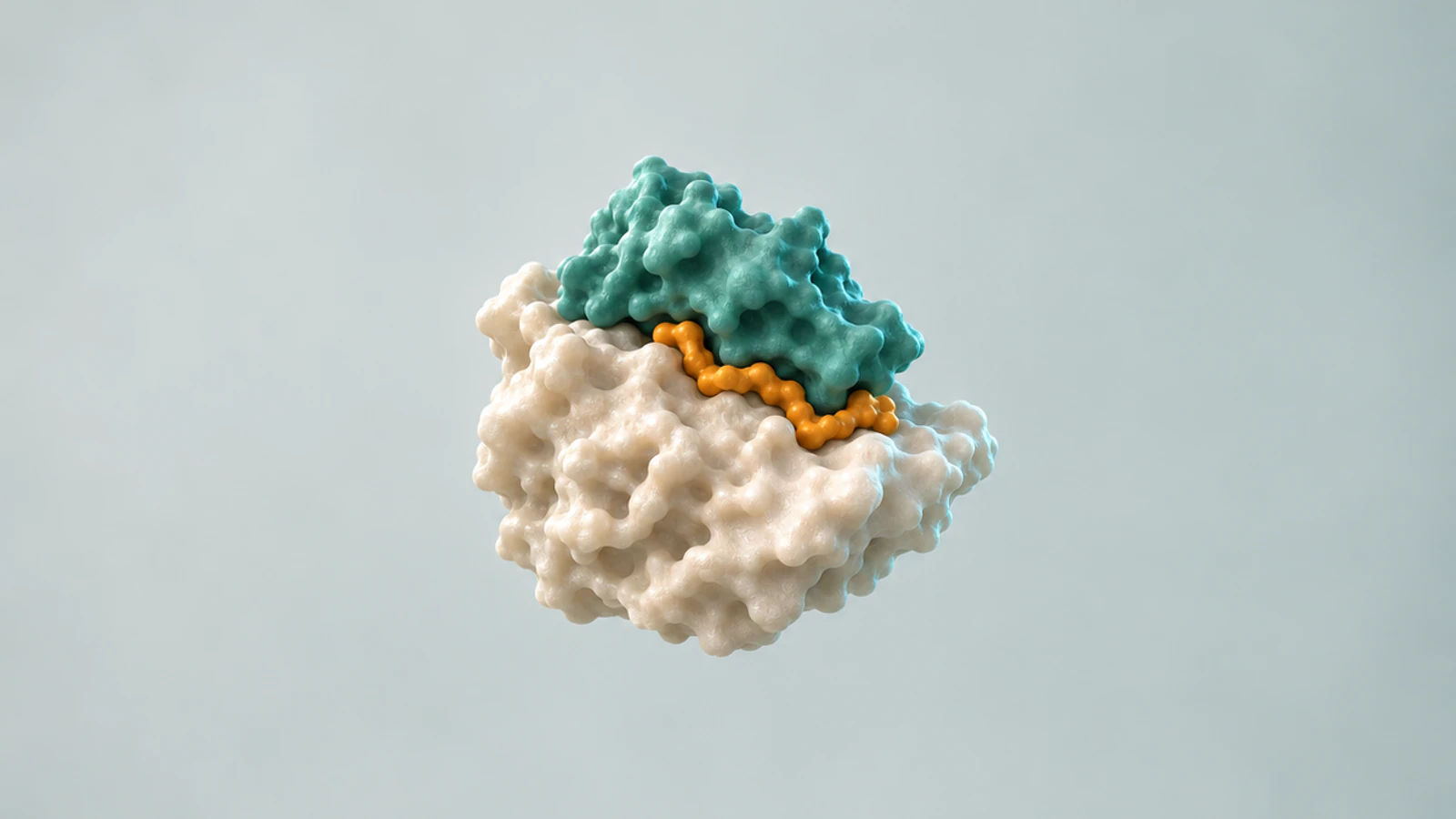
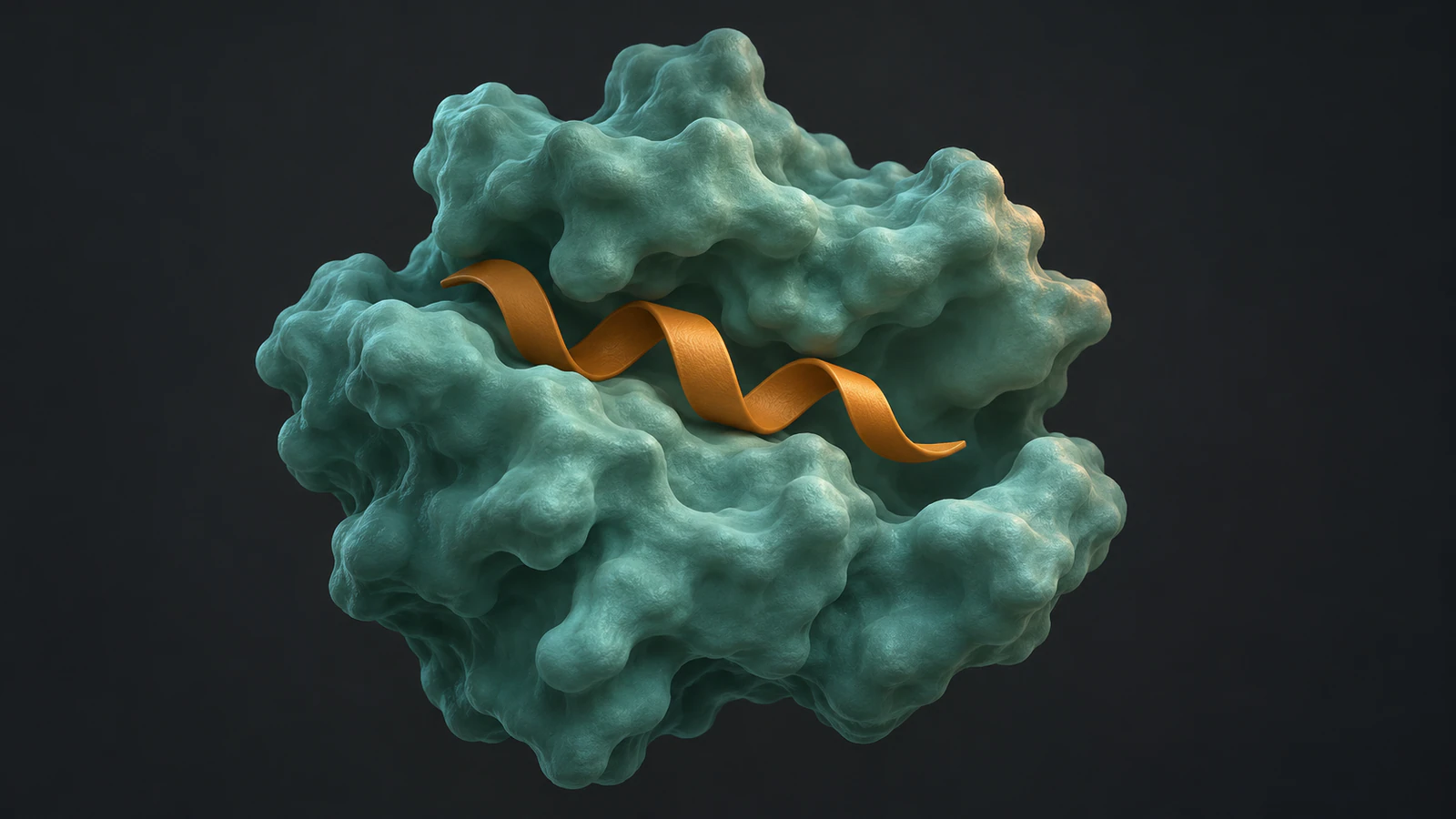
The table is an original review exercise, not a report of an executed Animiotics production. Its screen durations are editorial choices. The article images are conceptual illustrations and were not generated from 1ATP coordinates.
| Proposed shot | Acceptance question | Decision for this pilot |
|---|---|---|
| 0 to 5 seconds: orient the complex | Does the source record identify the kinase and bound peptide? | Accept only with inhibitor identity retained |
| 5 to 10 seconds: inspect the binding region | Are ATP and peptide distinguishable without invented reaction motion? | Accept a static orientation view |
| 10 to 15 seconds: peptide receives phosphate | Is the peptide a supported substrate in this scene? | Reject for the deposited inhibitor complex |
| Alternative ending: hold the complex | Does narration explain the limit of the structural snapshot? | Accept after wording and source review |
Keep observation, inference and presentation separate

Give each disputed statement one of three descriptions in your review record. An observation is supported directly by the cited experiment within its conditions. An inference combines evidence to explain something not directly observed in that source. A presentation choice determines how the explanation is shown, such as colour, camera position or slower playback.
These descriptions are useful because they lead to different corrections. A wrong organism needs a source or identity correction. An inferred sequence needs justification and suitable wording. A camera move that hides the peptide may need only a clearer view. Treating all three as visual preferences leaves scientific disagreements unresolved.
For a measured result, retain the relevant experimental context, units and comparison. For a conceptual motion, say what the motion is intended to explain and which details are unknown. Do not borrow the authority of a structure citation for an uncited timing or efficacy claim.
A useful review comment is: “Shot 3 labels the inhibitor as substrate; retain inhibitor identity or supply a justified replacement and reopen this shot.” It identifies the defect and the evidence needed without dictating an unsupported artistic fix.
Review motion without inventing experimental time
Watch the rough animation once without narration. Describe what appears to cause what. Then watch it with the approved script. A camera cut, directional path or sudden colour change can communicate causation even when the spoken wording remains cautious.
Check for objects intersecting, binding partners changing identity across cuts and a molecular close-up being mistaken for the whole cell. Make scale transitions explicit in the narration or presentation. If a reviewer cannot follow which object persists, simplify the shot before adding more detail.
Unless the production is based on suitable time-resolved evidence, do not present screen seconds as measured biological duration. A slow orientation shot is a teaching choice. The molecular dynamics timing guide explains a different case where a simulation has a defined time basis that must be reported accurately.
Use a review worksheet with an actual closeout test
Copy the fields below into the system your team already uses. Keep one row per scientific issue and attach a frame or timecode. The closeout evidence should let a second reviewer see what changed without searching through a long discussion.
Do not close a row merely because a producer says it was fixed. Inspect the revised scene and final preview against the acceptance question. If a correction changes narration, timing or another linked shot, reopen those dependent checks. Reserve the word approved for the named version that was actually reviewed.
| Field | Example entry |
|---|---|
| Version and location | Pilot v03, shot 3, 00:11 |
| Issue | Inhibitor peptide is presented as a reacting substrate |
| Supporting evidence | 1ATP record and primary paper; bound peptide identity |
| Required action | Remove the transfer shot or submit a separately supported substrate scene |
| Owner and status | Named scientific reviewer; revision required |
| Closeout evidence | Revised frame and narration checked in pilot v04 |
| Release scope | Internal teaching preview only; no implied approval of other cuts |
Compare production options through one reviewable task
An annotated slide or structure viewer may be sufficient when your team only needs to discuss a static binding arrangement. Commissioning a cinematic film adds little if motion and spatial transitions do not help the intended explanation. Choose a studio when you need someone to manage research coordination, visual development and delivery, and specify who retains scientific approval.
An editable 3D workflow is useful when your own team expects to inspect placement and revise the scene. Animiotics documents editable scientific scenes, molecular inputs and manual controls. Its mechanism-of-action animation product page is the relevant starting point for assessing that workflow. Test the actual changes you need before assuming the product fits your review process.
The antibody receptor-blockade example shows an antibody binding a receptor on a cell membrane. Its page identifies the structures and timing as illustrative. Use it to discuss framing and object identity, not as evidence for your own therapeutic claim. Ask the same source and motion questions of purchased, manually authored and generated work.
Current generation, rendering and commercial-use terms should be checked for the plan and intended use. Access to a manual editor is not an allowance for free generation. Neither a subscription nor an editable file supplies independent scientific sign-off. Keep review labour and source preparation in the production scope.
Frequently asked questions
Does a PDB identifier prove that an animation is accurate?
No. It identifies a structural record. You must still check the biological state, assembly, modifications and claims added through movement or narration.
Who should give scientific approval?
A person with relevant subject expertise and defined authority for the intended use. Identify that reviewer before production and distinguish their decision from brand or aesthetic approval.
Can a simplified molecular scene pass review?
Yes, if the simplification preserves the intended meaning and its limits are recorded. An abstract shape can be appropriate for a pathway overview while being insufficient for a claim about a specific binding pose.
Do all corrections require a new animation?
No. A label or camera correction may be local, while changing a molecular identity can affect several shots. Review the consequences and confirm the revised version rather than assuming either that everything must restart or that nothing else changed.
Is a scientific checklist enough for external medical promotion?
No. It supports evidence review but does not replace the approval process required for the audience, product and jurisdiction. Have the responsible team determine what further review is needed.
Try a reviewable molecular scene in Animiotics
Start with the limited kinase orientation task: distinguish the catalytic subunit, ATP and inhibitor without depicting a reaction. Supply the structural reference, state the teaching purpose and inspect the result against the acceptance questions above. Keep the source record and your corrections with the project.
Try Animiotics on that defined scene before expanding to the full mechanism. Evaluate whether your team can identify the relevant objects, request or make a specific correction, and verify the revised preview. Choose current generation and usage terms appropriate to your project.