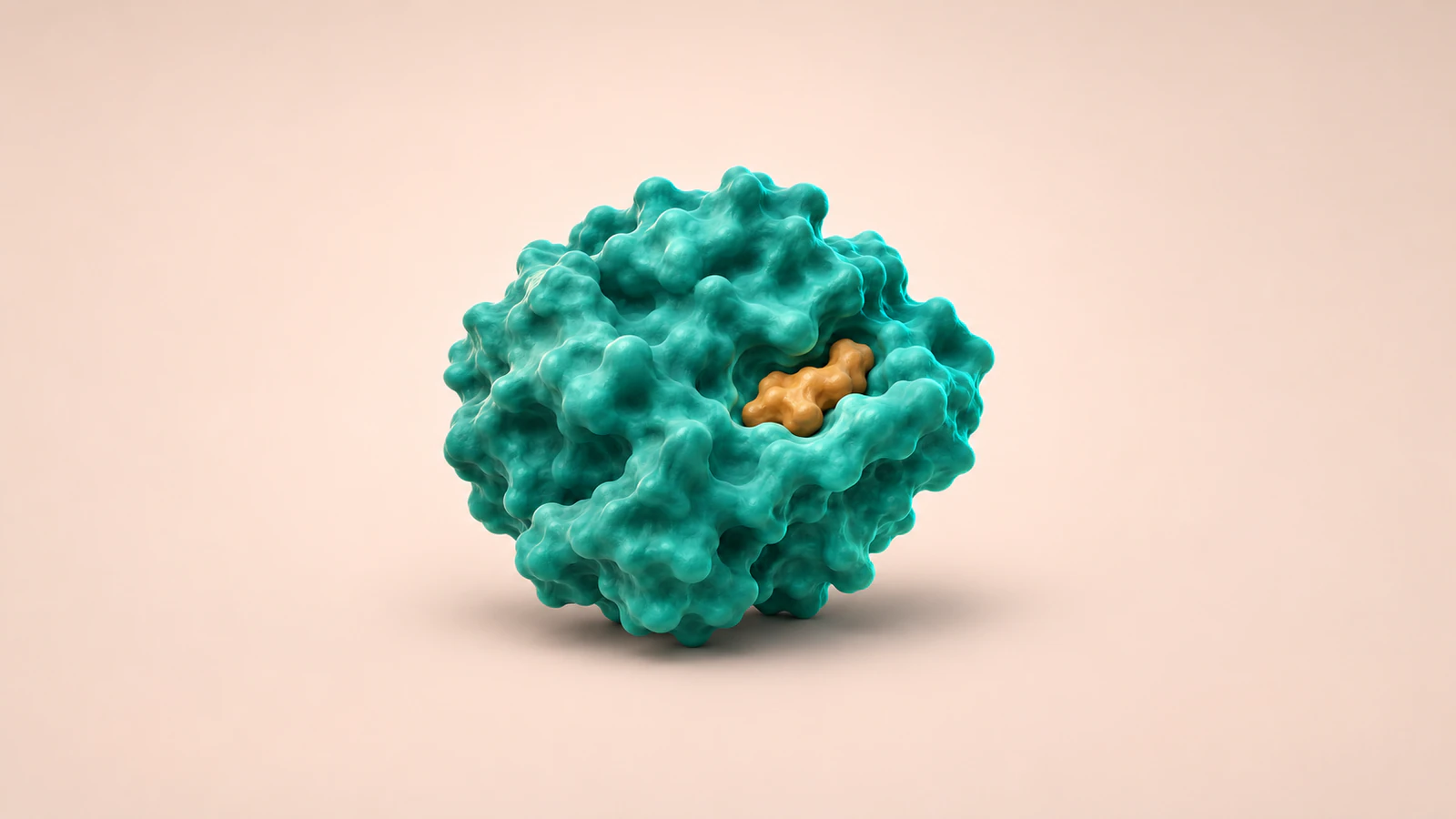
Start with the decision the film must support
A mechanism of action animation brief should specify the audience, the biological claim, its evidence, the required files and who approves each stage. Add a short scene sequence, explicit limits on what the pictures may imply and a definition of an included revision. These details let you compare production options against the same job before committing money or staff time.
For a biotech team, the starting question might be: can a partnering audience identify the target and understand the proposed intervention after one viewing? That is more actionable than asking for a cinematic molecular journey. A beautiful receptor close-up can still fail if viewers cannot tell which molecule is the therapy.
This checklist uses an illustrative 30-second molecular explanation. The duration, shots and review arrangement are planning choices, not a tested production estimate. Replace them with your audience, evidence and delivery requirements. The purpose is to make the job reviewable before you choose how to make it.
Write one audience and one message
Name the people who will watch, what they already know and where the film will appear. A silent conference loop needs to communicate without a presenter; an investor slide can rely on spoken context. Specify whether the film must stand alone and whether the viewer will see supporting data nearby.
Write the desired takeaway as one sentence. For example: “The inhibitor occupies a pocket in the target protein, and the film explains that binding state.” Then list claims outside scope. This example does not establish a clinical response, selectivity across other proteins or a measured route into the pocket.
Separate the internal evaluation version from the externally approved version. Give each a named owner and a deadline. If you need both a specialist and a general-audience cut, put both in the deliverables list rather than treating the second script as a simple export setting.
Build a claim and evidence record
For every important action, record what the viewer is meant to infer and which source supports it. Include the source version, figure or structural entry, the biological context and a person who can resolve questions. A folder of papers is useful background, but it does not tell an animator which conclusion belongs in which shot.
Use three categories: supported observation, supported mechanistic interpretation and illustrative choice. A resolved binding pose belongs in a different category from a smooth approach animation. Color, camera position and slowed motion are usually presentation choices. They become misleading when viewers are encouraged to read them as measured quantities.
Our guide to separating data from hypotheses develops this distinction for scientific visuals. Carry the same discipline into the film brief: a proposed mechanism can be communicated clearly without making it look experimentally settled.
| Brief field | Example entry | Review question |
|---|---|---|
| Claim | A small molecule occupies the displayed pocket | Does this source support this particular complex? |
| Evidence | Structural entry and associated paper | Are species, construct and ligand correctly identified? |
| Illustration | Slow camera orbit around the bound complex | Could viewers mistake the timing for measured kinetics? |
| Excluded inference | No predicted patient response | Do narration and imagery both respect this limit? |
Specify the structure before approving the model
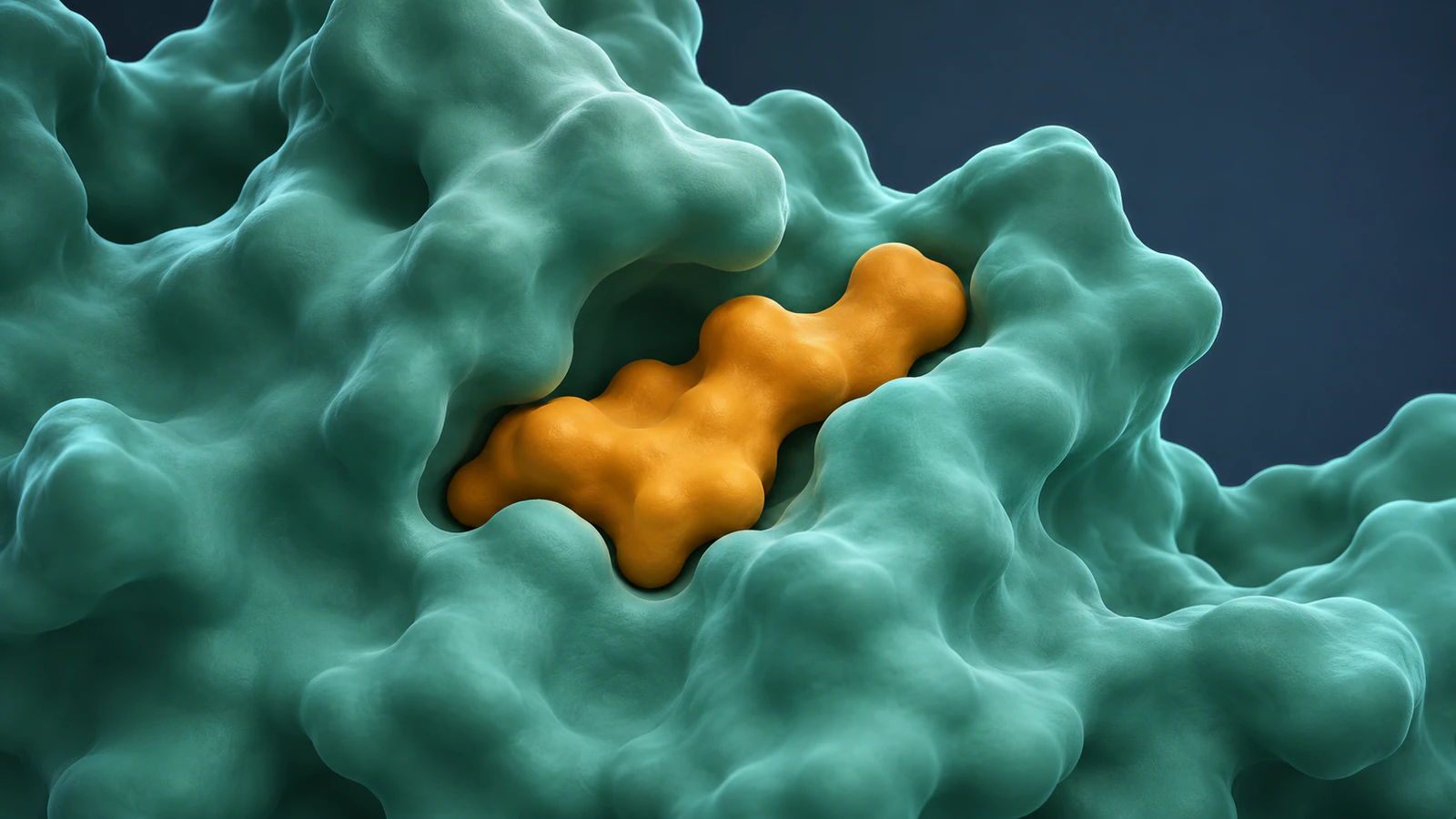
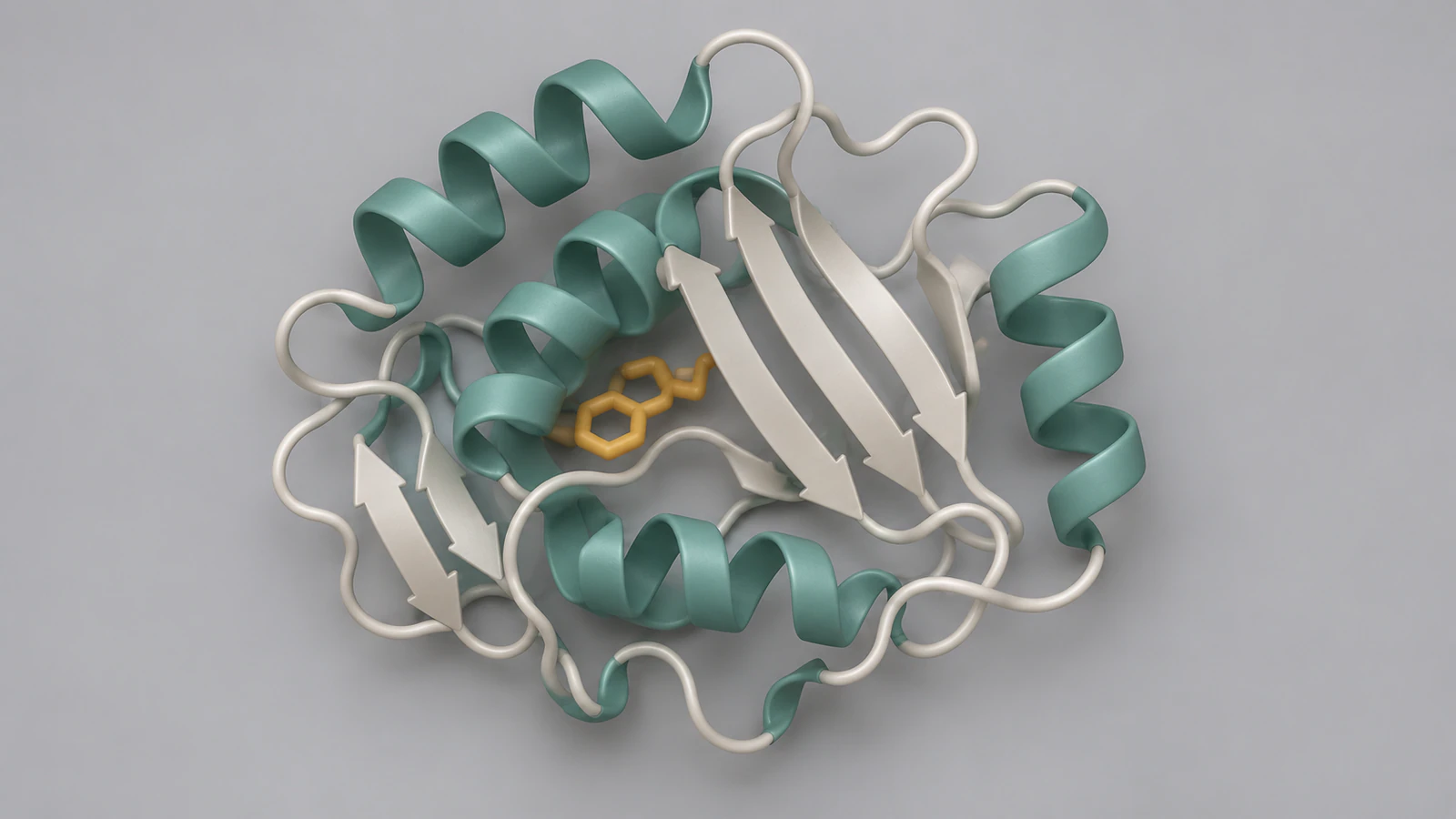
A concrete input record might use RCSB PDB entry 1IEP, the mouse c-Abl kinase domain in complex with STI-571, also known as imatinib. The entry reports X-ray diffraction at 2.10 angstrom resolution. It is a kinase-domain structure, not a complete human BCR-ABL protein or an entire cell.
The associated paper describes imatinib binding at the canonical ATP-binding site and an inactive activation-loop conformation. That supports an explanation of a bound structural state. The structure does not supply a recorded entry trajectory or a complete drug-response story. A proposed approach shot must therefore be identified as illustrative.
In the production brief, request the entry identifier, selected chain and ligand, coordinate-file version and a note on anything added or omitted. Have a scientific reviewer check the model before surface styling hides the underlying choices. Our molecular docking animation guide explains how an attractive moving ligand can exceed the evidence behind its final pose.
Turn the brief into four reviewable shots
Keep the first prototype small enough that reviewers can identify the scientific decision in every shot. For this example, begin with the bound complex rather than inventing a journey from a tablet to a cell. Ask the reviewer to approve the cast and endpoint before approving motion.
The following sequence is a proposed scene plan, not a generated or tested Animiotics film. Its seconds are editorial timing. A camera change does not measure molecular movement, and a color difference does not represent an experimentally measured chemical property.
For a longer film, use the same record for every additional scene. Add a new row when you introduce a cell type, pathway or physiological effect. The biology animation storyboard guide covers scene construction; this brief adds who must approve each claim and what the buyer expects to receive.
| Time | Visible content | Acceptance check |
|---|---|---|
| 0-6 seconds | Whole bound protein-ligand complex | Both objects identifiable; no full-body claim |
| 6-14 seconds | Camera moves toward the binding pocket | Ligand stays fixed relative to the displayed structure |
| 14-23 seconds | Pocket view from a second angle | Ligand remains distinct; no invented bonding or trajectory |
| 23-30 seconds | Return to the original context | Closing statement stays within the sourced structural claim |
Choose the production route against the same brief
Compare responsibility as well as output. An in-house scientist may already have a suitable molecular viewer and need only a restrained structure movie. A team explaining several biological scales may need scene construction and repeated visual revision. A launch project may need a producer, scientific writer and professional narration.
Animiotics provides mechanism-of-action animation software for building editable scientific scenes from a description and supporting inputs. The same page describes made-for-you and custom studio options. Your brief should state which work remains with your team, particularly evidence selection and approval.
A studio can be the sensible choice when you need delegated production and a coordinated review process. For example, Random42 describes discovery, scriptwriting, storyboarding and client reviews at key stages. That is evidence about its advertised process, not a promise that every supplier includes the same work.
| Route | Fits this job when | Confirm before choosing |
|---|---|---|
| Existing molecular viewer | A structure rotation or annotated pocket view is enough | User license, export format and who prepares the structure |
| Animiotics self-service | Your team wants an editable scene and can review the science | Relevant plan, input support, generation allowance and final export |
| Made-for-you short film | You want production delegated within a bounded scope | Duration, review round and what a changed brief costs |
| Custom studio production | Writing, narration and coordinated delivery need a dedicated team | Named reviewers, milestones, source-file handoff and usage rights |
Make revisions a defined part of the scope
Write down what happens when feedback arrives. A correction to a mislabeled target differs from introducing a new pathway after the storyboard is approved. Specify whether a revision round means one consolidated response from your team, and nominate a person to reconcile contradictory comments.
Use three approval points: the referenced script, the key visual states and the final exported film. A storyboard is a set of planned frames; an animatic is a timed draft used to judge sequence and pacing. Agree which of these you need and what is considered approved at each point.
Addax describes agreeing the script and storyboard before production. Use that as a question for any supplier rather than assuming the process. Ask how a late scientific correction differs from an aesthetic preference and whether either changes the quoted scope.
Keep a feedback record with a timecode, issue, requested change and owner. “The ligand is hidden at 00:17; adjust the camera while preserving its position” is easier to act on than “make the binding clearer.” Record the accepted correction so it is not lost in a later version.
List files, usage rights and budget assumptions
Specify aspect ratio, resolution, audio, subtitles, still frames and any alternate cut you actually need. Ask separately about editable project files and the ability to reopen them. Receiving an MP4 does not by itself establish access to the scene that produced it.
Keep subscription costs separate from labor, scientific review and commissioned production. The current Animiotics pricing page separates Academic and Industry use. It states that one generation can create or edit an animation, so an allowance is not necessarily the same number of approved finished films. Check the selected audience and billing interval before budgeting.
The Animiotics terms describe commercial-use rights for animations created under Industry plans and preserve third-party license obligations. Check your intended distribution, source materials and credits against the applicable terms. Put unresolved rights or procurement requirements in the brief before production starts.
For quotes, ask every provider to price the same deliverables and review assumptions. A short silent loop and a narrated film with several audience versions are different jobs. Do not compare a subscription fee with a full production quote as though both include your team’s time and the same responsibilities.
Use a small example to test the handoff
Before commissioning a large sequence, choose one interaction and ask how it will be checked. The Animiotics antibody receptor blockade example is a 10-second film depicting an antibody binding a membrane receptor and obstructing a signaling molecule. It offers a concrete visual reference for a focused interaction.
That example is not evidence for your antibody, epitope or therapeutic claim. Use it to discuss framing and readability, then replace its biological assumptions with your own documented inputs. A useful test question is whether the reviewer can identify the target and the blocking event without your verbal explanation.
For the kinase example, an Animiotics starting brief could request a scene based on 1IEP, a clear distinction between protein and ligand and an orbit around the fixed bound pose. Ask it to retain the source record and omit cell death, clinical outcomes and a supposed measured entry path. Inspect the resulting structure and film before approving them; this suggested prompt has not been executed for this article.
Send a brief someone can act on
Put the agreed requirements in one versioned document. Attach the approved references rather than leaving the animator to infer which file in a shared folder is current. Name the person who can approve a scientific change and the person who can authorize a scope change.
The brief is ready when a producer can identify the deliverables and a scientist can identify the evidence limits. If either has to guess, resolve that uncertainty before requesting a final quote or starting a longer generation.
- Audience, viewing context and one-sentence takeaway
- Mechanism, source record, biological context and excluded claims
- Shot sequence with acceptance checks and illustrative timing
- Required exports, versions, editable handoff and credits
- Scientific reviewer, final approver and consolidated feedback owner
- Budget assumptions, included revisions and delivery milestones
Frequently asked questions
What should an MOA animation brief include?
Include the audience, message, referenced mechanism, inputs, scene sequence, files, usage requirements, review owners and revision scope. Each visible scientific claim should have an identifiable source or be clearly marked as illustrative.
Do I need a finished script before choosing software or a studio?
A short approved message and an evidence record are enough to begin comparing routes. State whether scriptwriting is part of the work you expect the supplier to perform.
Can a PDB structure prove the whole mechanism?
No. A structure supports particular geometric observations in a defined experimental context. It does not independently establish a complete temporal pathway, clinical benefit or binding trajectory.
How many revision rounds should I request?
Base that decision on your reviewers and deliverables. Define what one round contains, consolidate feedback and agree how corrections and later scope changes are handled.
Can I reuse a public example for my therapy?
Treat it as a visual reference only unless its scientific inputs and usage rights support your intended use. A generic interaction cannot substitute for evidence about a particular molecule.
Try a focused mechanism scene in Animiotics
Use your first scene to answer one reviewable question: can the audience distinguish the target, the ligand and their relationship? Try Animiotics with that bounded brief, check the current plan terms and inspect the result against your source record before extending the film.