Build for a viewer who arrives halfway through
A medical animation booth video should explain one scientific point without relying on sound, tolerate viewers joining mid-sequence and repeat without implying that biology runs backward. Adapt an existing film when its pictures already carry that message. Build a new editable scene or commission a studio when the mechanism, framing or review requirements need substantial changes.
Specify the viewing conditions before asking for a quote: audience, screen shape, playback device, likely viewing position and approved claim. Then buy a short test of the difficult shot. A beautiful narrated website film may fail when its explanation disappears with the audio or its labels become unreadable on the booth screen.
The worked example below is a proposed antibody sequence, not a completed congress project or a measured lead-generation result. Its timings are illustrative. The four accompanying images are conceptual scientific illustrations, not renderings of experimental coordinates.
Choose the production route from the missing work
Start by reviewing the material you already own with the sound muted. Identify what is missing: an explanation, a different camera view, a clear transition or simply an approved text layer. An editor can often solve a delivery problem without rebuilding the molecular scene.
Use the same acceptance criteria when comparing quotes. CDI Studio describes separate booth-loop and narrated meeting versions, a useful example of distinct outputs from a shared production. That is a supplier offering, not evidence that one duration or format works for every audience.
| Route | Choose it when | Check before buying |
|---|---|---|
| Adapt the existing film | Approved pictures remain understandable without narration | Rights to edit, clean master, text placement and loop seam |
| Build an editable scientific scene | You need control of molecule identity, timing or camera | A representative scene, review access and export suitability |
| Commission a specialist studio | You need substantial art direction and managed production | Named scientific reviewer, milestones, versions and venue test |
| Use a static visual | One figure communicates the point more clearly than motion | Readability, evidence qualification and display format |
Write one scientific sentence the loop must preserve
Write the sentence you want a visitor to understand after one viewing. For a generic binding demonstration, it might be: “An antibody recognizes a site on a target.” A statement about blocking a signal, changing cell behavior or helping patients adds further claims that need their own evidence. Do not attach all of them automatically to a binding shot.
CAST PHARMA’s booth-video guidance recommends focused stories and audience-appropriate qualifications. In your brief, put the qualification beside the claim it limits. A viewer joining halfway through may never see a disclaimer that appeared only at the beginning.
Choose a scientific owner who can approve both the words and what the movement implies. Ask them whether the film depicts an established mechanism, a proposed explanation or a simplified teaching example. Carry that distinction into the visible text and the staff explanation at the booth. The scientific review checklist provides a broader claim-by-claim review process.
Keep the binding site identifiable without narration
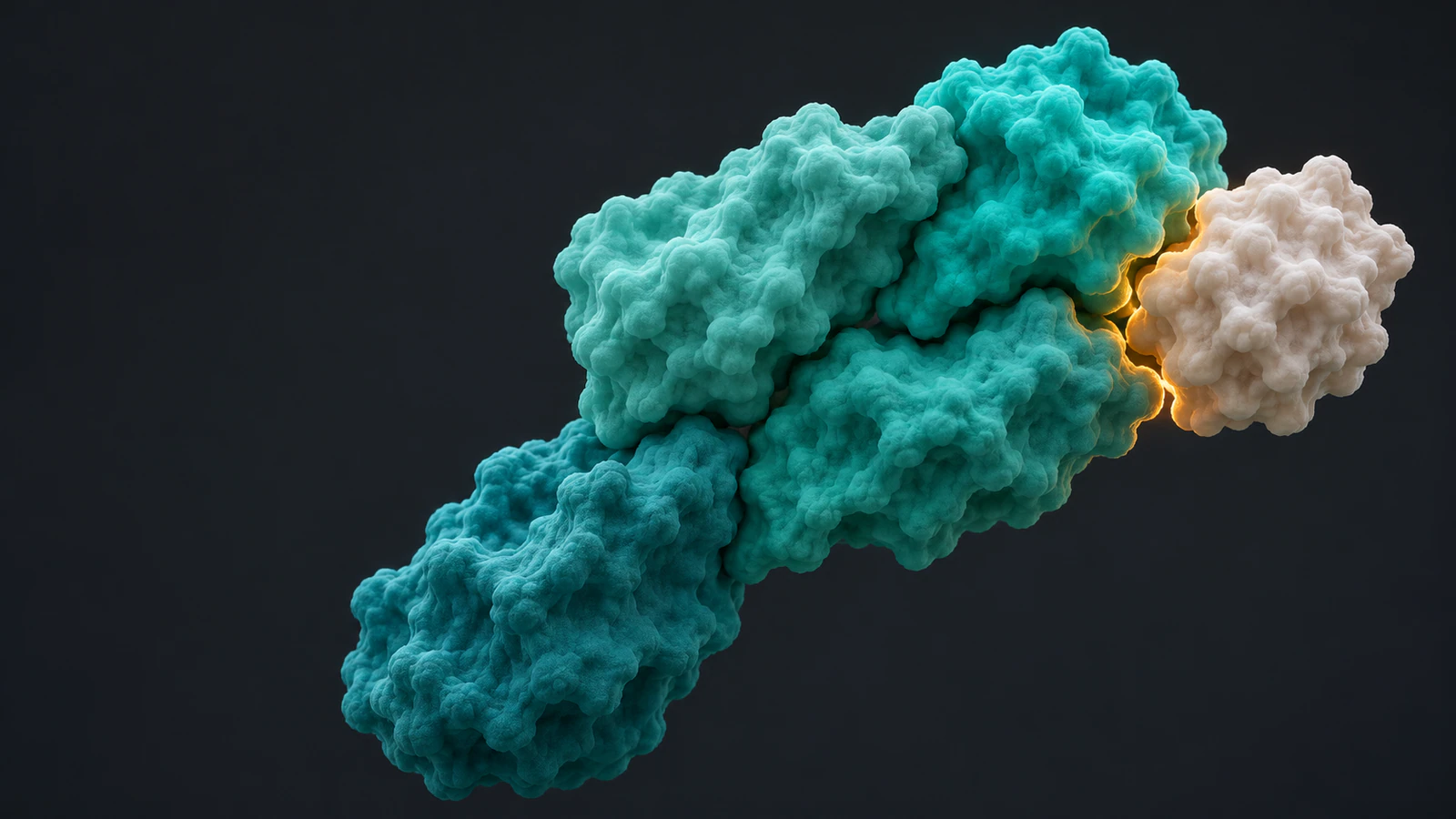
Use stable colors and a camera that leaves the interaction visible. Before adding moving particles or a dramatic camera orbit, check whether the target and the approaching molecule remain distinguishable. A close-up can explain contact, but a brief wider view should establish where that contact occurs.
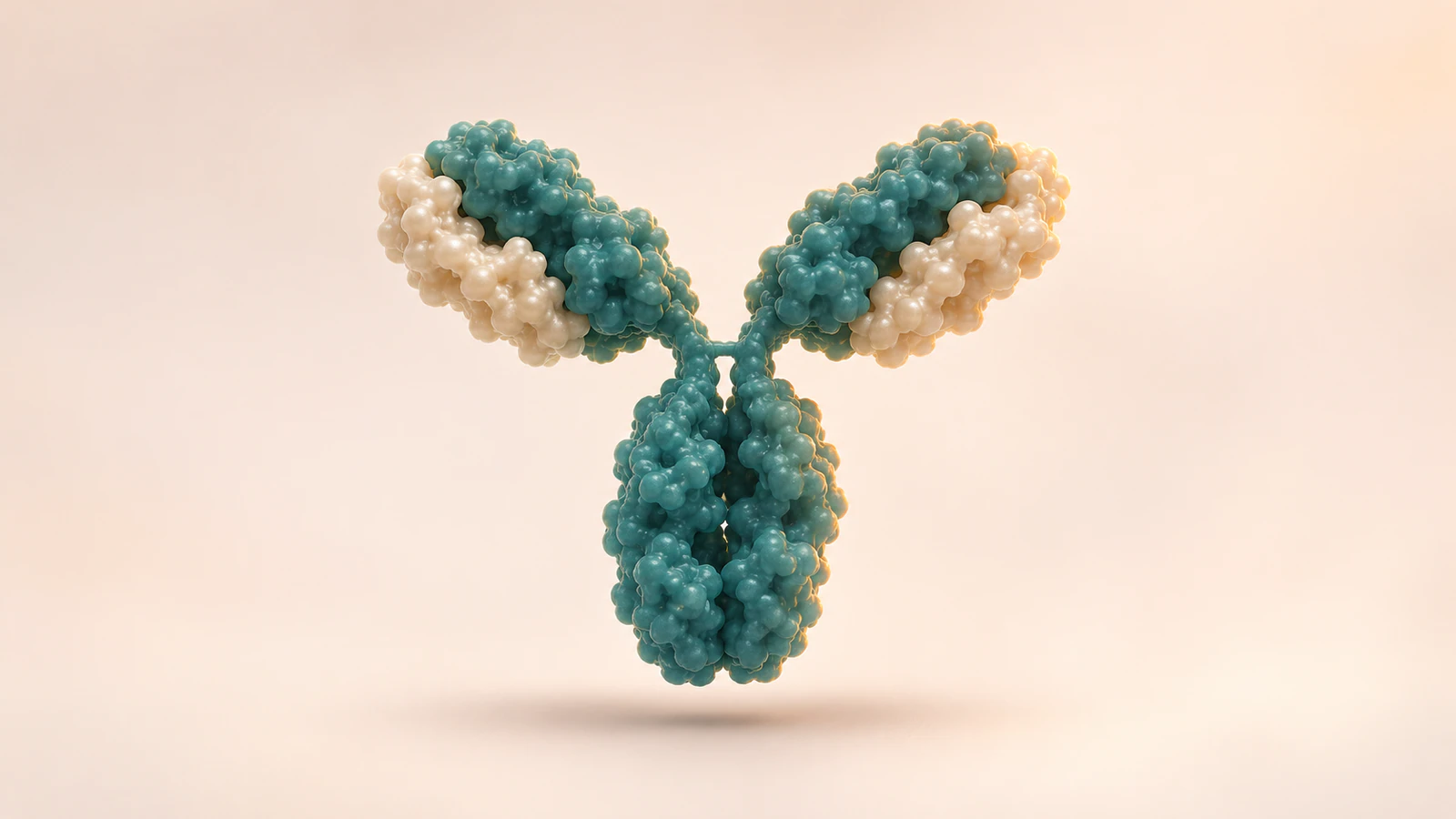
For an immunoglobulin G antibody, the two Fab arms contain the antigen-binding regions; Fc is the stem region. RCSB PDB-101’s antibody guide describes the two heavy chains, two light chains and flexible connections. A stylized Y can introduce this organization, but its silhouette alone cannot establish which receptor a particular antibody binds.
Give each necessary label a job: identify the antibody, identify the target or qualify the event. Avoid a paragraph of transcript over a moving molecular interface. Place captions and labels so they do not obscure the contact that the visitor is meant to understand. If the explanation still needs a presenter to decode the color scheme, revise the visual sequence before rendering every version.
Separate structural evidence from the booth illustration
Record the provenance of every important model. RCSB entry 1IGT is an intact mouse IgG2a antibody structure determined by X-ray diffraction at 2.80 angstrom resolution. It is useful for studying antibody organization. It is not a structure of your therapeutic antibody bound to its receptor, and it does not measure binding speed.
For a real product, request the appropriate antibody-target complex or document the limits of the available model. A PDB identifier in the credits does not establish that every object, orientation and motion in the film came from that structure. Keep a source record linking the model, assembly choice and simplifications to the shot that uses them.
For this generic pilot, either use a reviewed coordinate-derived antibody or an explicitly conceptual model. Keep the target generic unless its identity is supported. Do not turn an illustrative contact into a claimed molecular fit by giving it an experimental-looking surface. Ask for that distinction in the project notes as well as in the finished presentation.
Commission one short pilot before the whole loop
The following 24-second plan is an illustrative buying test, not a recommended universal duration. It asks whether the supplier can preserve identity, communicate the contact and return to the beginning cleanly. The final running time should follow what viewers can understand and what the display requires.
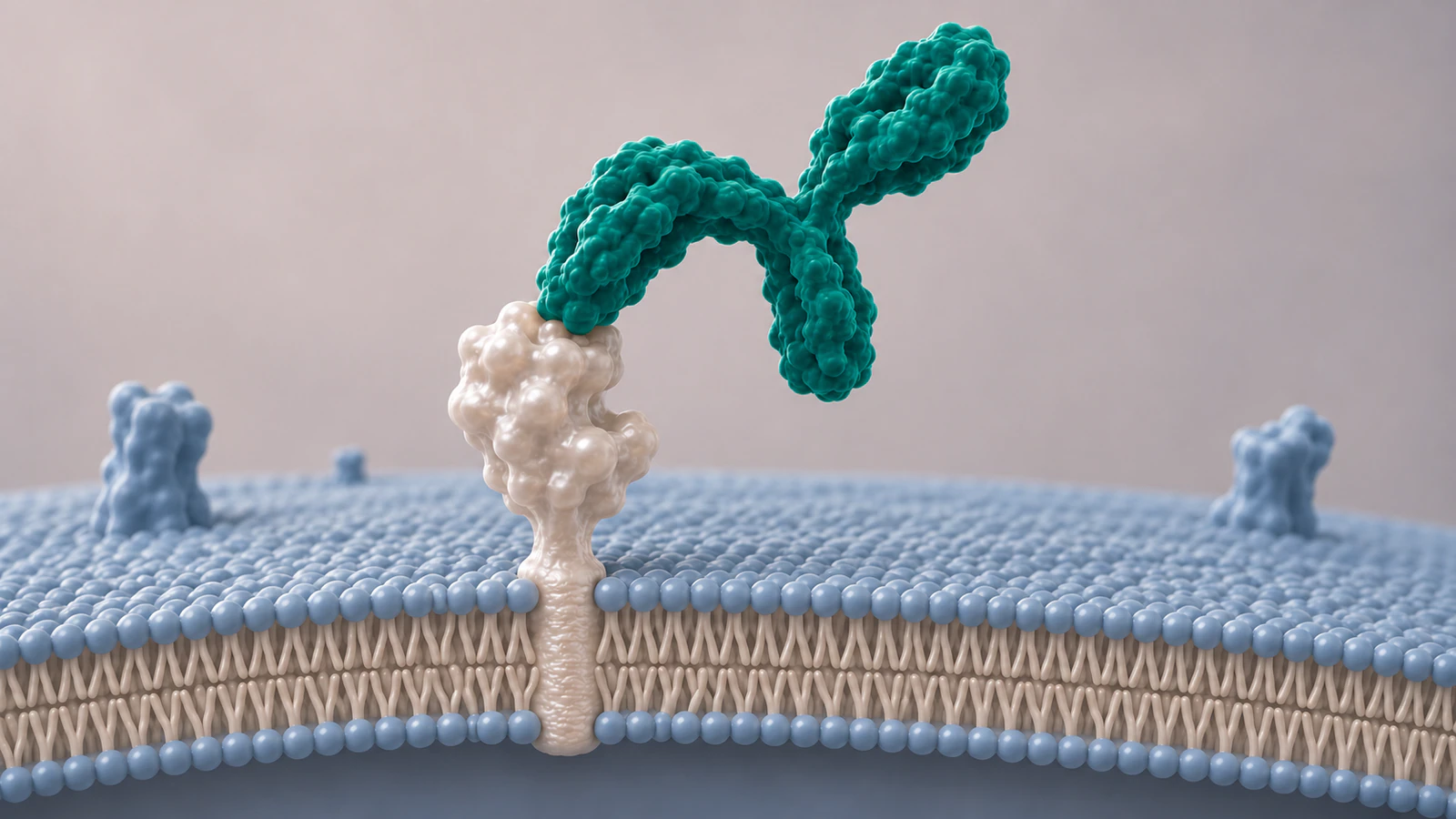
Animiotics’ antibody receptor-blockade example shows a Y-shaped antibody approaching and binding a membrane receptor. Its page explicitly identifies the molecular models and timing as illustrative. Use it to discuss framing and spatial readability, not as proof of your own molecule’s specificity or clinical effect.
| Illustrative time | Picture and message | Acceptance question |
|---|---|---|
| 0–5 seconds | Establish antibody and target with stable identities | Can a new viewer identify both objects? |
| 5–13 seconds | Show one binding-site contact without hiding the interface | Is contact visible without the voice track? |
| 13–20 seconds | Hold the result and its evidence qualifier | Does the image claim only what the evidence supports? |
| 20–24 seconds | Use a clearly editorial transition back to the opening | Does the restart avoid suggesting reverse biology? |
Make the reset an edit, not a biological event
Repeating a movie file is a playback function. It does not make the final shot a scientifically sensible continuation of the first. A reverse-motion reset could accidentally suggest that an internalized particle exits the cell, a cleaved molecule repairs itself or an irreversible treatment effect reverses on command.
For the proposed antibody pilot, use a short neutral transition or an unmistakable return to an introductory view. Do not require the bound antibody to fly backward simply to match the starting frame. If dissociation is part of the intended scientific explanation, source and explain it as an event rather than using it as a convenient editing trick.
Ask for two consecutive cycles in the review file. Inspect the last frame, first frame and the transition at normal speed. Check for a black flash, abrupt camera jump, missing label or sound burst. Then test the actual player, since a clean edit can still pause when hardware reloads a file. Assign responsibility for that playback behavior to the venue or audiovisual supplier.
Specify text, screen versions and the delivery player
Obtain the screen’s native pixel dimensions, orientation, visible area and accepted file specification from the audiovisual team. Include frame rate, supported codec, playback software and whether the player crops or scales the image. Ask for a small test file early. A filename containing “4K” does not answer those compatibility questions.
Approve each aspect ratio as a composition. A vertical crop can remove the antibody’s second arm or cut off the target label even when the source is sharp. Keep a clean picture master and separately identified display versions. The handoff checklist covers source files and delivery records that make later adaptations manageable.
For narrated versions, W3C distinguishes captions from translated subtitles and describes open captions that remain visible. For a muted booth, decide which words must always appear in the picture and verify that the player shows them. A silent edit is not, by itself, a complete accessibility plan. If another language is required, approve its reading time and scientific meaning using the localization planning guide.
Run a muted acceptance test at three entry points
Show the pilot from its beginning, from the interaction and from the result. Ask a colleague who was not involved in production what they think is happening. Record their answer before explaining it. This is a practical comprehension check, not a clinical study or a validated measure of conference performance.
Use the intended display, or the closest available setup, at the agreed viewing position and under representative lighting. Check the label contrast, the smallest essential detail and whether reflections hide the interaction. If the booth hardware is unavailable, record that limitation and keep venue playback approval open rather than calling the laptop preview a complete test.
Keep feedback specific enough to fix. “The blue object disappears behind the receptor at the contact moment” identifies a shot problem. “Make it more exciting” does not establish an acceptance condition. Put scientific changes through the scientific owner and delivery changes through the audiovisual lead.
- Muted meaning: the viewer can name the two actors and the event without a presenter.
- Partial entry: a visitor joining at contact or result sees enough context and qualification.
- Repeat: two full cycles play without a misleading reversal or technical interruption.
- Delivery: the approved display version plays with intact framing, readable text and the expected audio state.
Compare the full order, including revisions and rights
Ask each supplier to separate the pilot, final scene, text work, alternate formats and venue test in the quote. Record who approves each stage and how changes after approval are handled. A low initial price may cover a single export while your brief requires several reviewed versions; compare the same deliverables before choosing.
For an editable route, Animiotics’ MOA animation software provides a relevant place to build and revise the scientific scene. Check the current plan, generation allowance and commercial terms against the intended use. Manual editing and paid generation are different; this guide does not promise a free generation trial or a native signage system.
The current Animiotics terms provide commercial-use rights for exports under the specified Industry plans while preserving third-party license obligations. Confirm the rights for models, images, narration and any existing footage separately. Keep the signed-off file name, version, evidence record and venue test result together so the booth team plays the approved film.
Frequently asked questions
How long should a medical animation booth loop be?
Use the shortest sequence that communicates the approved point clearly under the actual viewing conditions. The 24-second example here is a pilot specification, not a measured optimum or industry rule.
Can we mute our existing narrated film?
Yes, if its pictures and visible text still carry the required meaning. Test it from the middle as well as the beginning. If narration supplies essential context, budget for an adaptation.
Does a seamless loop require the biology to return to its starting state?
No. An editorial transition can reset the presentation. Do not reverse a molecular or cellular event merely to hide the playback seam.
Should we buy software or hire a studio?
Choose editable software when your team can own the scientific review and production work. Commission a studio when you need managed art direction and delivery. A video editor may be sufficient for adapting an already approved master.
Does a successful booth test prove the film will generate leads?
No. Playback and comprehension checks establish that the deliverable works in its intended setting. Commercial impact needs separate measurement and cannot be inferred from a polished animation.
Try an antibody scene in Animiotics
Start with one antibody-target interaction and an approved sentence. Make the contact visible, hold the result long enough to read its qualification, and review the scene with the sound off before commissioning every display version. Keep the pilot small enough that a failed comprehension check leads to a practical revision.