Animation example
Hummingbird feeding 3D animation
A male ruby-throated hummingbird hovers at scarlet bee balm, first in real time, then slowed 20 times, then in a cut through one flower where its tongue pumps up nectar. A 36-second film.
What the animation shows
A ruby-throated hummingbird beats its wings about 53 times a second while it hovers, so at real speed the wings are a blur. Slowed 20 times, the stroke becomes visible: the wings sweep forward on the downstroke, turn over and sweep back. In hovering hummingbirds the downstroke gives about three quarters of the lift and the upstroke about a quarter (Warrick, Tobalske and Powers, 2005).
The bill goes deep into a bee balm floret, a narrow red tube with nectar at its base. The tongue reaches past the bill tip into the nectar, where its two tips spread apart and close again as it is pulled back (Rico-Guevara and Rubega, 2011). The grooves of the tongue work as an elastic pump that fills as they spring open in the nectar, so a hummingbird can lick more than ten times a second (Rico-Guevara, Fan and Rubega, 2015).
Bee balm (Monarda didyma) grows in eastern North America, where the ruby-throated hummingbird breeds. Its long red flowers suit a bird's bill better than a bee's tongue.
What it is built from
The bird is a scan-based model with a rig and a forked tongue by Animal Animator (animalanimator.com, CC BY 4.0), coloured as an adult male with a ruby throat. Wings, tail, body and tongue run on separate layers, so the wings can beat at their real rate while the tongue keeps its own.
The bee balm is modelled flower by flower. The park behind it is a photographed sky and garden from Poly Haven (CC0), seen through a shallow focus as a long lens would show it.
What is illustrative
The slow-motion shots run 20 times slower than real time. The cut through the floret removes the near half of the tube so the bill, the tongue and the nectar can be seen, and the tongue is drawn paler than a real one so it reads against the red wall.
Make your own
Describe an animal and what it does, and Animiotics builds the 3D scene. A few to try:
- Show a honeybee collecting nectar from a lavender flower, with its wings slowed down.
- Show how a woodpecker's tongue wraps around its skull.
- Show a chameleon catching an insect with its tongue, in real time and slowed down.
Questions
How fast does a hummingbird beat its wings?
A ruby-throated hummingbird beats its wings about 53 times a second while hovering, faster in some display flights. That is why the film shows the same moment slowed 20 times.
How does a hummingbird drink nectar?
It licks. The forked tongue reaches into the nectar, its grooves spring open and fill, and the bill squeezes the nectar out as the tongue comes back, more than ten times a second.
Can Animiotics animate other animals?
Yes. Describe the animal and what it does. Animiotics can use real 3D models of animals and plays their motion at its real speed, and you can attach reference photos to guide the look.
Keep reading
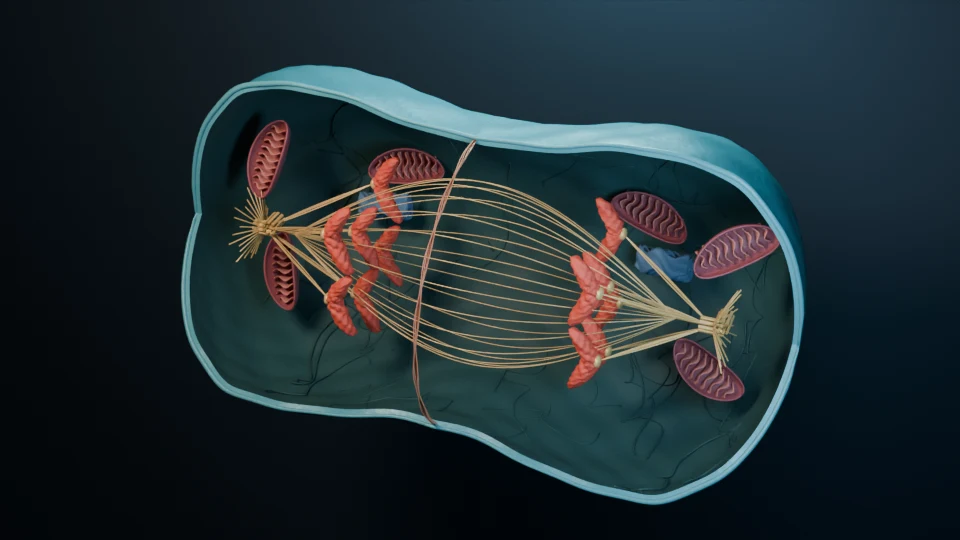 For educatorsDescribe a biological process and get a 3D animation for your lecture. Students can explore it in the browser from a link, with no sign-in.Learn more
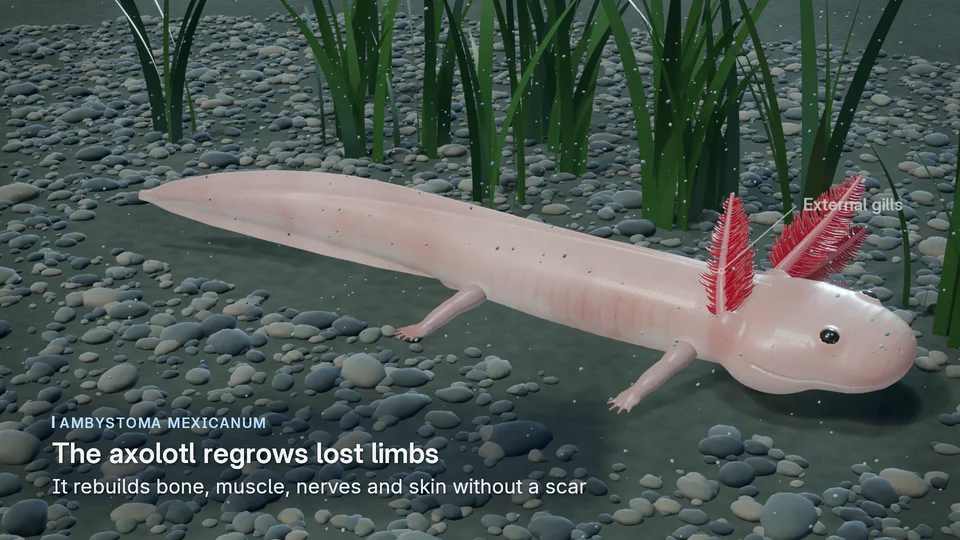 Science animationsWatch 3D science animations of cells, molecules and your body: short films seen by millions, long YouTube films and sample scenes you can edit.Learn more
Describe it. Watch it move.
Start your first animation from a description, a structure or a photo.