
Animation example
Axolotl limb regeneration 3D animation
An axolotl loses a forelimb and grows it back: the wound closes, a blastema forms and cartilage lays out a new arm and four digits. A 52-second film you can open in Animiotics as a sample scene.
What the animation shows
The axolotl, a salamander from the lakes around Mexico City, can regrow a complete limb, with bone, muscle, nerves and skin, without a scar. Within hours of an amputation, skin cells migrate over the wound and seal it. This wound epidermis thickens into a signaling center called the apical epithelial cap.
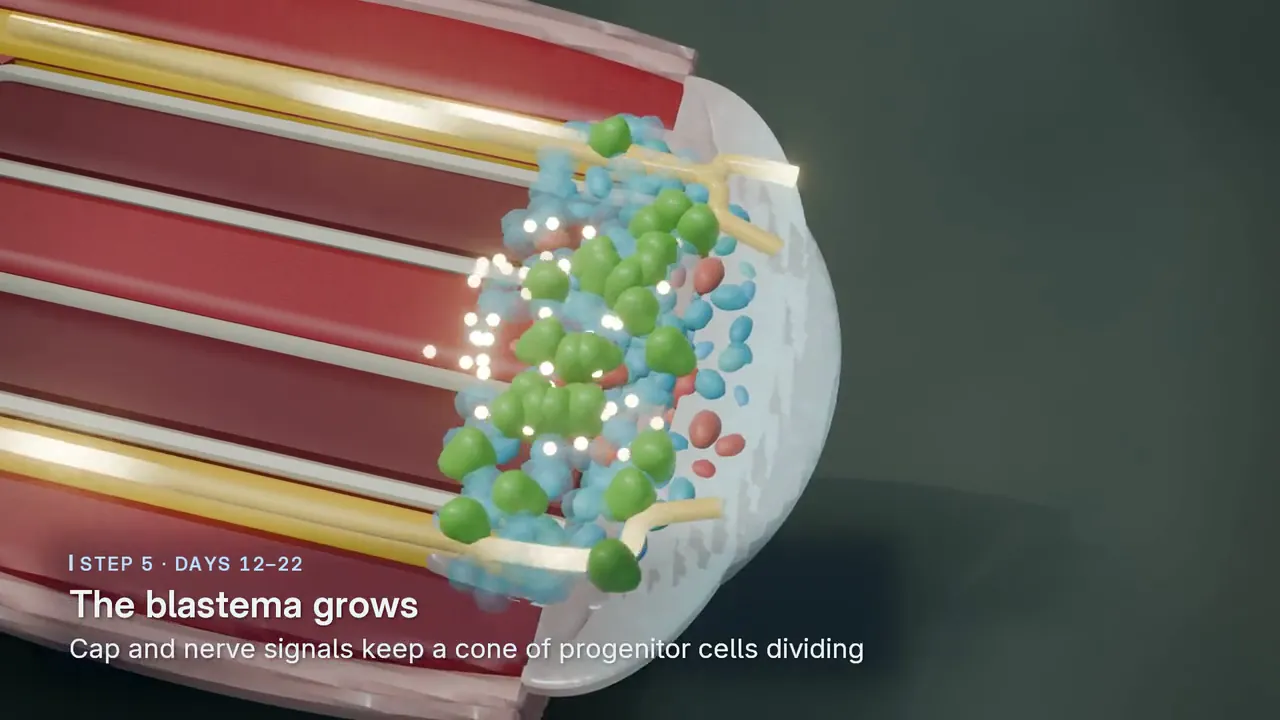
Underneath, cells from the stump lose their specialized identity and gather into a blastema, a mound of progenitor cells. Regeneration depends on nerves reaching the wound. The blastema grows, then cells condense into cartilage in the order of the original limb, from the forearm to the wrist and the four digits of an axolotl's front foot.
What it is built from
The stages and their timing follow the staging of Tank, Carlson and Connelly (1976) for adult axolotls kept at 21 degrees Celsius. The axolotl itself is modelled, not scanned.
What is illustrative
Weeks of regrowth are compressed into under a minute, cells are enlarged about four times so they can be seen, and the cut-away through the limb is illustrative.
Make your own version
Open this film as a starter and customize it, or describe a new animation. A few variations to try:
- Show the difference between axolotl limb regeneration and scar formation after a wound in a mouse.
- Zoom in on the blastema and show connective tissue cells reverting to a progenitor state.
- Show a zebrafish regrowing a fin ray after amputation.
Questions
What is a blastema?
A mass of progenitor cells that forms under the wound after amputation and grows and differentiates into the new limb.
Can Animiotics animate other organisms?
Yes. Describe the organism and process. Animals, cells and molecules can all be part of a scene, and you can attach reference photos to guide the look.
Keep reading
Describe it. Watch it move.
Start your first animation from a description, a structure or a photo.