
Animation example
DNA hybridization 3D animation
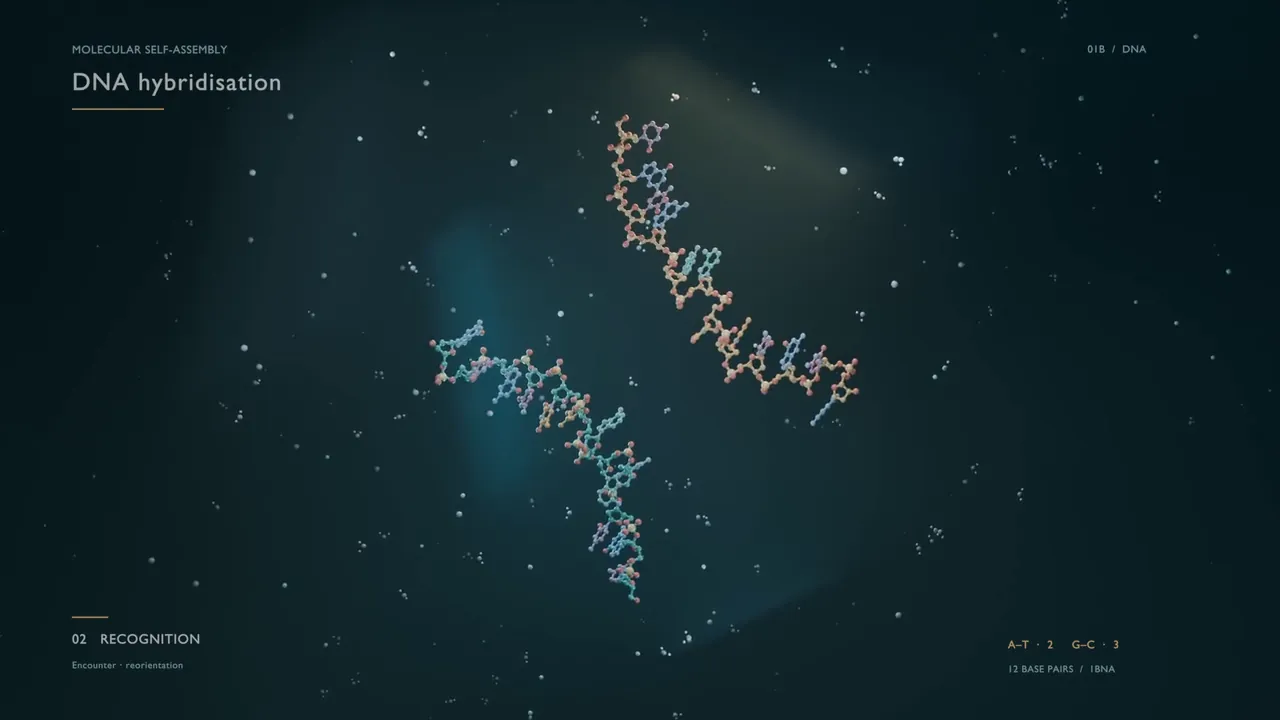
Two complementary DNA strands find each other in solution and base pairing zips them into a double helix. A 20-second film you can open in Animiotics as a sample scene.
What the animation shows
DNA hybridization is the pairing of two single strands whose bases are complementary: adenine with thymine and guanine with cytosine. The strands run in opposite directions, and hydrogen bonds between the base pairs, together with stacking between neighboring bases, hold the double helix together.
Hybridization is the principle behind many lab methods. PCR primers and qPCR probes hybridize to their targets, microarrays and FISH use labeled probes that bind matching sequences, and the stringency of a wash decides how perfect a match has to be.
What it is built from
The double-helix geometry is derived from PDB 1BNA, the classic B-DNA dodecamer. The motion of the strands, the colors and the timing are illustrative.
Make your own version
Open this film as a starter and customize it, or describe a new animation. A few variations to try:
- Show a qPCR probe hybridizing to its target and being cleaved so its dye lights up.
- Show DNA melting as the temperature rises and the strands separate, then annealing again as it cools.
- Show a mismatched base pair weakening a hybrid during a stringent wash.
Questions
Why do G-C rich strands bind more strongly?
A guanine-cytosine pair forms three hydrogen bonds and stacks more strongly than an adenine-thymine pair with two, so G-C rich duplexes melt at higher temperatures.
Can I animate my own sequence?
Yes. Describe the sequence and what should happen, or load a structure file in the editor and animate it yourself.
Keep reading
Describe it. Watch it move.
Start your first animation from a description, a structure or a photo.