
Animation example
Bisulfite conversion 3D animation
Follow cytosine through sulfonation, deamination and desulfonation until it becomes uracil, the chemistry that lets sequencing read DNA methylation. A 55-second film you can open in Animiotics as a sample scene.
What the animation shows
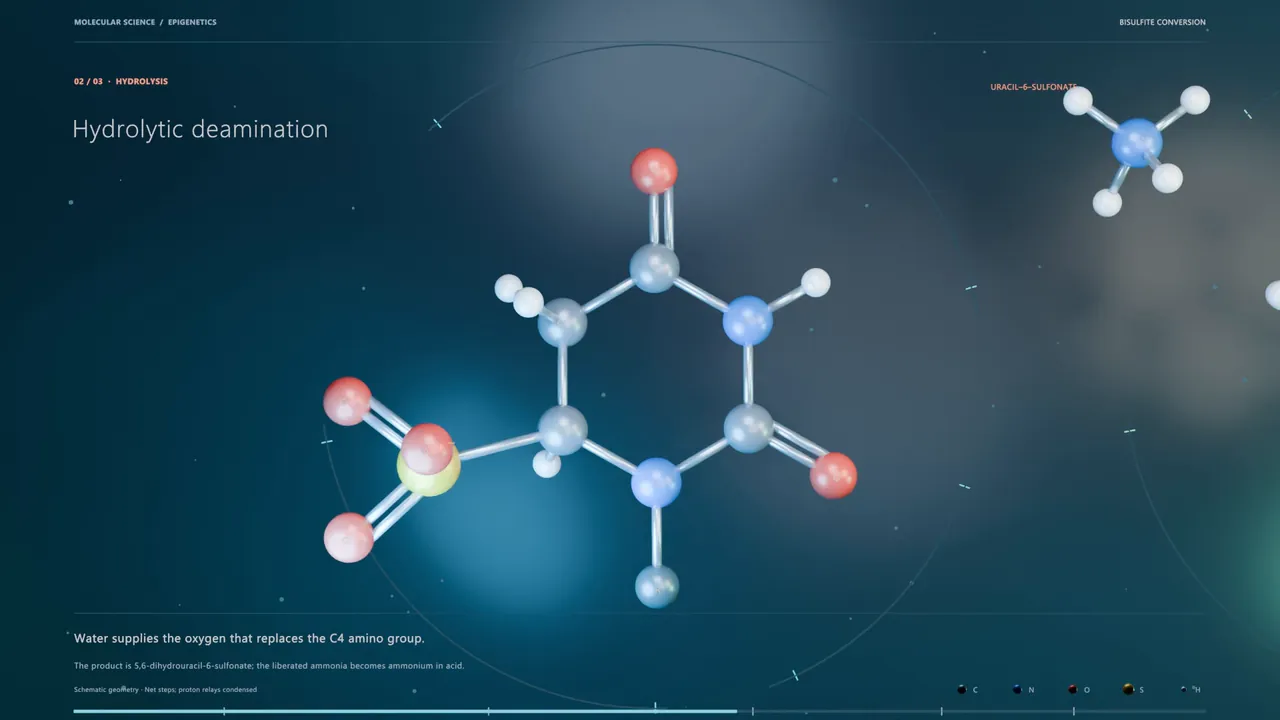
Bisulfite conversion is how most DNA methylation is measured. Sodium bisulfite adds to the 5,6 double bond of cytosine (sulfonation). The resulting intermediate loses its amino group by hydrolytic deamination, and under alkaline conditions the sulfonate group is removed again (desulfonation), leaving uracil.
5-methylcytosine reacts far more slowly, so it stays a cytosine. After PCR, uracil reads as thymine, while methylated cytosines still read as cytosine. Comparing the treated sequence with the reference shows which cytosines were methylated, the basis of bisulfite sequencing.
What is illustrative
This is an illustrative reaction sequence. Molecular geometry, colors and timing are schematic, and the film shows one molecule rather than a strand of DNA.
Make your own version
Open this film as a starter and customize it, or describe a new animation. A few variations to try:
- Show a DNA strand before and after bisulfite treatment, with methylated CpG sites staying as cytosine.
- Show the enzyme TET oxidizing 5-methylcytosine during active demethylation.
- Compare bisulfite sequencing with enzymatic methyl-seq in two parallel scenes.
Questions
Why does methylated cytosine survive bisulfite treatment?
The methyl group at position 5 makes the sulfonation step much slower, so under standard conditions 5-methylcytosine is not converted and still reads as cytosine.
Can I make chemistry animations in Animiotics?
Yes. Describe the reaction and the molecules involved, or import structures in the editor. Check reaction details against your sources, as with any illustration.
Keep reading
Describe it. Watch it move.
Start your first animation from a description, a structure or a photo.