
Animation example
Receptor-mediated endocytosis 3D animation
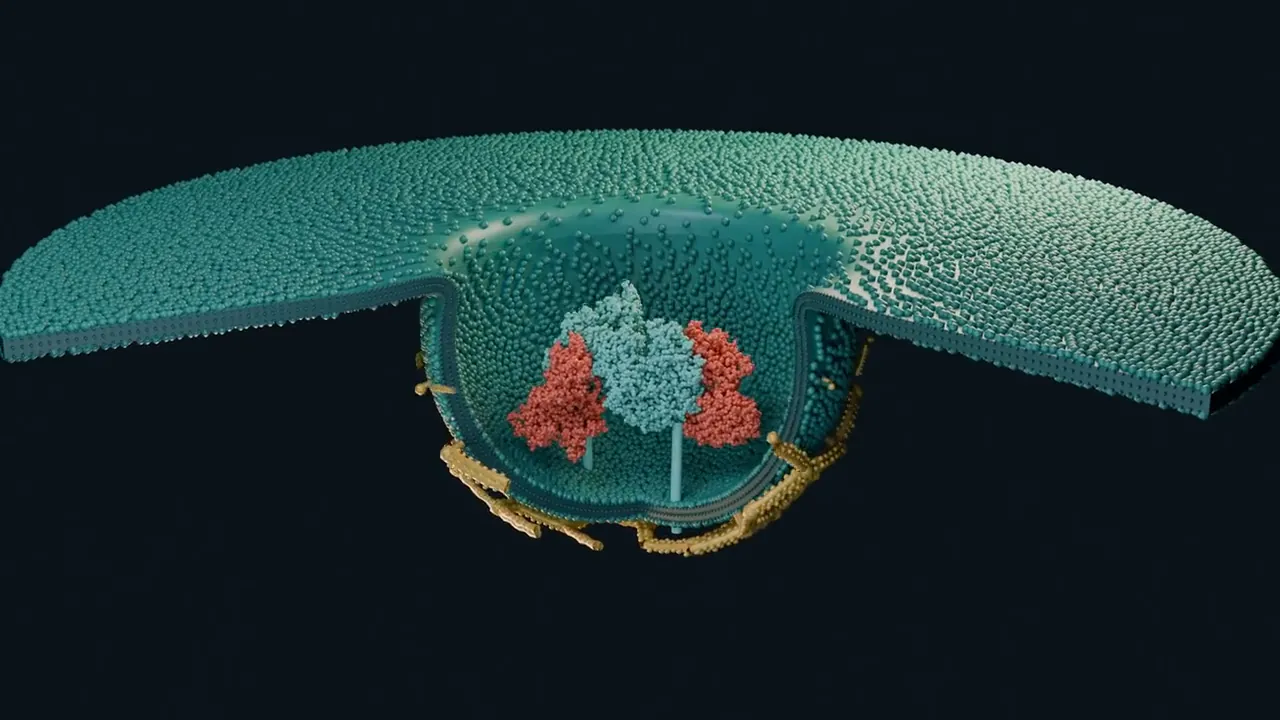
Cargo gathers at receptors on a cell membrane, the membrane curves inward and a vesicle forms inside the cell. A 10-second film you can open in Animiotics as a sample scene.
What the animation shows
Cells take up specific molecules, such as LDL cholesterol particles or iron-carrying transferrin, by receptor-mediated endocytosis. The cargo binds receptors on the surface, and the loaded receptors gather in patches of membrane coated on the inside with the protein clathrin.
The coated patch curves inward into a pit, the protein dynamin constricts its neck and a vesicle pinches off into the cell. The coat then falls away and the vesicle delivers its cargo to an endosome, where many receptors are sorted back to the surface to be used again.
What is illustrative
This is a conceptual example of receptor-mediated endocytosis. Structures and timing are not to scale.
Make your own version
Open this film as a starter and customize it, or describe a new animation. A few variations to try:
- Show LDL particles binding the LDL receptor, entering a clathrin-coated pit and the receptor returning to the surface.
- Show an antibody-drug conjugate entering a cancer cell by receptor-mediated endocytosis and releasing its payload in the lysosome.
- Show a lipid nanoparticle being taken up by a cell and escaping the endosome.
Questions
How is this different from phagocytosis?
Receptor-mediated endocytosis takes in small, specific cargo through coated pits. Phagocytosis is how immune cells engulf large particles such as bacteria.
Can I show a specific receptor?
Yes. Name the receptor and its cargo in your description. Where experimental structures exist, the generator downloads them from the Protein Data Bank.
Keep reading
Describe it. Watch it move.
Start your first animation from a description, a structure or a photo.