
Animation example
How caffeine keeps you awake: a 3D animation
From an espresso cup into the brain, where adenosine builds up the longer you are awake. Caffeine slips into the same receptor pocket and blocks it, until it wears off. A 43-second film you can open in Animiotics as a sample scene.
What the animation shows
Adenosine is a small molecule that builds up in the brain while you are awake, partly from the breakdown of ATP, the cell's energy currency. When it binds adenosine receptors on neurons, it dampens their activity, which is one of the signals behind the feeling of tiredness.
Caffeine has a shape similar enough to adenosine to sit in the same receptor pockets without switching the receptor on. It is an antagonist: by occupying the A1 and A2A receptors it keeps adenosine out, so its slowing signal is weaker and you feel more alert.
The effect lasts only while caffeine is present. As the body clears it, adenosine can bind its receptors again, which is why tiredness often returns when the coffee wears off.
What it is built from
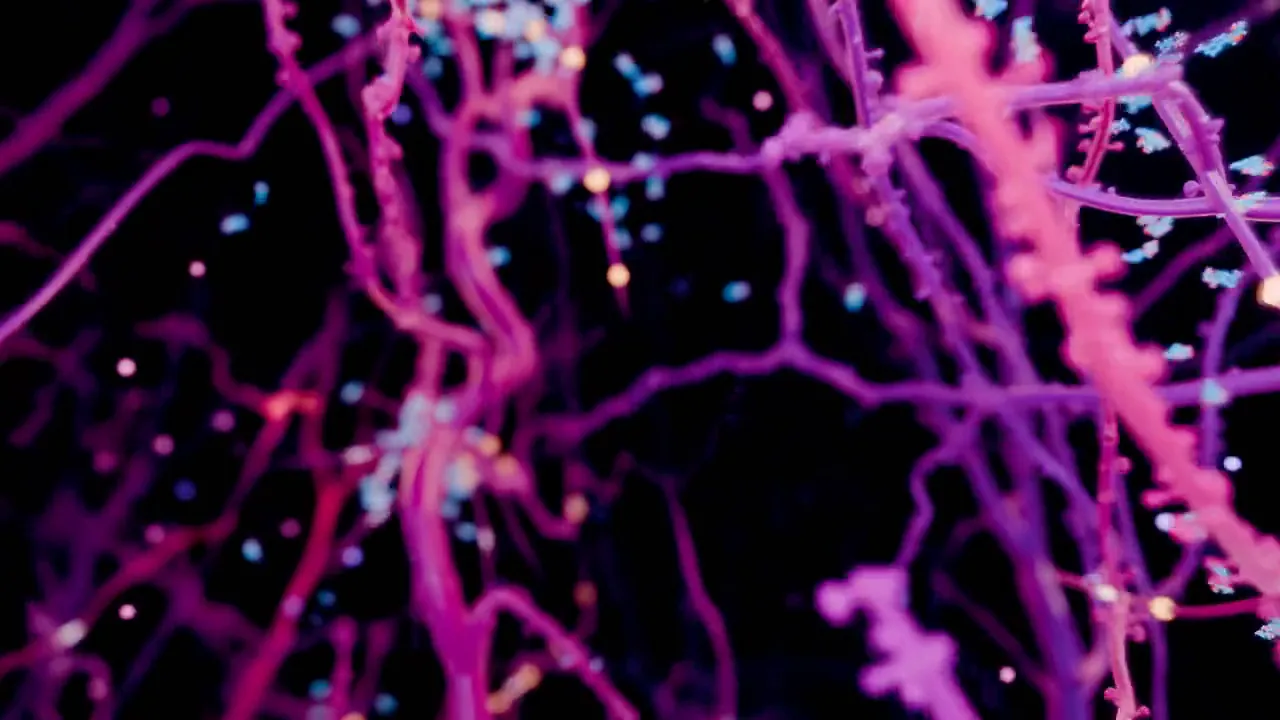
The A2A receptor is PDB 2YDO, a crystal structure with adenosine bound, and caffeine is placed in the pocket from PDB 5MZP. Membrane orientations come from the OPM database. The neurons are twelve reconstructed human cortical neurons from the Allen Cell Types Database, via NeuroMorpho.Org (CC BY 4.0).
What is illustrative
Molecules in the tissue shots are drawn about 2000 times too large so they can be seen. Binding and signalling are choreographed and slowed, the membrane is far less crowded than a real one, and A1 receptors, which caffeine also blocks, are not shown.
Make your own version
Open this film as a starter and customize it, or describe a new animation. A few variations to try:
- Show caffeine blocking the A1 adenosine receptor in the hippocampus, side by side with the A2A receptor in the striatum.
- Show adenosine levels rising over a long day and falling during sleep, with receptors switching on and off.
- Show theophylline from tea binding the same adenosine receptor pocket as caffeine.
Questions
How does caffeine block adenosine?
Caffeine resembles adenosine closely enough to fit the receptor pocket but does not activate the receptor. While it occupies the pocket, adenosine cannot bind and send its slowing signal.
Is this a mechanism of action animation?
Yes. It follows the classic structure of an MOA film: the body, the tissue, the receptor and the drug blocking it. The same structure works for receptor antagonists in drug development.
Keep reading
Describe it. Watch it move.
Start your first animation from a description, a structure or a photo.