Why Purification Needs A Visual Story
Protein purification animation services turn a dense downstream process into a clear scientific story that buyers, partners, investors and review teams can understand quickly. A purification workflow is not just a list of unit operations. It is the moment where a biologic becomes credible as a manufacturable product. The animation has to show how a target protein is captured, how impurities are reduced, how aggregates are controlled and how each step protects yield.
Many platform decks describe expression, binding biology and clinical promise in detail but treat purification as a black box. That gap matters. Downstream processing often carries the practical questions that shape diligence: can the team isolate the molecule cleanly, can the process scale, can it remove host-cell proteins and can quality attributes stay consistent when the program moves from discovery material to clinical supply. A focused animation helps answer those questions without overwhelming the viewer with every buffer exchange and process variable.
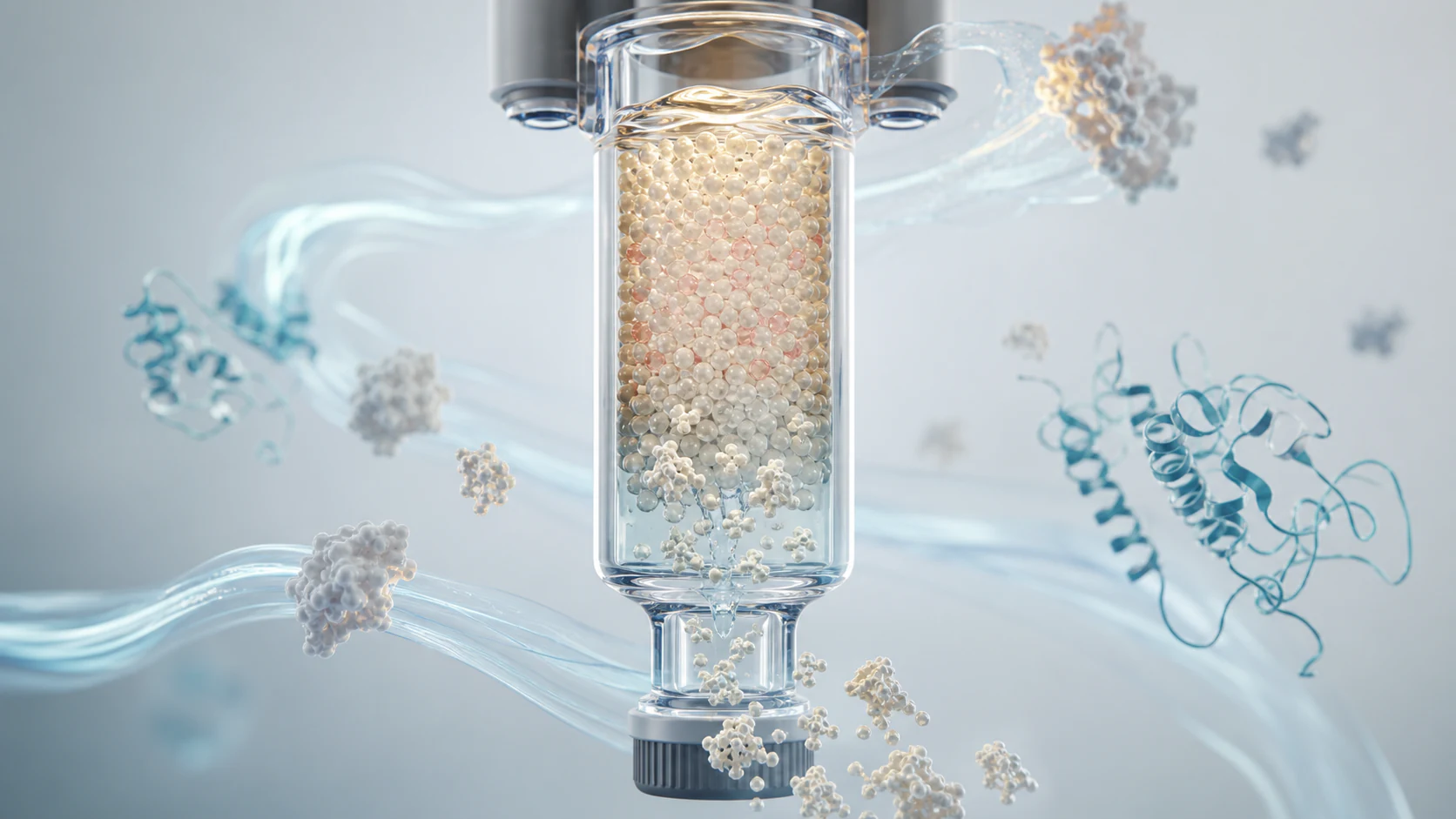
For Animiotics clients, the best purification visuals usually combine one hero sequence with a few supporting proof points. A chromatography column can become the main stage. Protein molecules bind to a resin, impurities flow through, elution releases the product and polishing removes remaining risk. The result is a buyer-ready explanation that feels concrete enough for technical audiences while still clean enough for a homepage, launch deck, investor update or BD meeting.
What Buyers Need To Understand
A strong purification animation starts with the commercial question behind the science. A platform buyer does not need a generic cartoon of a column. They need to see why the process supports product value. For a therapeutic protein, antibody fragment, enzyme, cytokine, fusion protein or engineered scaffold, the buyer is asking whether the molecule can be isolated with enough purity, activity and consistency to justify the next step.
The visual should make the target product obvious. Use one recognizable protein surface or ribbon form as the hero molecule. Then show it moving through a simplified downstream path: clarified harvest, capture, wash, elution, polishing and final collection. The supporting molecules should be sparse and purposeful. Host-cell protein fragments, DNA, aggregates and leachables can be represented as distinct forms only when they serve the story.
This is where protein purification animation services differ from general bioprocess graphics. The goal is not to decorate a manufacturing workflow. The goal is to translate process logic into trust. Show selectivity during capture, control during polishing and evidence during final QC. If the viewer can explain in one sentence why the purification strategy strengthens the program, the animation is doing useful commercial work.
- Make the therapeutic protein the hero subject.
- Show one clear capture event before showing later cleanup.
- Represent impurities as secondary forms with restrained color.
- Connect each visual beat to purity, yield, safety or scale.
- Keep the scene scientific but not crowded.
Capture Chromatography As The Hero Scene
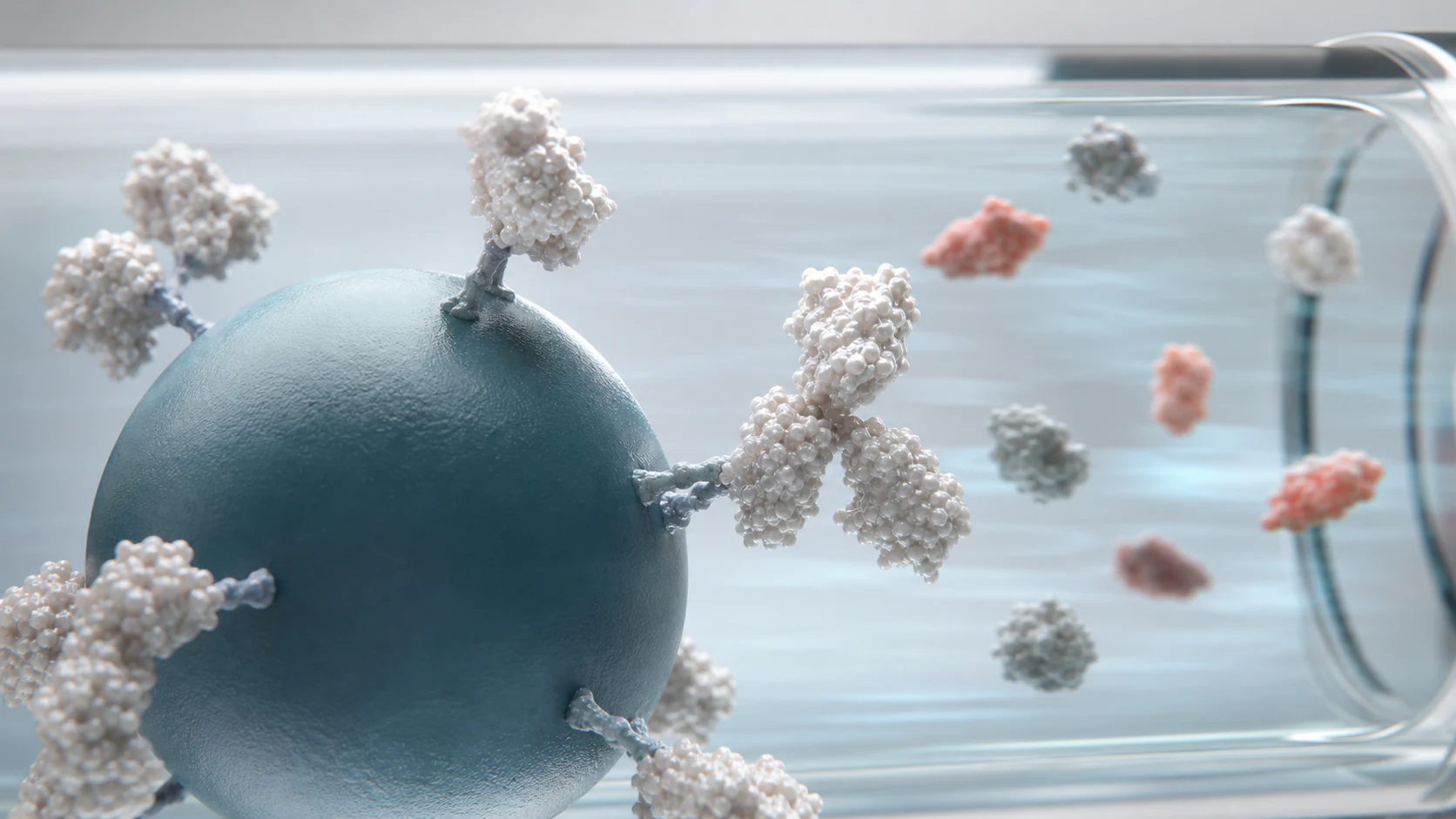
Capture chromatography is often the easiest purification step to animate because it has a natural visual logic. The product binds. Unwanted material flows through. A wash clears weak interactions. Elution changes the environment and the purified molecule is released. This sequence gives the audience an intuitive model of selectivity without asking them to decode a chromatogram or a process development table.
In a polished render, the column should be a clean 3D object with physically plausible glass, resin, liquid flow and molecular scale cues. The protein can approach a resin bead surface, lock into a ligand-like binding site and remain there while muted impurity particles pass by. A later camera move can show the product released as a coherent stream after the elution condition changes. The viewer should never need labels to understand the direction of travel and the difference between product and background material.
For marketing and diligence assets, the capture scene should avoid false precision. It does not need to claim a specific resin chemistry unless that detail is part of the platform story. Instead, use the scene to communicate controlled separation. If the client has a proprietary affinity tag, engineered ligand or unusual scaffold, Animiotics can make that feature visually distinctive while staying within a scientifically defensible abstraction.
| Beat | Visual | Buyer Question | Value Signal |
|---|---|---|---|
| Load | Target protein enters a clean column stream | Can the product be isolated from harvest material | The process has a defined capture strategy |
| Bind | Protein attaches to a resin surface while impurities pass | Is the separation selective enough | The platform can distinguish product from background |
| Wash | Weakly associated fragments leave the resin bed | Can early impurities be reduced | The story supports purity and consistency |
| Elute | A concentrated product stream exits the column | Can yield be protected | The process converts biology into usable material |
Polishing, Impurity Clearance And Risk Reduction
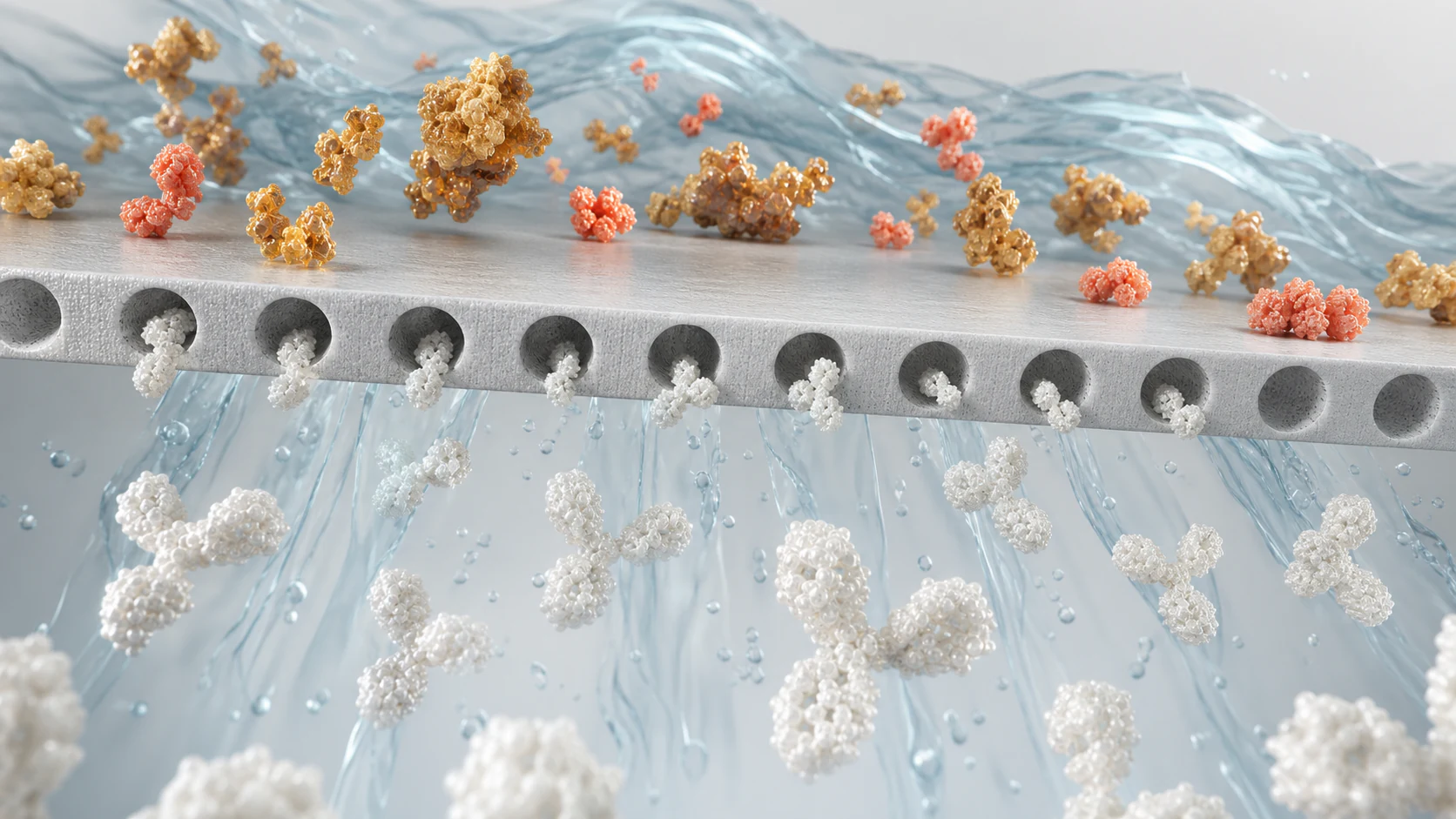
Polishing steps are where a purification story becomes more credible. Capture may show selectivity, but polishing shows risk reduction. This is the right section for ion exchange, hydrophobic interaction, size exclusion, viral clearance, filtration and aggregate control. The visual language should remain simple: a clean membrane plane, a second column bed or a pore structure that separates the final product from remaining impurity forms.
The key is to avoid making the scene look like a random cloud of particles. Use a few distinct supporting forms and assign each one a reason to exist. Aggregates can be larger paired structures. Host-cell proteins can be small amber fragments. DNA or nucleic acid impurities can appear as fine strands if the program context needs it. The therapeutic protein should stay visually consistent from the capture scene so the viewer can track product identity across the workflow.
Protein purification animation services can also show why clearance data matters. A section can transition from the filtration scene into a restrained evidence moment: not a fake chart or dashboard, but a purified sample, a simplified analytical lane or a clean molecular comparison. This gives technical viewers a bridge from process animation to the analytical package. It also gives commercial viewers language for quality without turning the asset into a dense regulatory slide.
- Use scale and color to separate product from impurity forms.
- Show aggregate removal as a visual risk-control beat.
- Keep viral clearance or filtration scenes scientifically restrained.
- Avoid overclaiming exact mechanism when the data are process-specific.
- End with a visibly cleaner product stream.
How Animation Supports CMC And Platform Discussions
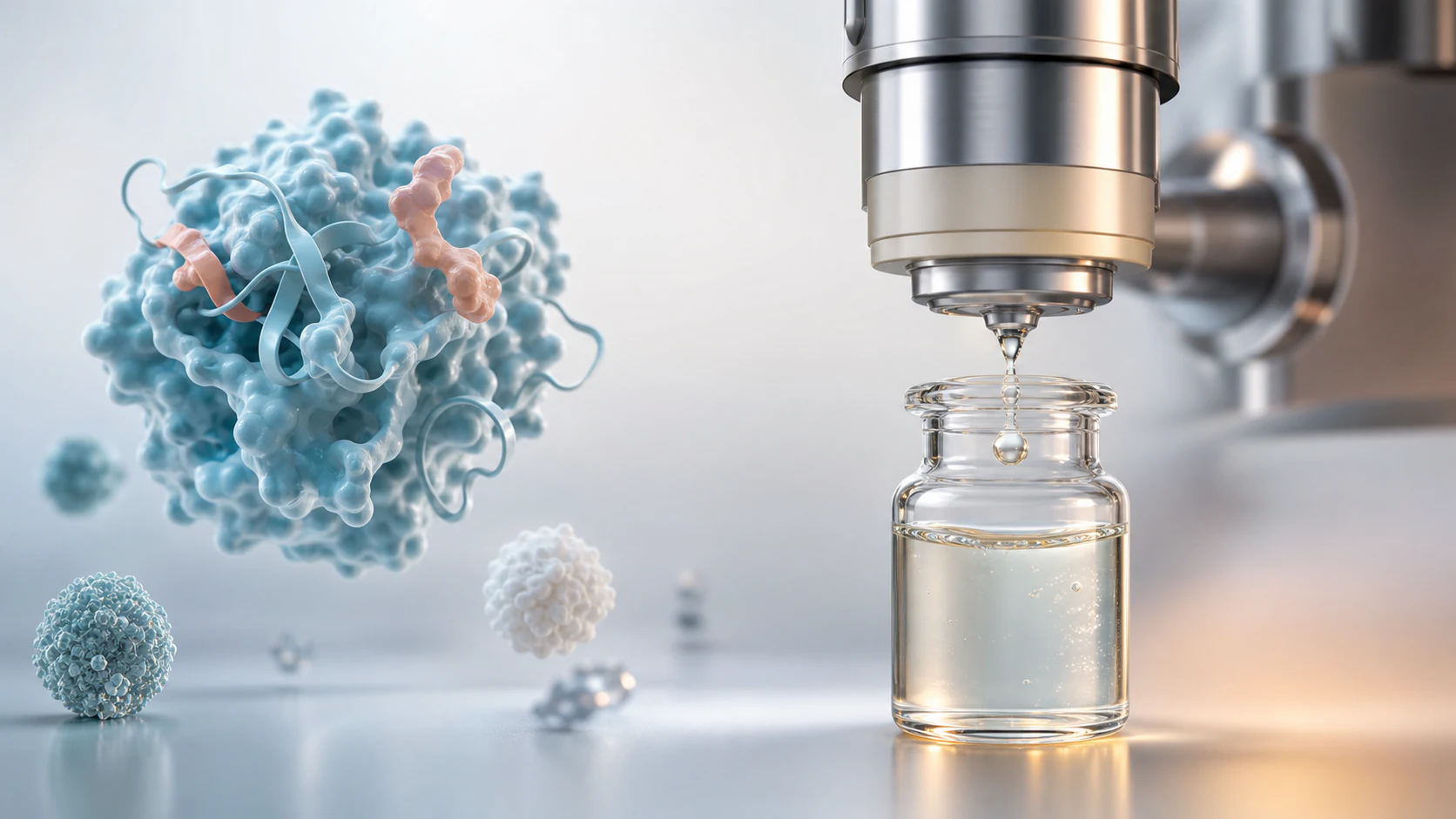
CMC conversations are difficult because they combine biology, chemistry, manufacturing and evidence. A good animation does not replace the data package. It helps the audience navigate it. When a purification sequence is shown clearly, a viewer can understand what the assay results are supporting: recovery of the product, reduction of impurities, protection of activity and movement toward a scalable process.
This matters in platform storytelling. A purification process can signal that the company has thought beyond mechanism of action and discovery biology. It can show that the molecule is not only interesting but developable. For a BD audience, that often means highlighting repeatable downstream logic across a class of proteins. For an investor audience, it may mean showing where scale-up risk is reduced. For a technical partner, it may mean framing the questions that need deeper due diligence.
Animiotics often pairs purification visuals with internal links to related platform stories. Teams building a complete communication path can connect purification to broader bioprocess animation services or to scientific animation services for biotech. That keeps the article useful for buyers who arrive through a narrow downstream search but also need a larger visual system.
Recommended Visual Structure For A Purification Animation
The most effective structure is a short, modular sequence. Start with the expressed protein in a clarified stream. Move to capture chromatography. Show wash and elution. Add one polishing step that removes the most important risk for the program. Finish with a purified sample or final protein form that supports the quality story. This can be produced as a 30 to 60 second animation or broken into still renders for a web page, deck and publication-style figure.
The camera should stay calm. A wide hero view establishes the column or membrane. A macro view shows molecular selectivity. A final studio shot shows the purified output. This gives the animation a premium scientific feel while preserving the sense that every visual beat has a job. If the asset is going into a sales deck, the same scenes can be exported as still frames with captions. If it is going into a product page, the cover render can serve as the page hero and the in-post renders can support the body sections.
Use color discipline. The product should be pearl white or restrained teal so it remains recognizable. Impurity forms can use warm amber and sparse coral accents. Glass, metal and buffer materials should feel physically plausible rather than decorative. Avoid pastel capsule forms, busy bead clusters and generic science wallpaper. The buyer should see a believable purification platform, not an abstract biotech mood board.
- Open with one product molecule entering a clean downstream path.
- Use capture chromatography as the central visual event.
- Show polishing as a second focused separation scene.
- End with purified material and a clear platform takeaway.
- Export stills for SEO pages, BD decks and launch assets.
Scientific Review Checklist
Before a purification animation is used commercially, review it against the actual process story. Confirm which unit operations are known, which are representative and which should remain abstract. Make sure the visuals do not imply a resin, modality, impurity profile or clearance claim that the team cannot support. The more regulated the use case, the more carefully the visual should separate concept explanation from product-specific evidence.
The scientific review should also check scale and causality. Protein molecules do not need atom-by-atom realism for a commercial animation, but they should behave consistently. If the product binds in one scene, it should retain its identity in later scenes. If impurities are removed, the animation should show the intended category of impurity rather than a random stream of colored shapes. If a final vial or droplet is used, it should represent purified output rather than a promise of approved product quality.
For teams comparing vendors, this review step is a useful differentiator. Protein purification animation services should include both visual craft and scientific restraint. A render can be beautiful and still be commercially weak if it confuses the process. The right asset gives reviewers a clean abstraction, gives executives a concise platform story and gives buyers enough confidence to ask the next technical question.
- Check that every unit operation matches the approved story.
- Separate representative process visuals from product-specific claims.
- Keep product identity consistent across all scenes.
- Review impurity categories before assigning shapes and colors.
- Confirm that captions support the data rather than replacing it.
FAQ
What are protein purification animation services?
They are scientific visualization services that explain downstream purification workflows such as capture chromatography, polishing, filtration, impurity clearance and purified product collection for biotech and pharma audiences.
Who uses purification animations?
Biotech founders, BD teams, process development groups, CDMOs, scientific marketing teams and platform companies use them to explain how a biologic can move from expressed material to a cleaner product stream.
Can an animation show real process data?
Yes, but the data should be handled carefully. A visual can connect to purity, recovery, aggregate reduction or clearance evidence while avoiding fake charts and unsupported claims.
How long should a purification animation be?
Many commercial uses work best at 30 to 60 seconds. A shorter sequence can focus on capture and polishing, while a longer one can include harvest clarification, buffer exchange, analytics and scale-up context.
What makes a purification render look credible?
Credible renders use one clear hero subject, physically plausible lab materials, restrained molecular forms and a process sequence that technical viewers can recognize.
Ready To Build A Purification Visual System
A clear purification story can make a platform feel more complete. It shows that the team understands not only the molecule and mechanism but also the downstream path that turns biology into usable material. For buyers, partners and investors, that shift is often the difference between an interesting claim and a credible development story.
Animiotics can build cover renders, section stills and animation sequences that explain capture chromatography, polishing, impurity clearance and CMC value in a consistent premium 3D style. The same visual system can support a website page, conference deck, investor update, launch campaign or technical explainer.
Start a purification visual brief at Animiotics.