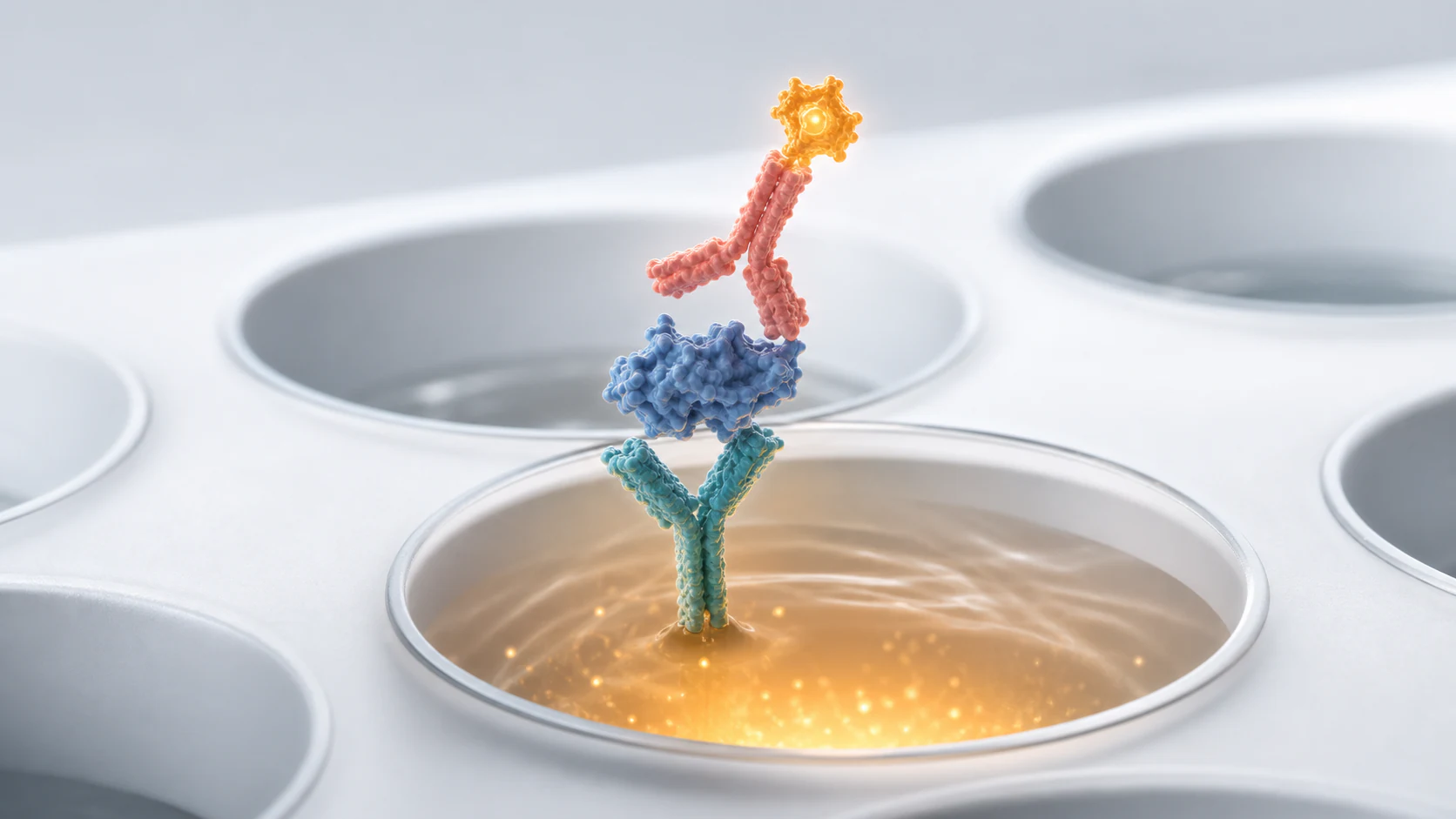
Why ELISA Assay Animation Services Matter
ELISA assay animation services help biotech, diagnostics, pharma and research teams explain assay evidence without asking buyers to mentally reconstruct a workflow from dense methods language. ELISA is familiar to many scientists, but familiarity does not automatically make the commercial story clear. A plate, antibody pair, biomarker target and colorimetric or luminescent readout can still feel abstract when the audience needs to understand what the assay proves.
The visual challenge is that ELISA combines molecular recognition, surface chemistry, timed wash steps, signal generation and quantitative interpretation. Each step is simple in isolation. Together, they can become a slide full of wells, arrows, abbreviations and tiny reagent labels. That is where a clear animation or premium render can make the assay feel inspectable.
For Animiotics clients, the goal is not to turn an ELISA into a decorative lab scene. The goal is to show why the assay matters: which biomarker is captured, how specificity is created, how signal develops and how the result supports a platform, diagnostic workflow, translational study or buyer decision.
The Buyer Problem: The Assay Workflow Hides The Proof
Most ELISA explanations start with the protocol instead of the claim. They show coating, blocking, sample addition, detection antibody, enzyme conjugate and substrate before the audience knows what decision the assay is supposed to support. Technical viewers may follow the sequence, but commercial audiences often lose the biological point.
A buyer-ready ELISA visual should invert that problem. First, show the question: is the target biomarker present, changing or measurable with enough confidence? Second, show the molecular basis of the answer: capture antibody, antigen and detection antibody forming a specific complex. Third, show signal development as the visible outcome of that binding event. Finally, connect the signal to the platform value or clinical use case.
This matters for diagnostic developers, assay service providers, translational biomarker teams, antibody companies and platform biotechs. These teams often need to prove rigor while still communicating quickly on product pages, investor decks, conference screens and sales materials.
- Lead with the biological question before showing the protocol.
- Make the capture complex the hero subject, not the plate layout.
- Show signal development as evidence of specific biomarker binding.
- Keep method detail available without letting it dominate the story.
What A Strong ELISA Assay Visual Should Show
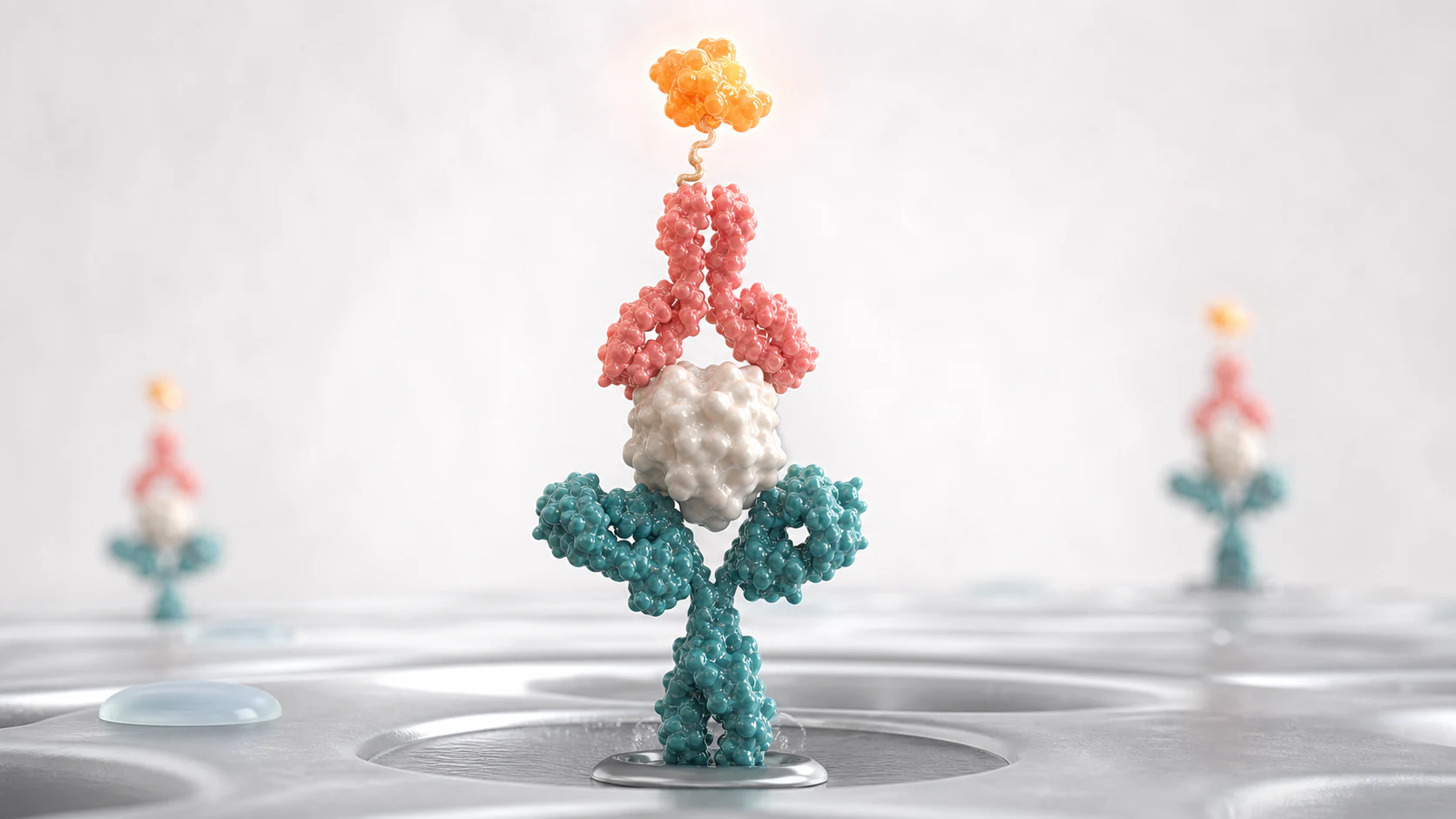
A strong ELISA assay visual has one clear scientific subject. That subject may be a biomarker captured between two antibodies, a coated well surface, a receptor-ligand complex, a multiplexed marker family or a polished assay volume where the signal emerges from a specific binding event. The viewer should understand the focus before reading the caption.
The supporting forms should stay disciplined. A few wells, a subtle plate edge, a clean antibody-antigen-antibody complex, controlled reagent volumes and a warm signal glow are enough for most buyer-facing assets. Too many pipette tips, labels, charts or miniature protocol panels can make the asset feel like a methods poster instead of a premium scientific render.
Related Animiotics resources such as https://animiotics.com/blog/companion-diagnostic-visualization-services-how-to-explain-assays-biomarkers-patient-selection-and-clinical-utility-clearly/ and https://animiotics.com/blog/translational-biomarker-visualization-services-how-to-turn-assays-mechanisms-and-clinical-signals-into-clear-scientific-stories/ show how assay visuals can connect technical evidence to clinical utility, patient selection and platform credibility.
| Visual layer | Scientific job | Commercial job |
|---|---|---|
| Capture complex | Show antibody, antigen and detection reagent specificity | Make assay confidence visible fast. |
| Well environment | Ground the mechanism in a realistic plate assay | Connect molecular evidence to the test format. |
| Signal chemistry | Show colorimetric, fluorescent or luminescent development | Explain why binding becomes measurable evidence. |
| Platform context | Link assay logic to biomarker, diagnostic or service value | Help buyers remember what the workflow enables. |
ELISA Animation Versus Static Assay Renders

Static assay renders are useful when the campaign needs a memorable hero image, deck figure or product page visual. They can show the capture complex, the well surface and the developed signal in one polished frame. Static renders are also useful when the buyer already understands the assay format and needs a more premium way to see the claim.
ELISA animation is stronger when the order of events matters. A short sequence can show a target biomarker entering the well, binding to the capture antibody, receiving the detection antibody, recruiting enzyme activity and producing a visible readout. That motion helps non-specialists understand why the signal is not just a color change. It is the output of a specific molecular recognition event.
The best motion sequence stays honest. It should not imply single-molecule certainty when the real assay is ensemble-based and it should not turn a quantitative assay into a fake dashboard. The visual should simplify the assay logic while respecting the underlying biology and validation context.
- Use static renders for web hero images, sales decks and article visuals.
- Use animation when reagent order, binding specificity or signal development drives the explanation.
- Use a modular visual system when one assay story must support web, pitch and conference formats.
- Avoid fake interfaces, unreadable well maps and decorative science clutter.
Where ELISA Visuals Create The Most Value
ELISA visuals create the most value when the assay supports a buying decision but the evidence is trapped in protocol language or raw plate readouts. Examples include biomarker validation, cytokine quantification, antibody screening, companion diagnostic development, reagent platform marketing, contract research services, potency assays and translational pharmacology packages.
A diagnostic company may need to show how its assay detects a target biomarker with a clear capture-and-detection mechanism. A platform biotech may need to show that its antibody discovery workflow produces measurable functional signals. A service provider may need to explain why its assay design, validation discipline and reporting system are worth trusting.
ELISA assay visualization also works well with broader mechanism assets. For example, a therapeutic story can show a drug changing pathway activity, then use an ELISA visual to show how the biomarker readout confirms that shift. A diagnostic story can show patient sample context, then zoom into the well where specific binding creates the measurable signal.
Visual Direction For Premium ELISA Renders
Premium ELISA renders should feel mature, scientific and controlled. The scene should usually include one clear assay hero subject: a central antibody-antigen-antibody complex above a clean well surface, a single assay well with signal developing from a biomolecular layer or a focused plate corner that supports the molecular story. Supporting wells and reagents should be sparse.
A restrained biotech palette keeps the image credible. Muted teal blue, pearl white, silver gray, warm amber and small coral accents can separate antibodies, biomarker targets and signal energy without turning the scene into a colorful lab cartoon. Physically plausible materials, polished studio lighting, subtle depth of field and a neutral light background make the assay feel premium rather than decorative.
The image should not rely on text, labels, fake UI panels, charts or numeric readouts. ELISA already has enough technical artifacts. The hero visual should remove clutter and focus attention on molecular recognition, signal development and assay confidence.
- Favor biomolecular surfaces, antibody forms, clean well geometry and lab-grade materials.
- Show one assay result rather than every step of the protocol at once.
- Use warm amber signal only where it helps explain detection chemistry.
- Avoid pastel capsules, toy-like beads, glass clusters, labels and watermarks.
How To Scope An ELISA Assay Visualization Project
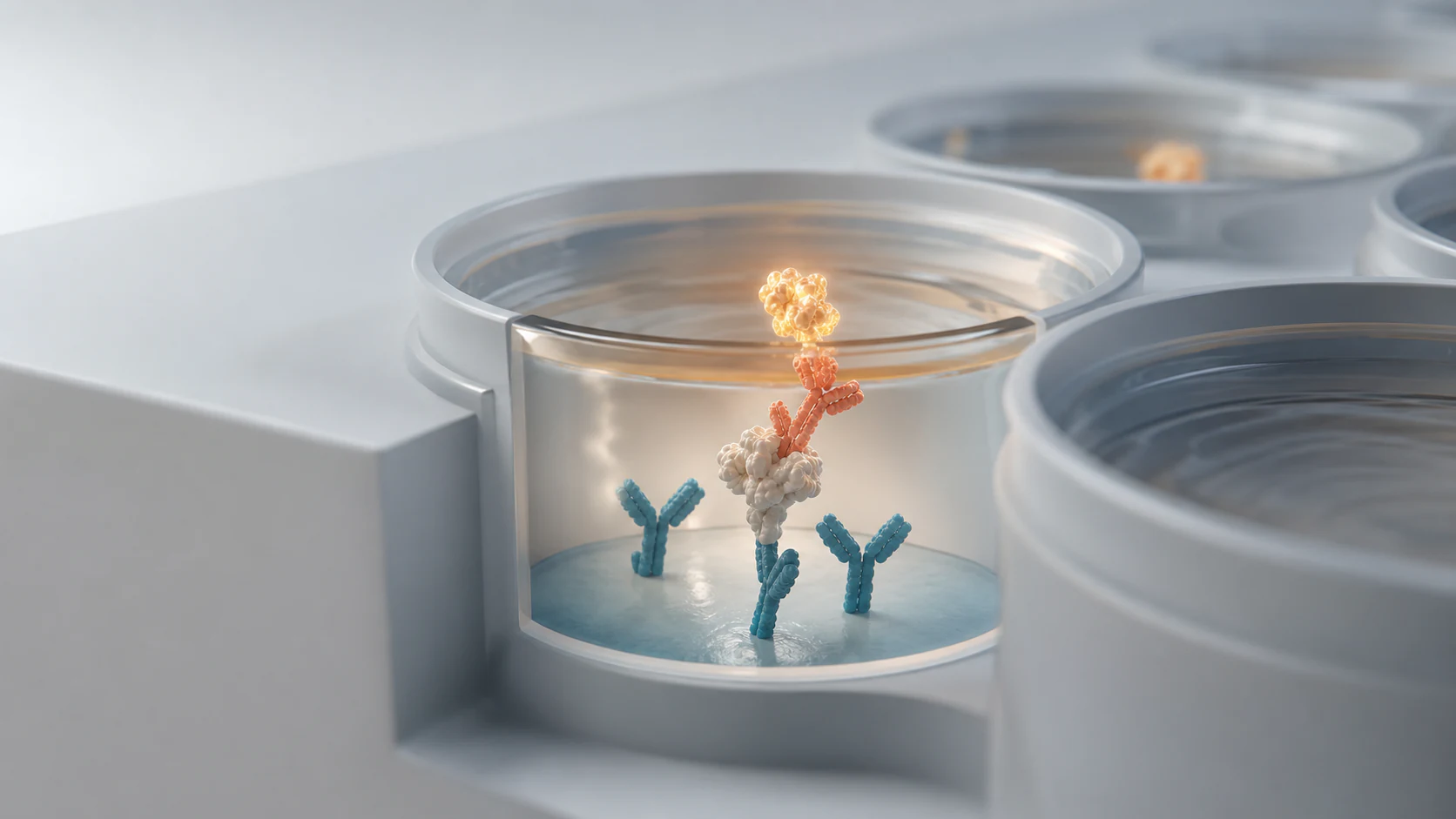
An ELISA assay visualization project should start with the decision the visual needs to support. Is the asset meant to sell an assay service, explain a diagnostic product, support a biomarker program, clarify a platform workflow or turn a validated method into a campaign image? The answer determines whether the deliverable should be a static render, short animation, figure set or reusable visual system.
Next, define the assay story. The team should identify the format, target biomarker, sample context, capture reagent, detection reagent, signal chemistry, comparison condition and claim. That information lets the visual team decide which details need to be explicit and which can be simplified for clarity.
Useful inputs include assay schematics, representative plate data, reagent descriptions, validation notes, biomarker context, audience, channel requirements and existing brand constraints. Animiotics can then build a visual system that respects the assay while making it easier to understand in product pages, sales decks, investor materials, papers and conference campaigns.
FAQ: ELISA Assay Animation Services
What are ELISA assay animation services?
ELISA assay animation services turn immunoassay workflows, antibody binding, biomarker detection and signal development into clear scientific visuals for biotech, diagnostics, pharma and research communication.
Can ELISA visuals simplify a protocol without misrepresenting the assay?
Yes. A good visual keeps the order, binding logic and assay claim faithful while simplifying the graphical language. It should clarify how the signal is generated, not replace detailed validation data where that data is required.
Who needs ELISA assay visualization?
Diagnostic developers, assay service providers, translational biomarker teams, antibody platform companies, reagent brands and research groups often benefit when assay evidence has to support a buyer, reviewer, partner or investor conversation.
What should we provide before starting?
Useful inputs include assay format, target biomarker, reagent details, protocol outline, validation context, representative results, target audience, channel requirements and any scientific or brand constraints.
Ready To Turn ELISA Assay Evidence Into Buyer Ready Visuals
If your ELISA assay is technically strong but hard to explain quickly, Animiotics can help turn the capture biology, signal development and platform value into a polished visual system. We build premium scientific renders, mechanism visuals and short animation sequences for biotech, diagnostics, pharma and research teams that need assay evidence to feel clear.
Use ELISA assay animation services when your product page needs a better assay hero, your sales deck needs a clearer biomarker story or your research team needs figures that connect methods to biological meaning. See related scientific rendering guidance at https://animiotics.com/blog/biotech-3d-rendering-services-how-to-turn-platform-science-into-buyer-ready-visual-assets/ or start from the Animiotics homepage at Animiotics.
- Create a premium assay hero render for a diagnostic or platform page.
- Turn capture and detection logic into a clear visual sequence.
- Build deck-ready figures for biomarker and reagent performance claims.
- Develop reusable web, pitch and conference visuals from one assay story.