Start with three kinds of movement
A diffusion vs directed transport animation should let viewers answer three questions: what is the individual object doing, what is changing across the population and what is the camera doing? If those movements are blended together, random encounters can look purposeful and a camera pan can look like cargo transport.
For a short Animiotics scene, begin with a fixed viewpoint and a small cast. Compare freely moving molecules with a vesicle visibly connected to a motor and its track. Establish that distinction before adding dramatic camera travel, detailed stepping or a cellular destination.
The framework below is for directing a conceptual explanation. It is not a molecular dynamics simulation protocol, and the illustrations are not measured structures or trajectories. Its practical test is whether a viewer can identify the kind of movement without relying on a decorative arrow.
Show random motion at the individual level
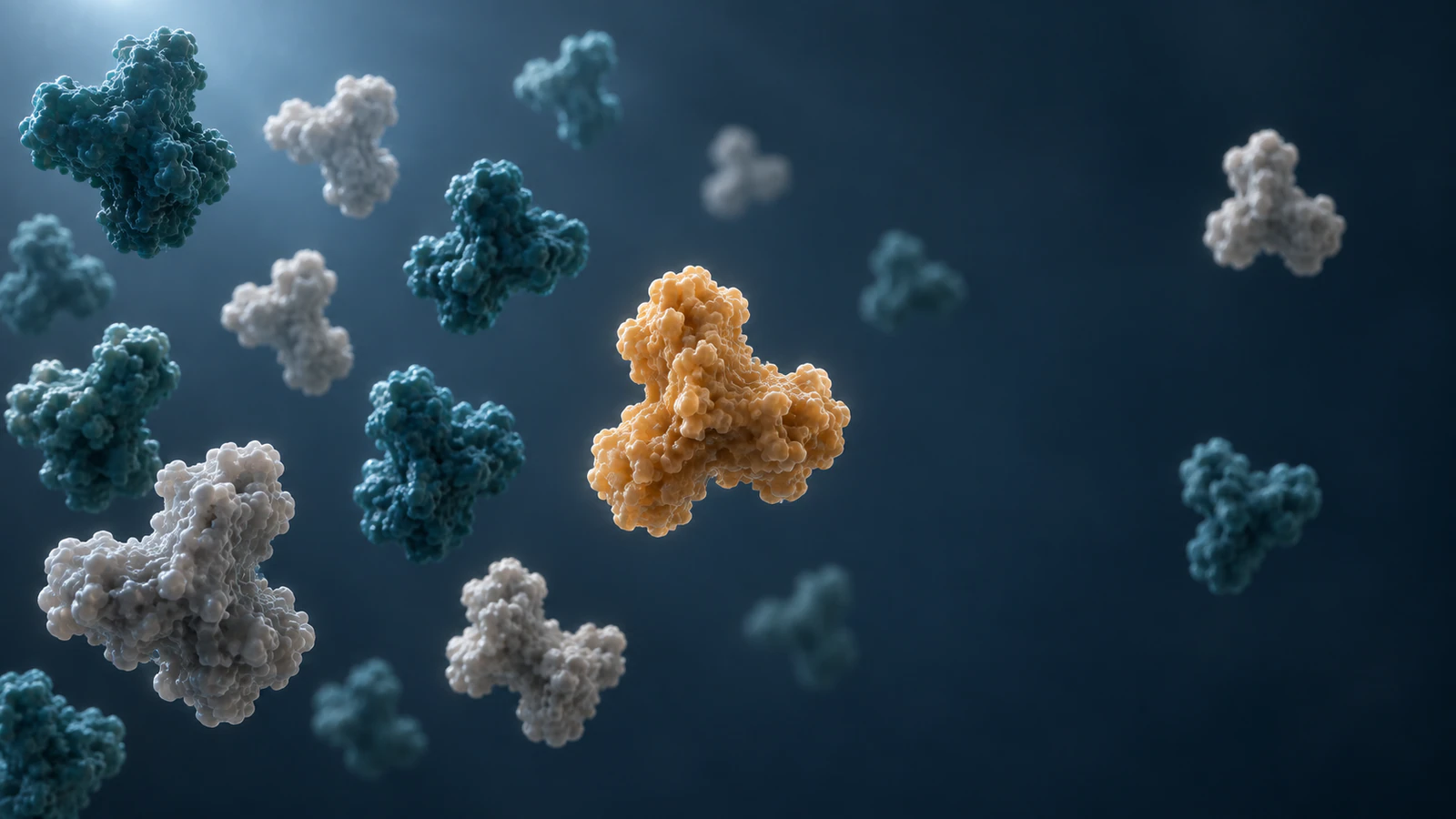
Brownian motion describes irregular thermally driven movement. In a simple diffusion example, individual particles move randomly while the population can spread from a region of higher concentration to one of lower concentration. A concentration gradient is that difference in concentration across space. At dynamic equilibrium, particles still move even though there is no net redistribution. OpenStax explains this distinction.
Direct the scene so the highlighted molecule has no privileged route. Let it turn away from the less crowded region sometimes, and avoid having every neighbour reverse direction on the same frame. A synchronized flock reads as coordinated transport, regardless of how irregular each individual path looks.
For this teaching example, specify neutral particles in an open, uniform medium. Ions, selective barriers and other forces require a more specific explanation. Keep the scene sparse enough to follow several individuals; the visible object count is an illustration choice, not a claim about cellular concentration.
Give directed transport a visible connection
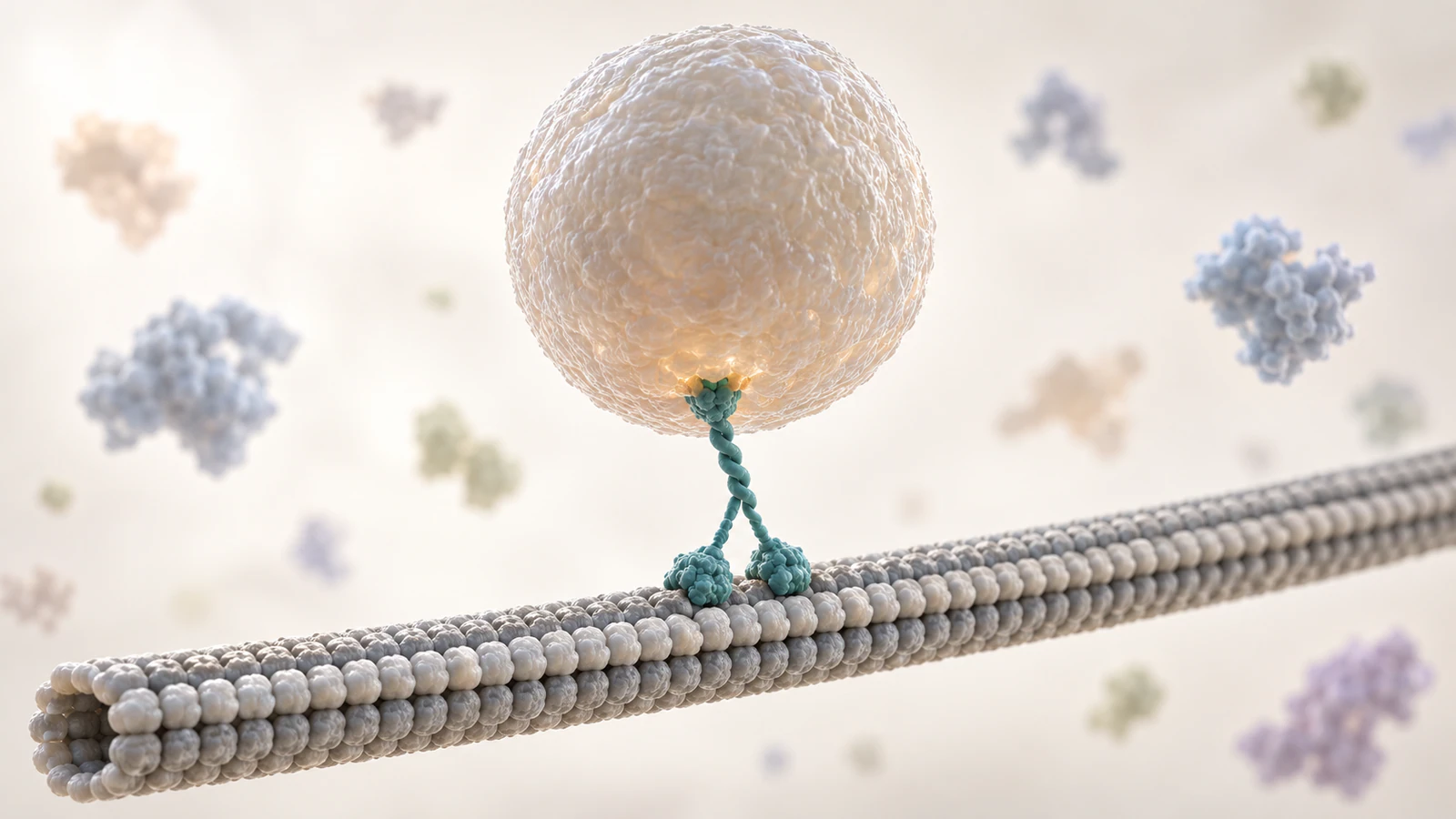
Cytoskeletal motors can carry membrane-enclosed cargo along polarized filaments using energy from repeated ATP hydrolysis. ATP, adenosine triphosphate, is a molecule whose chemical conversion helps power the motor cycle. Conventional kinesin provides a useful microtubule example: it moves toward the track's plus end. That direction is a property of the filament, not the right side of the screen. Motor families have different directionality. The NCBI molecular-motors chapter provides the biological context.
Keep three elements readable: cargo, motor and track. The connection matters more than an elaborate background. If the vesicle floats above the filament with no visible link, the audience cannot tell whether it is being carried, diffusing nearby or simply following an animation path.
At the overview scale, show attached travel without claiming to resolve every molecular step. Use a separate close view only when the motor mechanism itself is the question. The free molecules and the motor-bound cargo should remain visually distinct throughout the comparison.
Write an object, population and camera contract
Before arranging the timeline, write one sentence for each row below. This is a compact direction document: it states what the viewer should infer and what the shot is allowed to change. A collaborator can review it before anyone spends time polishing surfaces.
For example: the amber molecule moves independently; the initially uneven population becomes more dispersed; the camera stays fixed. In the transport shot: the vesicle remains attached; surrounding molecules have independent movement; a recognizable point on the track stays in view.
| Layer | Decision to record | Visible review cue |
|---|---|---|
| Individual object | Free movement or travel while attached to a named mechanism | The selected object's position relative to nearby landmarks |
| Population | What distribution changes across the whole visible region | Several peers remain visible, not just one successful journey |
| Camera | Fixed, following or revealing a wider context | A track feature or scene landmark stays identifiable |
| Evidence | Conceptual motion or a specific measured record | Caption names the basis and any timing simplification |
Use a six-shot comparison
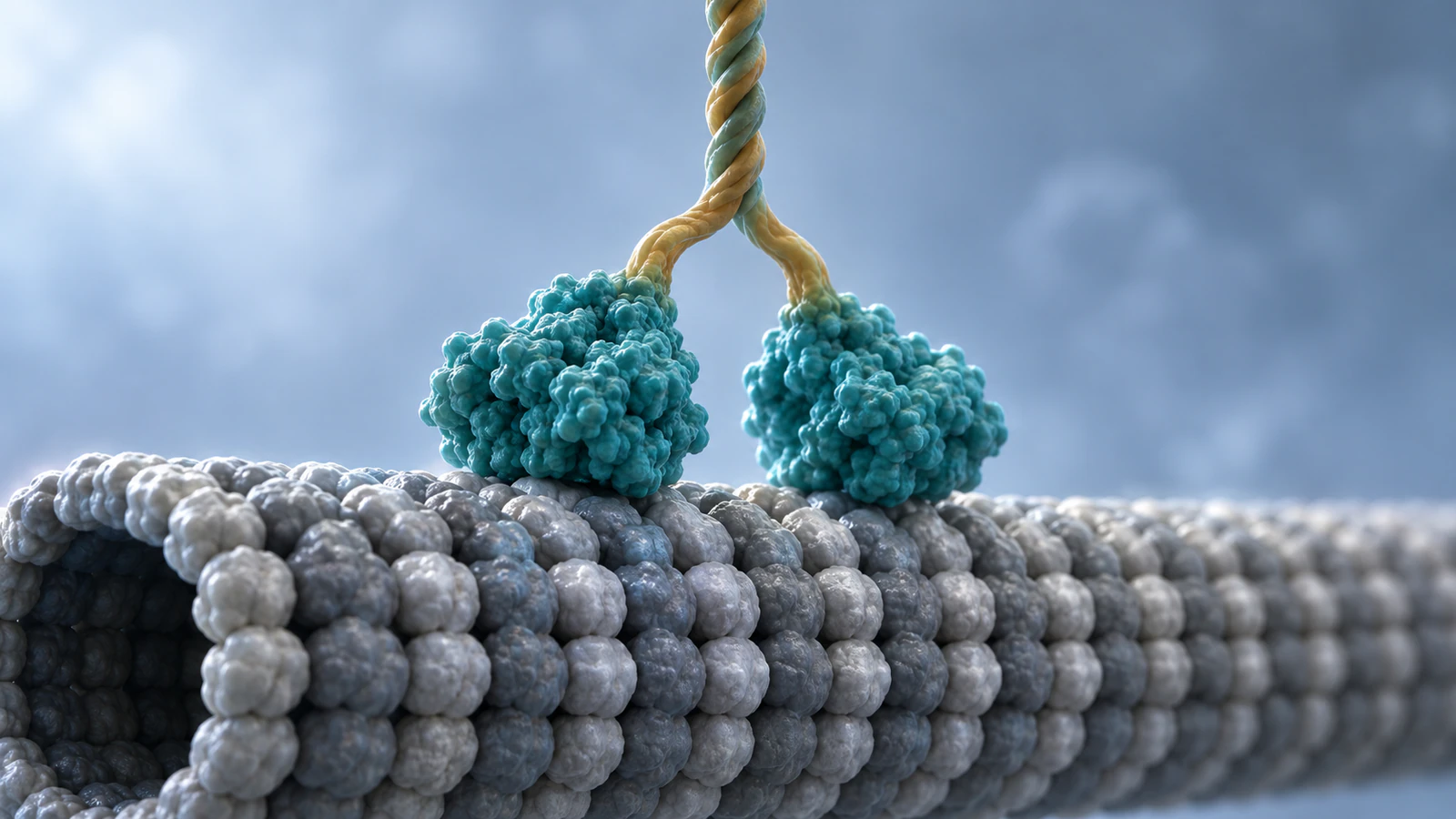
Build the explanation around two short sequences with the same visual language. Keep freely moving objects recognizable by shape, and give the transported cargo a clearly different silhouette. Reusing a single amber colour for attention is useful, provided the narration does not imply that the free molecule becomes the vesicle.
This storyboard is a proposed teaching sequence, not a cellular event order. Shots one to three explain an ensemble; shots four to six introduce a different example with a motor. A clear cut between them prevents a false transformation.
- Shot 1: Establish the volume. Hold the camera still and show an uneven distribution of free molecules. Keep enough empty space to distinguish silhouettes.
- Shot 2: Follow attention, not a destination. Highlight one molecule while several peers remain visible. Include changes in direction without synchronized turns.
- Shot 3: Revisit the whole population. Show a more even distribution while individual movement continues. Do not finish by freezing every molecule.
- Shot 4: Introduce the track. Show a vesicle, its connecting motor and a short microtubule segment together. Establish which direction along the track is being illustrated.
- Shot 5: Show attached travel. Keep the same track landmark visible long enough to judge progress. Use a close view only if attachment or stepping needs explanation.
- Shot 6: Compare the explanations. Return to a calm overview and state what each sequence demonstrated. Keep diffusion and motor transport as separate examples.
Check the motion with a fixed landmark
A following camera is effective at keeping cargo large, but it can hide the very displacement the scene is meant to explain. Temporarily review the sequence with the camera fixed. Choose a recognizable track feature and check whether the motor-cargo connection progresses past it.
Then review the camera move on its own with the objects held still. If this version tells almost the same transport story, the original shot depends too much on camera motion. Reduce the camera move or include a brief fixed-view beat before following the cargo.
For diffusion, watch a few unhighlighted molecules rather than only the hero. If all of them drift together across the screen, inspect whether the camera or a shared object movement is responsible. This is an editorial review technique, not a statistical test that establishes diffusion from a movie.
Separate screen timing from measured stepping
A smooth, watchable sequence is not automatically a measured motion record. Svoboda and colleagues used optical trapping interferometry with silica beads carrying single kinesin molecules on microtubules and reported 8-nanometre steps. This was a controlled single-molecule assay, not a movie of vesicle delivery inside a person. Read the original study's abstract.
That result does not justify assigning one step to every frame of an arbitrary animation. Record whether the sequence compresses time, omits intermediate states or simply illustrates attached travel. If you show a step distance, tie the geometry, scale and measurement context to the cited system.
For a general explanation, it is often clearer to avoid a stopwatch and state that motion is slowed and simplified for visibility. If timing becomes the scientific claim, return to the underlying data. The molecular-scale guide explains how to keep spatial and temporal scale decisions explicit.
Keep the ending scientifically readable
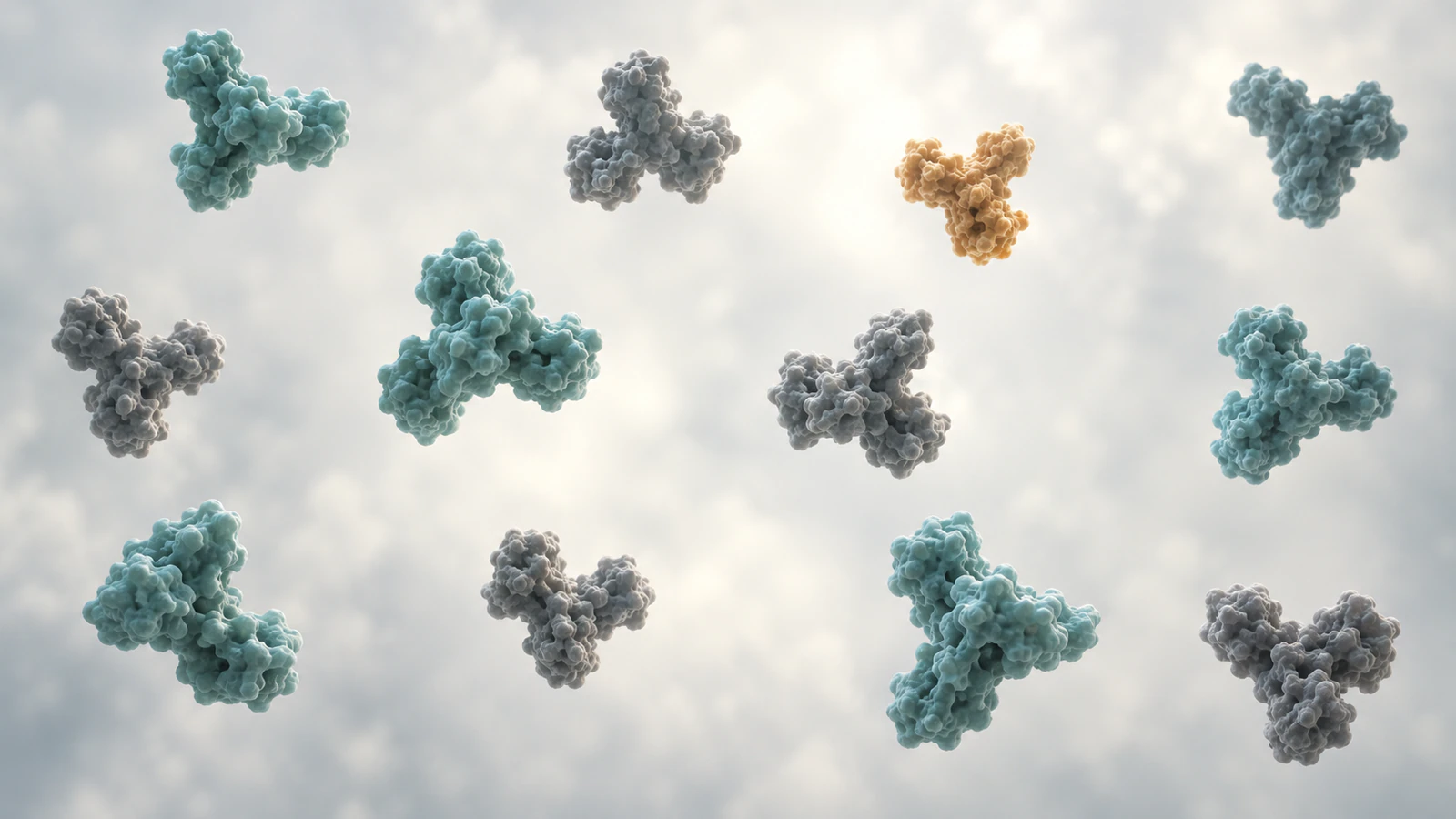
The diffusion sequence needs an ending that preserves movement. Use the more evenly spread population as the visual conclusion, then hold the composition while the objects continue changing position. A final still can illustrate the distribution, but cannot demonstrate that equilibrium has been reached.
The transport sequence needs a different boundary. If the shot only explains travel along a microtubule, stop while the vesicle is still attached and the track remains visible. Adding release, fusion or delivery into another compartment creates a new biological claim that needs its own evidence and scene logic.
For the same reason, avoid ending every random path inside a binding pocket. A hand-selected successful encounter may be useful in another scene, but here it shifts attention from motion to recognition. The enzyme-inhibition guide develops that separate distinction between showing a binding state and establishing kinetic behaviour.
Prepare a useful Animiotics scene brief
Translate the storyboard into a small, reviewable scene before adding a whole cell. Specify the free-molecule view and the motor-transport view separately. For each, name the visible objects, the movement relationship and the camera restriction; do not hide the main instruction inside a long description of cinematic style.
A concise direction could read: show several independently moving molecules in an open volume from a fixed camera, then cut to a vesicle visibly connected to conventional kinesin on a microtubule. Keep the track recognizable during travel. Treat the sequence as a conceptual explanation with simplified shapes and timing.
Review the result against the contract rather than assuming the brief guarantees the outcome. Check the connections from more than one angle and remove ambiguous intersections. Animiotics is the place to develop the visual explanation; a scene's appearance alone does not establish a diffusion coefficient, motor speed or molecular mechanism.
Run one focused review before sharing
Give a colleague the animation without its title and ask them to describe what moves. Their answer should distinguish the free objects, the population change and the attached cargo. If they say that molecules seek a target or that the entire fluid travels in one direction, revisit the shot that created that impression.
Finally, read every caption against what is actually visible. Use conceptual illustration for invented geometry, and measured trajectory only when a genuine record supports the movement. A good caption tells the viewer what the frame helps explain and where its evidence stops.
FAQ
Does diffusion mean every molecule moves toward lower concentration?
No. Random individual movements can produce net redistribution across a population. Keep both levels visible in the example rather than making each object travel directly to the less concentrated region.
Should all molecules stop at equilibrium?
No. Dynamic equilibrium includes continuing molecular movement. End with a stable overall distribution while individual objects keep moving, and identify a still image as a conceptual view of that distribution.
Is directed transport always a perfectly smooth path?
Do not use smoothness alone to identify a mechanism. In this comparison, the important visual evidence is a named motor connected to cargo and a track. Any detailed stepping or pauses need a system-specific basis.
Can a rendered path prove a diffusion coefficient or transport speed?
An authored path cannot establish either quantity by appearance. Quantitative claims need a defined measurement or model, appropriate spatial and temporal calibration and the relevant assumptions.
Can I use these images as exact kinesin structures?
No. These are conceptual illustrations made to explain movement relationships. They are not coordinate-derived structures, measured motor states or experimental trajectories.
Try a molecular-motion comparison in Animiotics
Start with one short animation: freely moving molecules followed by a vesicle visibly carried along a microtubule. Use the six-shot plan to keep the camera, connections and scientific claim clear, then refine the scene after a colleague's review.