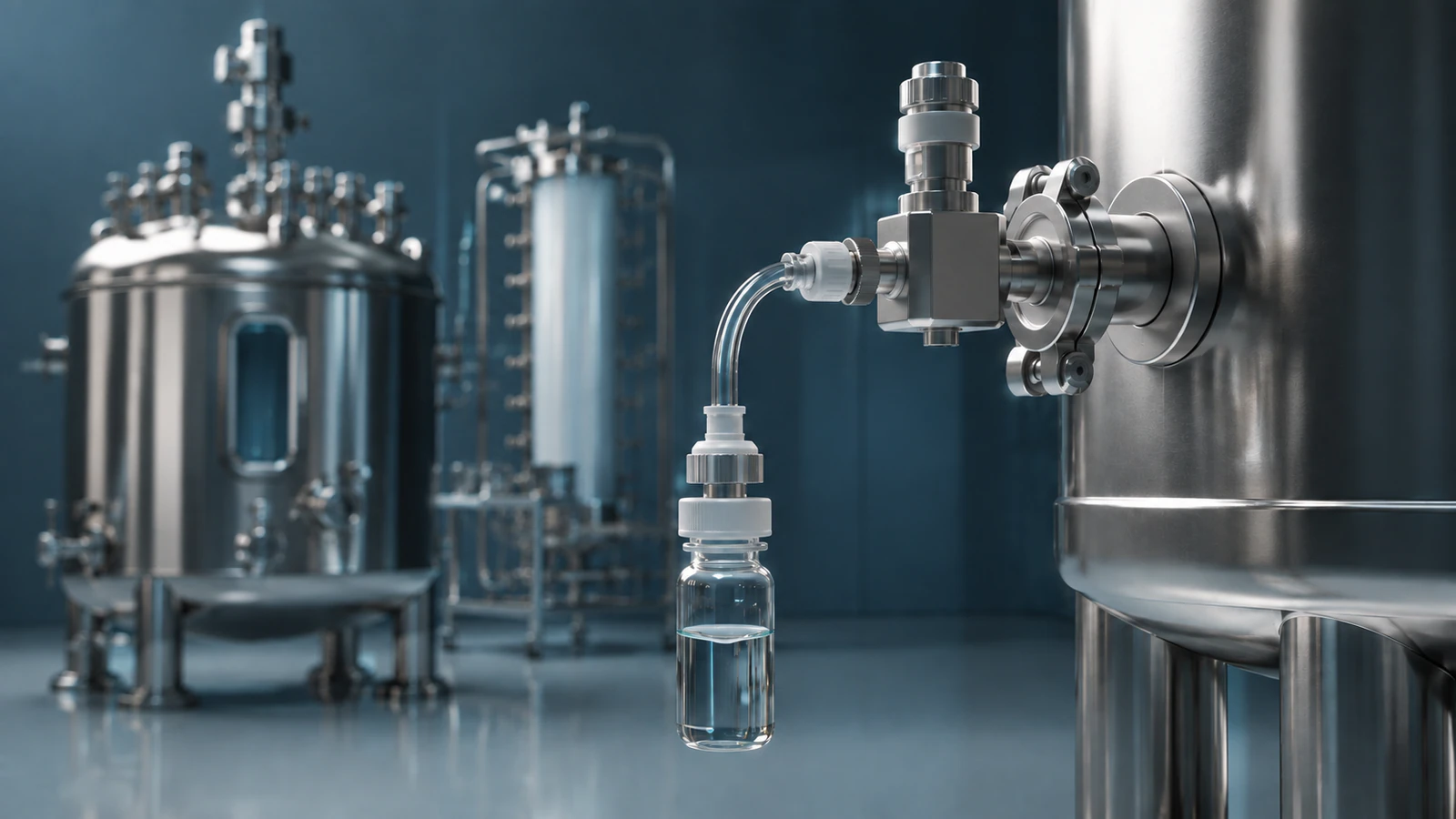
CMC Visuals Should Reveal The Evidence Chain
CMC visualization services are most useful when the audience needs to understand why a manufacturing process should produce a product with the intended quality. A factory tour cannot answer that question on its own. Stainless vessels, chromatography skids, and analytical instruments establish context, but the story becomes credible only when the viewer can follow the chain from product requirement to critical attribute, process influence, control, and measured outcome.
That chain gives technical and commercial teams a shared object to review. The CMC lead can test whether the causal links are defensible. The process scientist can check that unit operations and scale relationships are plausible. The analytical lead can see where each method supports a conclusion. A partner or investor can understand where the platform creates control without being asked to decode a module 3 dossier.
The visual must also show its boundary. It can organize approved facts, reveal dependencies, and make a change story easier to inspect. It cannot establish a critical quality attribute, prove comparability, validate a process, or predict a regulatory decision. Those conclusions remain grounded in the program's data, methods, risk assessments, and applicable guidance.
Start With The Product Promise And Its Critical Attributes

The first production decision is not camera angle. It is the product question. What quality characteristics must the audience understand, and why do they matter for the intended product? ICH Q8(R2) places the quality target product profile upstream of potential critical quality attributes, process selection, and the control strategy. That order is a useful editorial discipline because it prevents a process animation from becoming a sequence of attractive but unmotivated machines.
For a monoclonal antibody example, the visual brief might focus on identity, potency, aggregation, charge variants, or glycosylation. The team should not place every attribute on screen. Choose the one or two attributes that carry the argument, then identify the material attributes, process parameters, and analytical measurements that genuinely connect to them. If the evidence supports association rather than mechanism, the visual language should preserve that distinction.
A practical opening frame shows the product in its relevant physical state and names the scientific question in the surrounding copy, not inside the CGI. Subsequent frames can then reveal where variability enters and how it is detected or controlled. This is more precise than starting with a generic molecular hero and attaching a list of platform claims afterward.
- Define the intended audience decision before selecting any scene.
- Choose one product-quality question as the spine of the visual sequence.
- Separate measured attributes from inferred mechanisms and future hypotheses.
- Keep acceptance criteria, ranges, and numerical claims out unless the approved source data support them.
Show How Process Parameters Create Or Protect Quality
A critical process parameter is not simply a parameter the team considers important. ICH Q8(R2) defines it through its impact on a critical quality attribute and the resulting need for monitoring or control. A scientifically useful scene therefore connects a changing process condition to a relevant material or product state. It does not animate temperature, pH, mixing, residence time, or feed rate as free-floating numbers.
For an upstream biologics story, a sequence might move from the culture environment to cellular production and then to a selected molecular attribute. For downstream processing, it might show how a capture or polishing step separates the desired product from a named class of process- or product-related species. The biological subject, equipment, and scale must remain coherent within each shot. A molecule should not appear physically the size of a bioreactor unless the composition clearly signals a deliberate transition between scales.
The FDA PAT framework is useful editorial context because it emphasizes process understanding and science-based analysis or control. The visual should make that understanding legible. It should not present decorative sensors, glowing dashboards, or invented feedback loops that are absent from the actual process.
Make The Control Strategy Inspectable
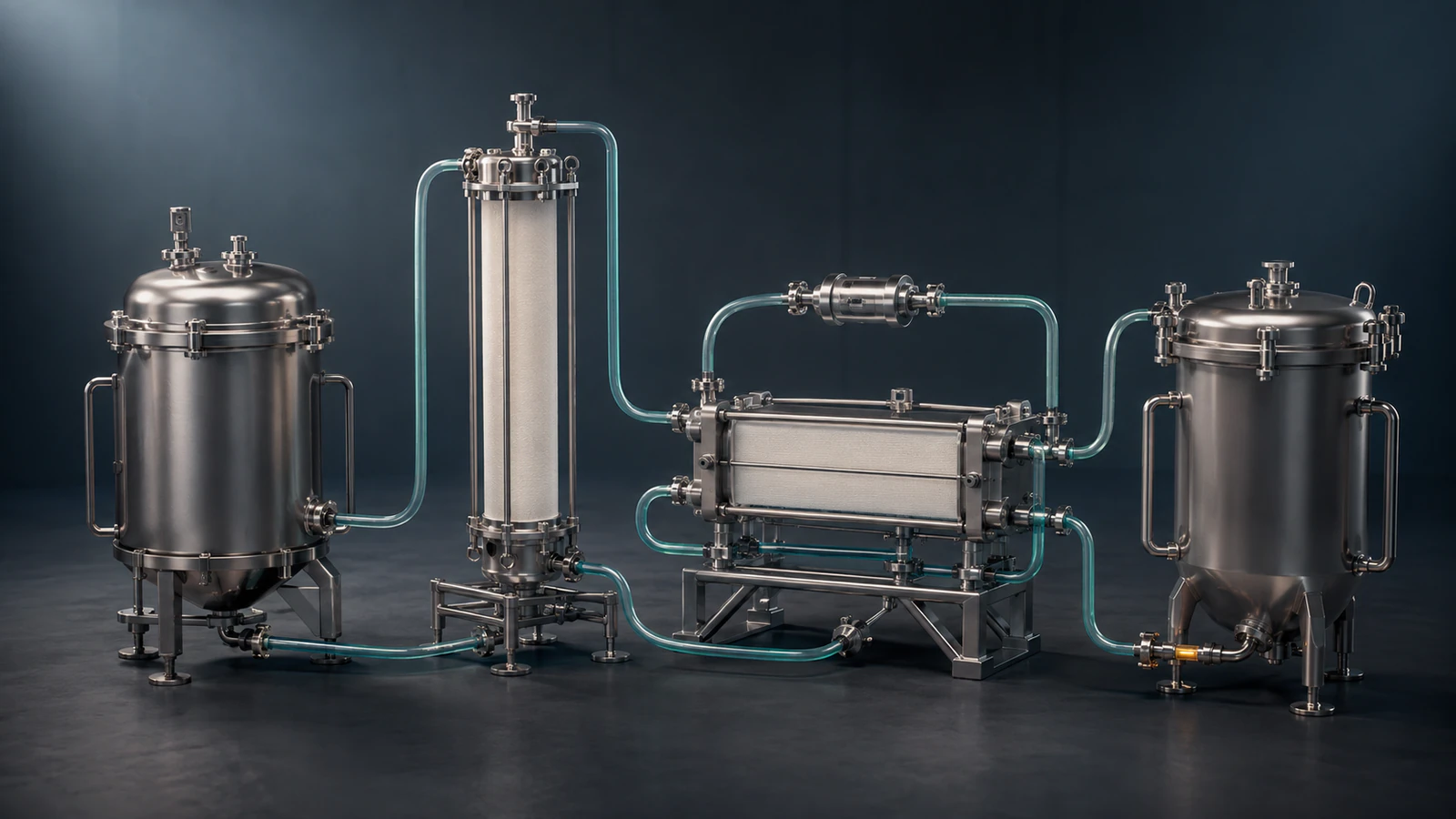
A control strategy is easier to understand when the viewer can see what is controlled, where the control acts, what is measured, and which product-quality concern it addresses. The scene plan should distinguish input-material controls, in-process controls, unit-operation controls, release tests, and ongoing monitoring. Collapsing all five into a single shield icon hides the scientific logic and invites overclaiming.
Use one visual grammar across the sequence. Stable materials can indicate the product and equipment. A restrained amber accent can indicate the active control point or measurement event. A coral accent should be reserved for a deviation, unwanted species, or observed difference, never used as general decoration. The audience should infer hierarchy from composition and motion, not from floating labels inside the render.
Teams commissioning bioprocess animation often need this layer because process flow alone does not explain control. The production brief should pair every control scene with its source evidence and approved wording so that the final animation never implies that monitoring by itself guarantees the desired outcome.
| Story element | Question it answers | Evidence needed |
|---|---|---|
| Input | What variability enters the process? | Material specification, characterization, or risk assessment |
| Process | Which operation can influence the attribute? | Development study, model, or process understanding |
| Control | What is monitored or constrained? | Approved control strategy and operating logic |
| Measurement | How is the relevant state observed? | Qualified analytical method and program data |
| Conclusion | What can the team responsibly say? | Reviewed claim with its uncertainty and scope |
Visualize Comparability As A Structured Argument

Comparability is not a beauty shot of two matching molecules. The current EMA page for ICH Q5E describes principles for assessing a biological product before and after a manufacturing change and for collecting technical information relevant to possible effects on quality, safety, and efficacy. A visual should reflect that evidence structure rather than reduce the conclusion to visual similarity.
Begin with the change itself: a scale, site, equipment, raw material, or process adjustment supported by the program's documentation. Then show the attributes most likely to be affected, the orthogonal methods used to assess them, and the observed pre-change and post-change states. Differences should remain visible when they matter. The editorial question is not whether two renders can be made identical, but whether the chosen evidence supports the approved statement.
This is where analytical characterization visualization can supply a second layer. Molecular CGI establishes the object and the hypothesized risk; analytical scenes show how identity, purity, potency, structure, or stability was evaluated. The two layers should meet at a clear claim boundary.
- Show the pre-change and post-change process context before showing the analytical outcome.
- Use the same camera, material model, and scale when the purpose is direct comparison.
- Preserve observed differences instead of smoothing them for visual symmetry.
- State whether a conclusion concerns quality attributes only or also draws on nonclinical or clinical evidence.
Use The Five-Layer CMC Evidence Spine
The five-layer CMC evidence spine is a commissioning framework, not a regulatory template. Layer one is the product promise: the intended quality characteristic or performance question. Layer two is the attribute: the measurable physical, chemical, biological, or microbiological property relevant to that promise. Layer three is process causality: the material attribute or process parameter that can influence the attribute. Layer four is control and measurement. Layer five is the conclusion the evidence permits.
Write one sentence for each layer before storyboarding. If the team cannot complete a sentence without words such as may, likely, or expected, keep that uncertainty in the visual and narration. If two departments provide different causal explanations, resolve the disagreement or present the alternatives. Do not ask lighting, arrows, or motion to manufacture certainty that the source evidence does not contain.
The framework also helps scope production. A still image may be enough when the relationship is spatial. Short animation is better when timing, transport, transformation, or a before-and-after comparison carries the meaning. A data-linked diagram may be necessary when the conclusion depends on multiple assays. The best format follows the claim, not the other way around.
- Promise: what must remain true about the product?
- Attribute: what property represents that requirement?
- Causality: what input or process condition can influence it?
- Control and measurement: where is variability constrained or observed?
- Conclusion: what statement is supported, and what remains uncertain?
An Eight-Shot Storyboard For A Biologic Program
A concise CMC film can follow one antibody program without pretending to summarize the entire control strategy. The sequence below uses glycosylation only as an example; a real project would substitute the program's approved attribute and evidence. Each shot has one teaching job and one evidence gate.
The sequence alternates scale deliberately: product, cell, process, separation, measurement, and comparison. Transitions should make the scale change explicit through camera movement or match cuts. That prevents molecular imagery from being mistaken for literal footage of the manufacturing line.
| Shot | Teaching purpose | Review gate |
|---|---|---|
| 1. Product state | Establish the antibody and the selected quality attribute. | Attribute and wording approved by CMC and analytical leads |
| 2. Cellular origin | Show the relevant production context without inventing a pathway. | Cell system and biological event verified |
| 3. Process influence | Connect one supported process variable to the attribute risk. | Causal or associative language matches the evidence |
| 4. Control point | Reveal where the parameter is monitored or constrained. | Control reflects the actual process |
| 5. Purification | Separate desired product from a relevant species or impurity class. | Unit operation and separation principle are correct |
| 6. Measurement | Show how the attribute is observed with an appropriate method. | Method and interpretation are supported |
| 7. Comparison | Place pre-change and post-change evidence in the same visual grammar. | Differences and uncertainty remain visible |
| 8. Bounded conclusion | Return to the product with the exact claim the evidence permits. | No regulatory, quality, or performance guarantee is implied |
Review The Story Through Three Different Lenses
The scientific accuracy pass checks nouns, mechanisms, scale, sequence, and evidence boundaries. Reviewers should verify the product form, cell type, unit operation, analytical method, and causal language in every shot. They should also identify what has been intentionally simplified. A polished render can make an unsupported relationship feel true, so this pass must happen before final lighting and compositing make changes expensive.
The skeptical editor pass asks whether each scene advances the argument. Remove generic laboratories, ornamental particles, dashboards, and duplicate molecular fly-throughs. Check whether the audience can state the product question, the relevant risk, the control logic, and the measured conclusion after one viewing. If not, the problem is usually story architecture rather than render quality.
The audience pass separates technical truth from communication fit. CMC experts may need the detailed attribute and process relationship. Business development may need the same relationship with less method detail and a clearer decision consequence. Regulatory-facing teams may require stricter wording and traceability. Build a shared master scene system, then vary emphasis and copy instead of creating contradictory versions.
- Scientific lens: Is every object, event, scale relationship, and claim defensible?
- Editorial lens: Does every shot answer a distinct question?
- Audience lens: Is the level of detail appropriate without changing the underlying conclusion?
- Production lens: Will silhouettes, materials, and actions remain readable on a slide and a phone?
CMC Visualization Services FAQ
What should we provide before production starts?
Provide the approved product description, process map, attribute and risk rationale, control-strategy summary, representative analytical evidence, known claim restrictions, and a named scientific reviewer. Redacted material is often sufficient for planning if the remaining relationships are unambiguous.
Can a CMC animation be used in a regulatory submission?
A visual may support explanation, but suitability depends on the submission context, regional requirements, source data, and reviewer expectations. Treat the animation as a communication artifact, not as a substitute for required documentation, validated methods, or regulatory advice.
How do we avoid exposing confidential process details?
Define the claim and audience first, then abstract only the details that do not carry the scientific meaning. Use representative equipment, omit proprietary ranges, and separate public-facing assets from controlled internal versions. The scientific reviewer should confirm that abstraction has not changed the conclusion.
Should we use animation, stills, or diagrams?
Use stills for spatial relationships, animation for sequence and change, and diagrams for evidence with several branches. Many programs benefit from a modular system: one hero film, a small set of stills, and a diagram that holds the traceable evidence structure.
How should we handle lifecycle changes?
ICH Q12 lifecycle guidance provides context for post-approval CMC change management. In a visual, identify the change, the affected knowledge and controls, and the approved conclusion. Do not imply a reporting category or regulatory outcome without region-specific review.
What makes a CMC visual credible to scientists?
Specificity. Correct product form, plausible equipment, coherent scale, accurate separation principles, disciplined causal language, and visible evidence boundaries matter more than visual complexity. The render should make inspection easier, not make the science look more certain than it is.
Turn Your CMC Evidence Into A Production Brief
A strong CMC brief can fit on one page: audience decision, product question, five-layer evidence spine, approved claims, prohibited claims, source owners, required formats, and review gates. Add the eight-shot storyboard only after those decisions are stable. This order protects both scientific accuracy and production budget.
Animiotics develops premium scientific CGI, animation, and visual systems for biotech teams that need manufacturing evidence to remain precise under close review. If your product-quality story is sound but difficult to see, start a CMC visualization brief with the product question and the evidence your audience must understand.