Start with the event
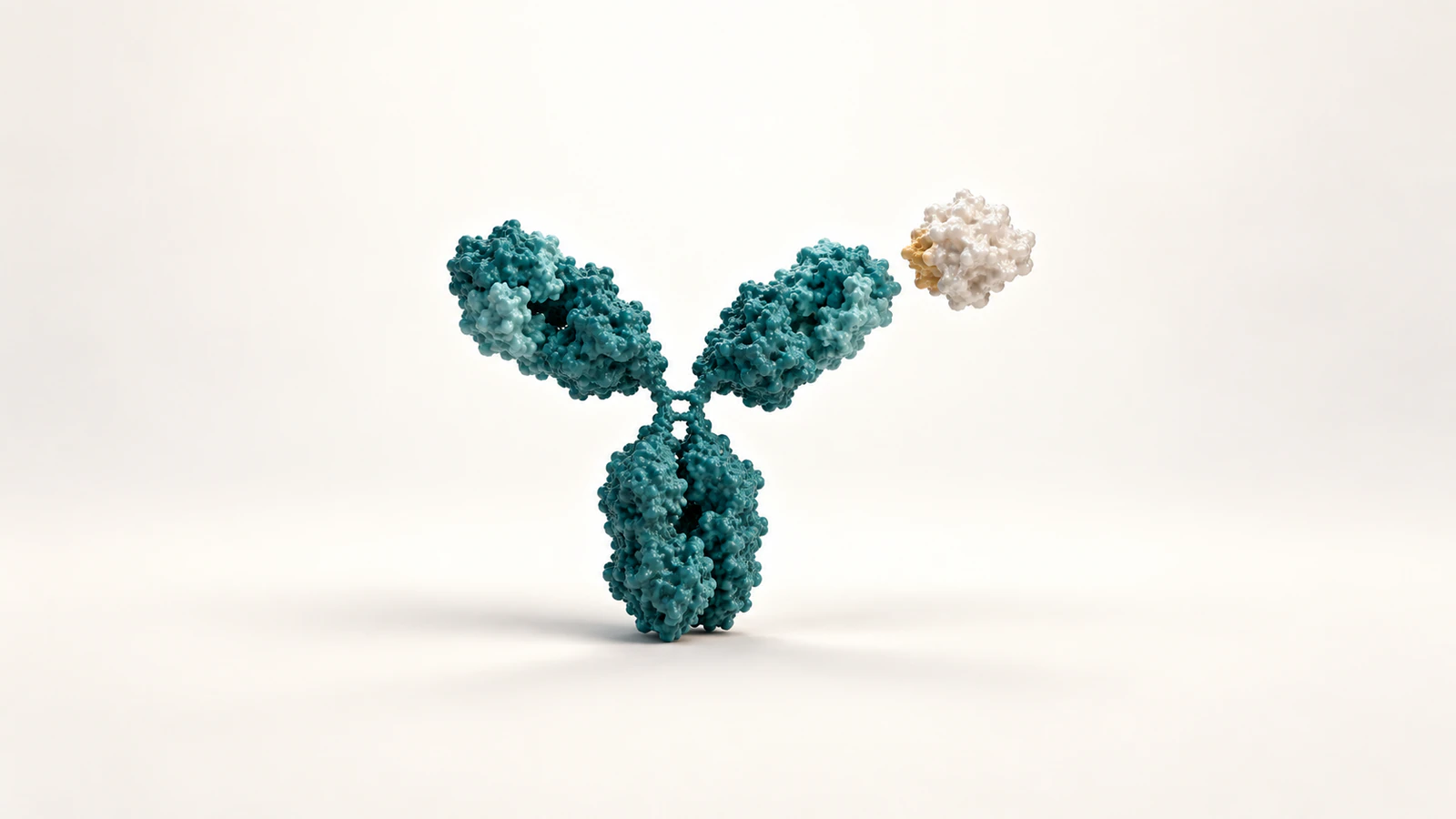
Good scientific animation prompts name the objects, describe one visible change and say what must remain unchanged. Add the camera, timing and visual treatment after those biological constraints. “Animate an antibody binding a protein” gives a useful starting event; “make an amazing molecular movie” leaves the important decisions unspecified.
In Animiotics, you can describe an idea to create an editable 3D animation and direct subsequent changes in words. This guide turns that starting description into a reviewable brief. It uses a hypothetical antibody encounter, with sample prompts you can adapt after checking your own science.
The examples are authored planning exercises, not benchmark results or promises that a prompt will succeed on its first attempt. An AI-generated scene still needs scientific review. The goal is to make the requested biology clear enough that you can identify an incorrect result and explain the correction.
Define the claim before the cast
Write a sentence completing this thought: after watching, the viewer should be able to identify what changed. For our example, the answer is that one arm of an antibody meets a particular region on a protein antigen. An antigen is a molecule recognized by an antibody; the region recognized is its epitope.
That teaching claim does not require a cell, a signaling cascade or a clinical outcome. Leave those out unless your actual question needs them. Asking for binding, receptor blockade, uptake and cell death in one short scene introduces several claims that require separate evidence.
Choose the audience too. A first-year student may need an establishing view of both objects. A structural biologist may instead need a specific experimentally supported interface. Those are different briefs, even when both contain the word antibody.
Specify which antibody you mean
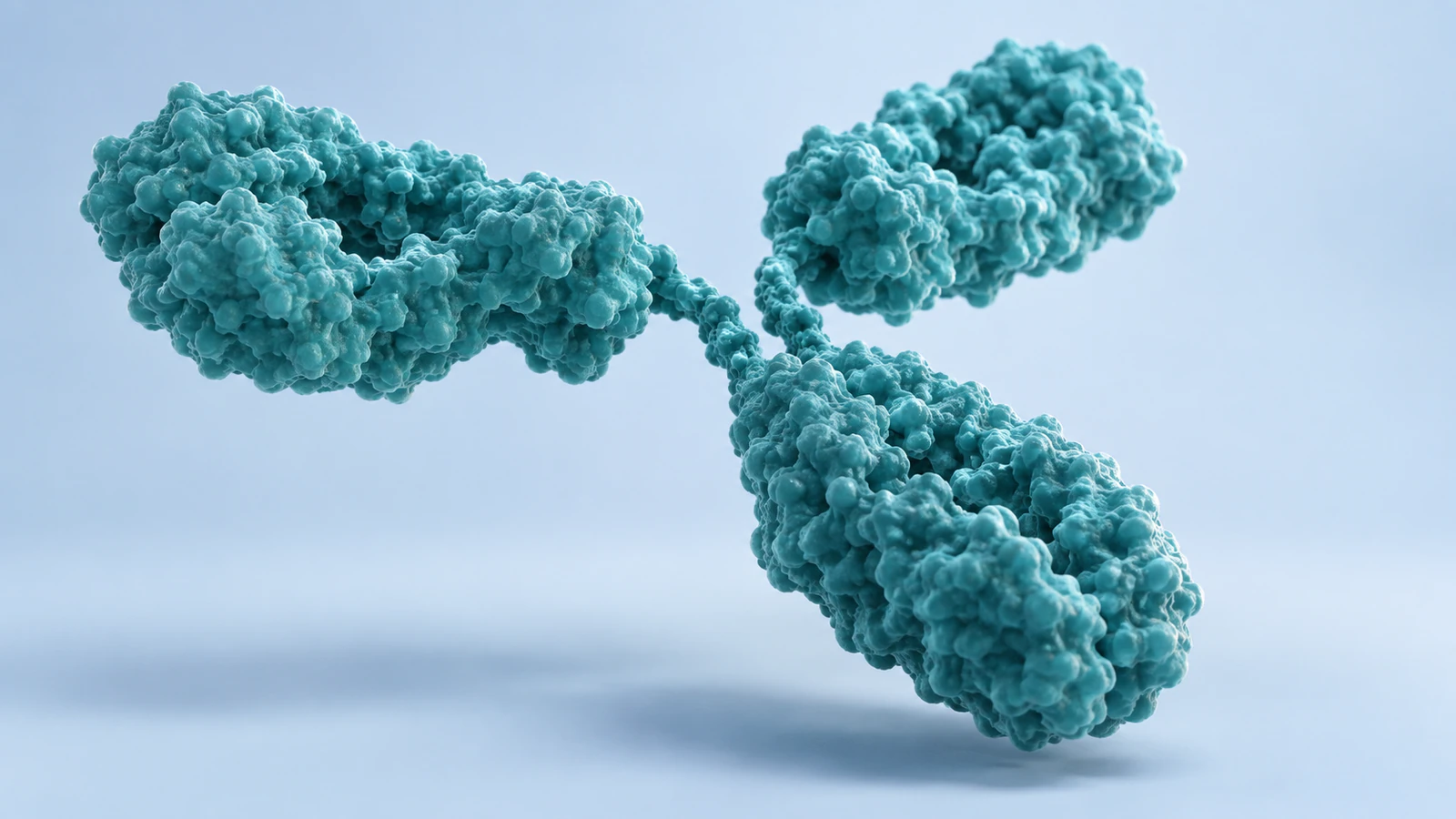
For this exercise, use an intact IgG-like antibody: two antigen-binding arms joined through a hinge region to a stem. The Fab regions are the antigen-binding portions; Fc names the other major region. The RCSB antibody overview explains this organization and shows why binding belongs at the arm tips rather than anywhere on the silhouette.
Keep the example deliberately limited to one arm contacting one small, soluble protein antigen. Do not describe every antibody as this shape, or imply that both arms must bind simultaneously. If you are showing an antibody fragment, a different antibody class or an engineered format, replace the cast description accordingly.
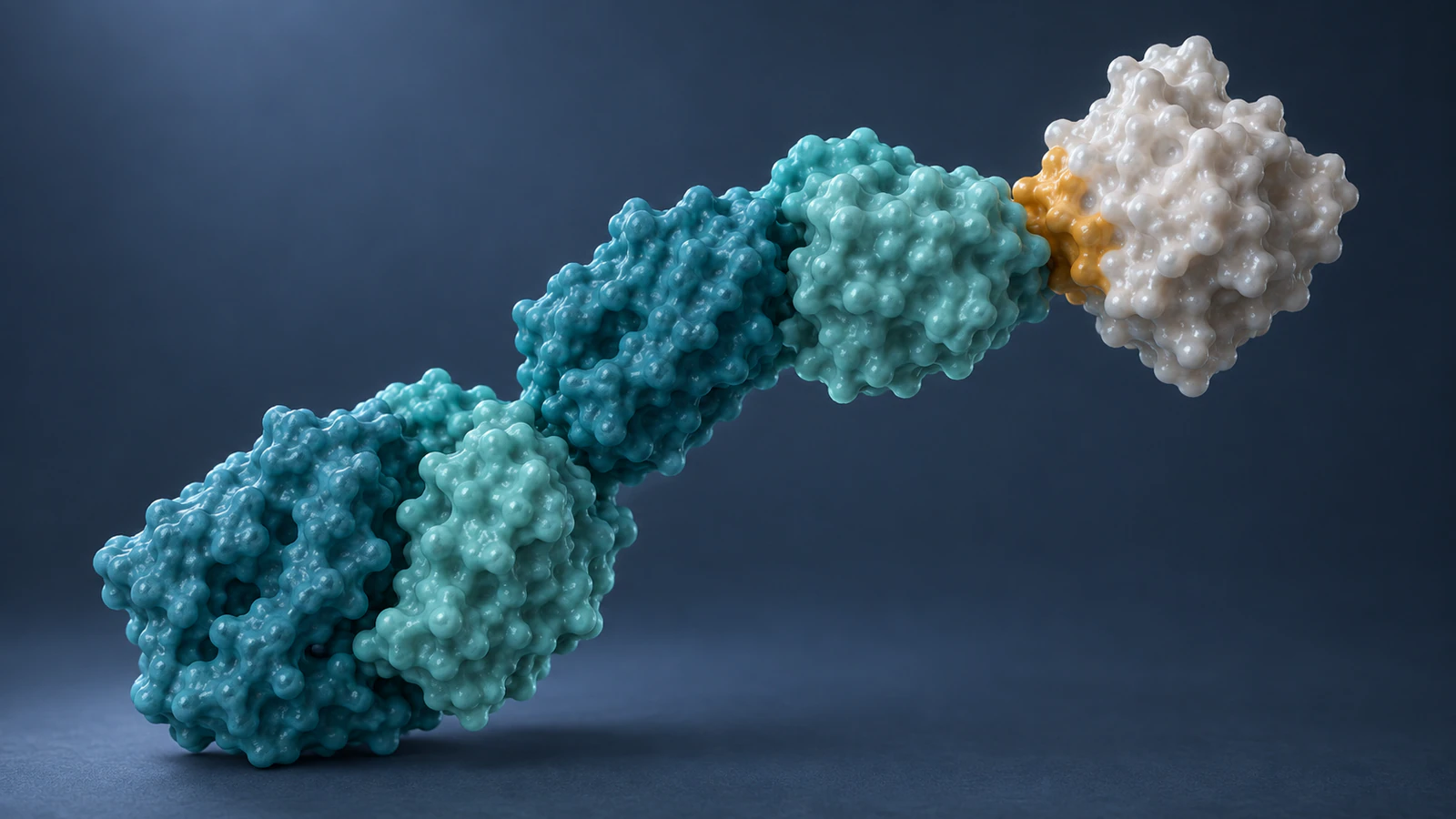
The illustrations here are conceptual CGI. Their shapes are not derived from a named coordinate file and they do not establish the exact interface of a real antibody. They illustrate decisions a prompt should make explicit: object identity, location of contact and the limits of the claim.
Use six prompt fields
Use the following six fields as a drafting worksheet, then combine them into plain language. This is an editorial framework for directing a scene, not a special command syntax or a required Animiotics form. Keep source notes beside the prompt so you can revise the brief without losing its evidence.
The invariant field deserves particular attention. An invariant is something that must stay the same while the animation changes: the number of objects, which tip contacts the target, or the identity of a chain. Naming these conditions gives you a concrete way to review both the opening and final frames.
| Field | Antibody example | Review question |
|---|---|---|
| Cast | One intact IgG-like antibody and one protein antigen | Are both objects identifiable? |
| Event | One Fab tip approaches an exposed epitope | Does the specified contact occur? |
| Invariants | Keep two arms, one stem and stable object colors | Did anything merge, vanish or change identity? |
| Evidence boundary | Conceptual encounter; no measured trajectory or efficacy claim | Does the scene imply more than the evidence? |
| Camera and timing | Fixed oblique view; hold the endpoint | Can a viewer inspect the contact? |
| Visual treatment | Teal antibody, pearl antigen, restrained lighting | Does styling help distinguish the cast? |
Rewrite a vague prompt
A vague version might read: “Make a cinematic antibody animation that shows how the drug works.” The problem is not the word cinematic. The brief fails to say which antibody, which target, what action should happen or where the explanation should stop. A model has to supply those missing decisions.
Try this conceptual starting prompt: “Create an educational 3D scene with one intact IgG-like antibody and one small soluble protein antigen. Show a slow illustrative approach of one Fab tip toward a single exposed epitope, ending in contact. Keep the second arm free and preserve the antibody’s two-arm, one-stem silhouette. Keep the camera fixed in an oblique view with both molecules visible. Use muted teal for the antibody and pearl for the antigen, with a small amber emphasis at the contact region. Hold the endpoint for inspection. Do not add receptor signaling, membrane crossing, internalization or therapeutic outcomes.”
The approach and hold are presentation choices, not measured molecular timing. Add that qualification to the accompanying explanation. If your real subject is a membrane-bound receptor, replace the soluble-antigen setup with a source-supported membrane arrangement rather than silently treating the two contexts as interchangeable.
Keep geometry and evidence separate
Choose the evidence level before requesting detailed molecular surfaces. A conceptual model can teach where an interaction occurs. A claim about a particular residue, interface or conformation needs suitable structural evidence and a model that actually corresponds to it. Adding the words “scientifically accurate” to a prompt cannot supply missing coordinates.
Experimental structures also require interpretation. The RCSB guide to structure determination explains how atomic models combine experimental observations with knowledge of molecular geometry. Keep the structure identifier, assembly choice and relevant limitations in your scene notes when using such data.
Predicted structures are a different evidence category. EMBL-EBI’s AlphaFold2 training explains that confidence measures help assess reliability within and between regions. Do not present an AI image, a structure prediction and an experimentally supported model as equivalent sources of geometry.
Plan the opening, change and endpoint
Before creating extra shots, decide what the viewer must be able to compare across time. The opening establishes the cast, the middle shows the change and the endpoint lets the viewer inspect the result. For the first draft, a fixed camera often makes this comparison easier to review than an orbit.
Here is a six-beat storyboard for the hypothetical encounter. The beats describe presentation tasks rather than biological time intervals. They can be combined into one continuous scene; they are not a claim that binding follows six discrete stages.
- Establish: show one antibody and one antigen separated, with the intended contact surfaces visible.
- Orient: make the selected Fab tip readable without hiding the second arm.
- Approach: move the antigen and selected tip toward the planned encounter, with no invented directed-search claim.
- Meet: stop at the intended surface contact, avoiding visible interpenetration.
- Inspect: hold the pose so the free arm, stem and antigen remain distinguishable.
- Explain: use the caption or narration to identify the conceptual simplification and the scientific question it illustrates.
Direct the scene in Animiotics
Use the event sentence as the starting point in Animiotics, then expand the cast and constraints where they help. The current homepage describes creating a complete editable 3D animation from an idea and making further changes in words. Keep requests tied to what you can inspect in the resulting scene rather than assuming that the tool has verified your mechanism.
The product documentation covers camera navigation, scene objects and animation controls. Once a draft exists, inspect the contact from another angle, then return to the intended presentation view. A persuasive camera angle can conceal overlap or a missing part; another view helps you spot that problem.
If a particular import, rendering option or account feature matters to your project, check its current availability before planning around it. The homepage currently allows joining without a card, while AI generation and exports require a paid plan. A useful first goal is one clearly explained encounter, not an elaborate sequence whose scientific assumptions remain unresolved.
Request a correction you can verify
Name the object, the defect and the required result. For a contact at the wrong end, try: “Move the antigen contact to the tip of the selected Fab arm. Keep the Fc stem separate from the antigen and keep the other arm free.” Check the revised geometry; the instruction is a request, not proof that the change happened.
For an unreadable shot, try: “Keep the molecules and their contact unchanged. Widen the view until the entire antibody and antigen fit inside the frame, with space around both.” This separates a camera correction from a molecular change. For a color swap, specify the persistent object names rather than saying left or right.
If the motion changes the identity or number of objects, return to the simplest opening and endpoint that preserve the cast. Do not cover the defect with blur, a fast cut or a dramatic light flash. The color continuity guide provides a more detailed way to keep identity readable across views.
Review motion as a scientific claim
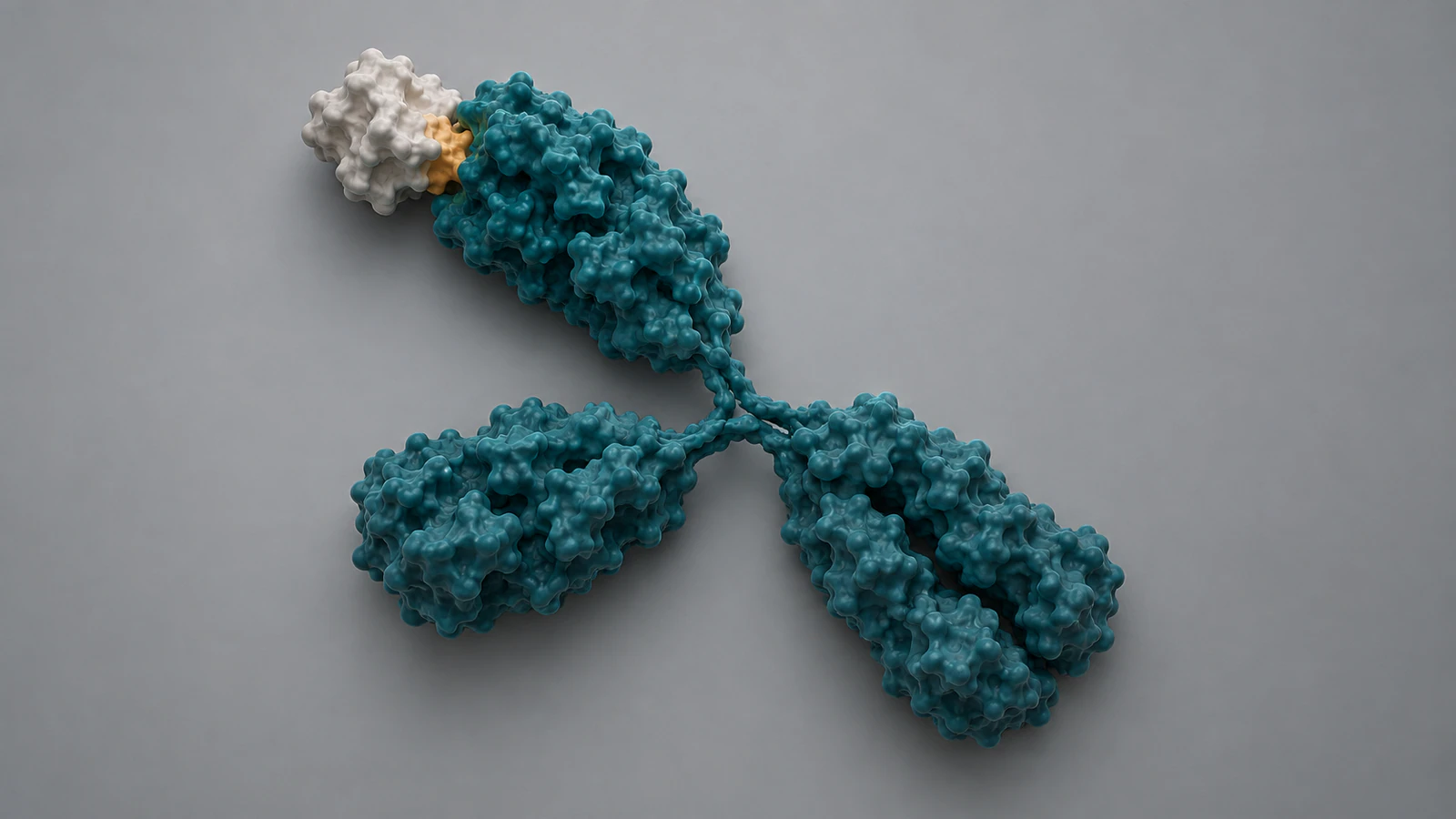
Pause before contact, at contact and at the final hold. Count the objects, trace their visible boundaries and check which regions meet. Then watch the sequence without narration. A caption cannot rescue a motion that visibly communicates a different event from the one you intended.
Keep camera movement distinct from molecular movement. If the camera circles a still complex, describe it as a change of viewpoint. If you author a smooth approach, describe it as illustrative motion unless you have suitable evidence for that path. Our protein morph versus simulation guide explains why a plausible transition is not automatically a simulated trajectory.
Finish by opening the actual exported result in its intended presentation context. Check whether the contact, silhouettes and explanatory caption remain readable at that size. Record the prompt, scientific sources and accepted simplifications with the approved version so another reviewer can understand what the scene claims.
FAQ
What should a scientific animation prompt include?
Specify the cast, one event, the conditions that stay unchanged, the evidence limits, the camera and the visual treatment. The six fields in this guide are a planning aid, not special software syntax.
Can AI-generated molecular animation be assumed accurate?
No. Compare the objects, connections, contact surfaces and motion against appropriate sources. Attractive lighting or detailed surfaces do not establish biological correctness.
Should I put a PDB identifier in the prompt?
Keep it in the scientific brief when a specific structure is relevant, but verify that the scene actually uses the intended data and assembly. Writing an identifier alone does not prove that generated geometry matches it.
How long should an animation prompt be?
Long enough to make the event and its important constraints unambiguous. Remove repeated style adjectives before removing object identities or biological limits; there is no universal word count that guarantees a better result.
Can I try Animiotics without a card?
The current homepage says you can join without a card. AI generation and exports require a paid plan, so check the current account options before planning a generation or export workflow.
Try one antibody encounter
Bring one verified biological question to Animiotics and turn it into a scene you can review. Start with the antibody and antigen, specify which region should meet and inspect the result before adding another event. Use the six prompt fields to make each revision more precise.