
Why Oligonucleotide Therapy Visualization Services Matter
Oligonucleotide therapy visualization services matter because RNA-targeted drugs often ask buyers to believe a precise sequence-level intervention before they can see the clinical value. Antisense oligonucleotides, splice-switching oligos, steric blockers, RNase H recruiting designs and conjugated delivery strategies all have different mechanism logic. A single flat pathway diagram usually makes them look interchangeable.
For biotech teams, that confusion has commercial cost. Platform companies need to show how chemistry, sequence design, tissue delivery and target engagement combine into a repeatable engine. Program teams need to show why a specific transcript, splice event or toxic RNA species is the right intervention point. BD teams need visuals that work for scientific diligence but still move quickly in an investor or partner meeting.
A strong visual system turns those claims into a staged story. It can show the oligonucleotide structure, the RNA target, the cellular compartment, delivery route and downstream effect as separate visual beats. That pacing helps audiences understand the core modality before they review assay data, patient selection or clinical strategy.
- Use oligonucleotide therapy animation when sequence design, RNA engagement or delivery drives the value story.
- Give each modality a distinct visual grammar instead of reusing one generic RNA diagram.
- Build still renders, short loops and full mechanism scenes from one approved 3D asset system.
Start With the Modality and Visual Claim

The first planning decision is not whether the image should show a helix, a cell or a delivery particle. It is which claim the buyer must understand first. An RNase H recruiting ASO needs a different sequence than a splice-switching oligo. A ligand-conjugated oligonucleotide needs delivery context before target engagement. A platform overview may need to compare chemistry modules, tissue tropism and transcript outcomes without overloading the viewer.
For an RNase H story, the visual can show the therapeutic strand pairing with a target RNA and creating a clear recognition state. For splice switching, the visual should focus on pre-mRNA processing and exon inclusion or exclusion rather than degradation. For steric blocking, the scene should show how access to a motif is physically changed. These differences help the audience avoid treating every oligo as a generic knockdown tool.
This discipline complements the approach in our article on siRNA therapeutic mechanism of action animation. siRNA stories often center on RISC loading and catalytic cleavage. Oligonucleotide therapy visualization services need a broader planning frame because ASO, splice-switching and conjugated designs can solve very different communication problems.
- Define whether the asset sells one program, one chemistry platform or a broader RNA medicine capability.
- Separate degradation, splice modulation and steric blocking into distinct visual beats.
- Avoid implying siRNA-like RISC activity when the therapy uses another oligonucleotide mechanism.
Translate ASO Mechanisms Into Buyer-Ready Scenes
Antisense oligonucleotide animation works best when it avoids molecular clutter. The viewer needs to understand target recognition, binding orientation and the outcome of that binding. They do not need every atom of the backbone in a commercial explainer unless the chemistry itself is the central claim. Clean surfaces, bead-based strands and restrained highlights can make the mechanism credible while keeping the scene readable.
A useful ASO scene starts with an accessible RNA target. The therapeutic strand approaches, pairs with the target and creates a stable duplex or blocking state. The downstream event then appears only after the binding logic is clear. For RNase H recruitment, the next beat can show a simplified enzyme presence and target RNA reduction. For splice modulation, the next beat should show transcript processing or exon choice in a clean nucleus-like context.
This sequencing makes the asset more useful in sales and diligence. A buyer can ask whether the target is nuclear or cytoplasmic, whether the oligo recruits RNase H, whether chemistry supports potency or whether delivery is the risk. The visual gives the discussion a shared mental model rather than forcing every stakeholder to interpret dense sequence, assay and biodistribution slides from scratch.
- Show RNA target engagement before showing downstream activity.
- Use simplified strand geometry when the audience does not need atomic chemistry.
- Keep mechanism claims visually conservative so the asset supports scientific review.
| Modality | Primary Visual Beat | Common Communication Risk |
|---|---|---|
| RNase H ASO | Therapeutic strand pairs with target RNA before target reduction is shown. | The animation jumps to knockdown before explaining recognition. |
| Splice switching oligo | A short strand changes access to a pre-mRNA processing region. | The scene looks like generic degradation rather than splice modulation. |
| Steric blocker | The oligo physically protects or blocks a functional RNA motif. | The visual implies enzyme recruitment when none is intended. |
| Conjugated oligo | A delivery ligand or particle guides the oligo toward the relevant tissue. | The asset ignores the delivery story that buyers care about most. |
Make Delivery and Tissue Uptake Understandable
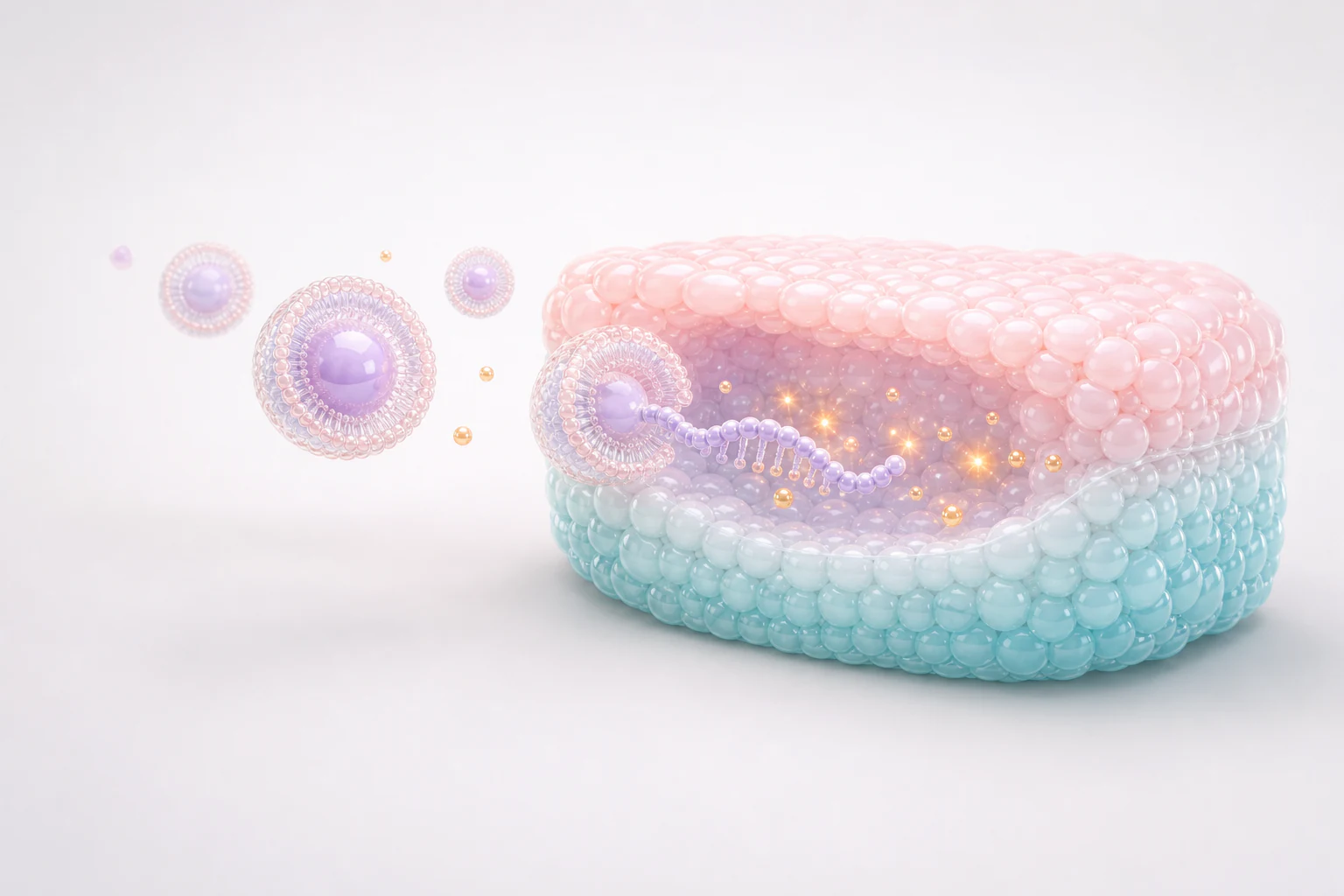
Delivery is often the hardest part of an oligonucleotide story to explain visually because it spans chemistry, formulation, tissue access, cell uptake and intracellular release. If all of that appears in one crowded diagram, the viewer may remember the particles but miss the decision point. Oligonucleotide delivery animation should show the route and constraint that matter most for the program.
For liver-directed therapies, a clean receptor or ligand-conjugation visual may be enough. For local delivery, the asset may need tissue context, dosing route and cell type. For CNS or muscle programs, biodistribution and compartment access may deserve their own scene before any RNA engagement appears. The goal is not to simulate pharmacokinetics. The goal is to make the delivery assumption visible enough for a buyer to evaluate.
This is related to cell therapy visualization services because both fields require scale transitions. The audience moves from product format to tissue context to cell-level mechanism. A polished animation can make those transitions feel natural instead of forcing the viewer to jump between unrelated slide styles.
- Give delivery its own beat when tissue access is a central risk or differentiator.
- Show uptake and release before target engagement when formulation is part of the value story.
- Use restrained particles and tissue forms so the scene stays scientific rather than decorative.
Build a Platform Asset System Instead of One-Off Graphics

Many oligonucleotide companies are not selling a single molecule. They are selling a platform that can nominate sequences, tune chemistry, improve delivery and expand across targets. One-off graphics rarely support that story because each program starts with a different visual language. A reusable asset system solves this problem by giving every program a shared set of materials, modules and motion rules.
The asset system can include strand modules, tissue modules, delivery modules, nuclear scenes, target RNA states and downstream evidence scenes. Each module can be reused in investor decks, BD materials, website sections, conference loops and scientific presentations. When a new program enters the pipeline, the team updates sequence identity, tissue context or mechanism emphasis without rebuilding the entire communication stack.
This matters when platform teams need to connect discovery workflow to therapeutic impact. A visual system can show how sequence design feeds chemistry selection, how chemistry changes biodistribution, how delivery reaches tissue and how target engagement becomes measurable biological activity. The story becomes cumulative instead of fragmented across slides made at different times by different vendors.
- Create shared visual identities for therapeutic strands, target RNA, delivery particles and tissue contexts.
- Design still images and animation scenes from the same 3D source assets.
- Keep program updates modular so the platform story can evolve without visual drift.
Connect Mechanism Visuals to Evidence
A commercial oligonucleotide visual should not stop at a beautiful strand. The buyer eventually needs to connect mechanism to evidence: target engagement, transcript correction, knockdown, protein rescue, biomarker change or tissue-level response. The visual sequence should make that handoff deliberate. Otherwise the animation feels like a scientific intro that never reaches the reason to believe.
A practical storyboard can pair each mechanism beat with an evidence beat. Delivery is followed by uptake evidence. RNA binding is followed by target engagement or transcript change. Splice switching is followed by exon outcome or restored protein context. Platform breadth is followed by a repeatable module set across programs. These pairings help the asset support both narrative and diligence.
For biotech teams preparing a financing, partnership or launch campaign, this evidence handoff is often where Animiotics adds the most value. We can help translate raw assay outputs into visual scenes that respect the data while still making the story legible. The result is not a generic science video. It is a buyer-facing explanation of why the platform can create value.
- Pair each mechanism scene with the evidence it prepares the audience to understand.
- Avoid visual claims that are stronger than the data package can support.
- Plan figure exports, deck stills and short loops while the storyboard is still flexible.
| Storyboard Beat | Evidence Handoff | Best Deliverable |
|---|---|---|
| Delivery route | Tissue exposure or uptake data becomes easier to interpret. | Investor deck figure |
| Target RNA engagement | Transcript or target engagement assays have a clear visual anchor. | Mechanism animation scene |
| Splice modulation | Exon inclusion or exclusion data connects to a visible mechanism. | Scientific presentation graphic |
| Platform reuse | Pipeline breadth feels coherent across multiple programs. | Website and BD visual system |
Review Scientific Accuracy Before Production Locks

Oligonucleotide therapy visualization services should include scientific review before the asset becomes expensive to change. The review should cover more than terminology. Reviewers should check whether the image implies the wrong compartment, wrong enzyme, wrong therapeutic class, wrong delivery route or unsupported strength of effect. A visual can make an accidental claim even when the script is careful.
Subject matter experts should review the storyboard, early stills and motion blocking. Regulatory or medical reviewers should check captions, voiceover and scene order if the asset will support external communication. BD and investor-facing teams should confirm that the visuals answer buyer questions quickly. If the asset only satisfies the internal science team but fails the business audience, it will not do its job.
The safest review process separates concept approval from render polish. First approve the mechanism logic in low-detail frames. Then approve the visual identity. Only then invest in final lighting, material refinement and animation timing. This keeps the project efficient and reduces the chance that a beautiful final render must be rebuilt because the mechanism was staged incorrectly.
- Review implied mechanism claims inside the image, not only written copy.
- Approve storyboard logic before investing in final render polish.
- Use captions and alt text that describe the mechanism without overstating certainty.
FAQ About Oligonucleotide Therapy Visualization Services
What should an oligonucleotide therapy animation show first?
Start with the communication claim. If delivery is the main barrier, show the route and uptake first. If the mechanism is the differentiator, show target RNA engagement first. If the platform is the value story, show reusable modules before individual program detail.
How is ASO visualization different from siRNA visualization?
ASO visuals may need to show RNase H recruitment, splice switching, steric blocking or tissue-conjugated delivery. siRNA visuals often focus on RISC loading and target RNA cleavage. The two stories can share RNA design language but should not imply the same mechanism.
Can oligonucleotide visuals include detailed chemistry?
Yes, but only when chemistry is essential for the audience. Many buyer-facing assets work better with simplified strand forms, clear compartments and evidence-linked scenes. More detailed chemistry can appear in technical figures or scientific review materials.
What deliverables are useful beyond a full video?
Still renders, website figures, pitch deck images, looping conference clips, storyboard frames and modular 3D assets are all useful. Planning them together keeps the platform story consistent across commercial and scientific channels.
- Use one visual system for ASO, splice-switching and delivery scenes.
- Keep mechanism captions specific to the oligonucleotide class being shown.
- Build reusable modules when the pipeline may expand across tissues or transcript targets.
Ready to Plan Oligonucleotide Therapy Visuals
Oligonucleotide therapy visualization services are most valuable when they turn sequence-level biology, delivery strategy and platform logic into assets that scientific, investor and partner audiences can follow. The strongest work explains one claim at a time, then connects the mechanism to evidence and commercial value.
Animiotics can help RNA medicine teams turn ASO mechanisms, splice-switching logic, delivery constraints and platform workflows into clean 3D figures, still renders and animation-ready scenes. The result is a visual system that supports BD outreach, investor updates, web explainers, conference campaigns and scientific review without rebuilding the story for every audience.
- Use this workflow when your team needs a mechanism video, figure set or reusable platform asset system.
- Bring sequence strategy, chemistry, delivery route, target biology and review constraints into the storyboard phase.
- Build visuals around buyer understanding rather than visual spectacle.