
Why Molecular Glue Degrader Animation Services Matter

Molecular glue degrader animation services matter because induced proximity is powerful but easy to misunderstand. A molecular glue may not look like a classic inhibitor, antibody or catalytic degrader. The central claim is that a small molecule can reshape a protein interface, recruit an E3 ligase, stabilize a new interaction and route a target toward ubiquitin-mediated degradation. That is a compact scientific idea with many moving parts.
For biotech teams, the communication problem is commercial as much as technical. A platform company may need to show why its screening strategy discovers new glueable targets. A medicinal chemistry team may need to explain selectivity through a neomorphic surface. A BD team may need to show why the program is different from a PROTAC or a conventional occupancy-driven inhibitor. Static pathway diagrams often flatten those distinctions.
A strong animation gives the audience a mental model before it asks them to absorb data. It can show the target protein, the E3 ligase, the small molecule glue, interface stabilization, ubiquitin tagging and proteasomal routing as separate beats. That sequencing helps investors, partners, scientific advisors and conference audiences understand the platform logic before they evaluate the full evidence package.
- Use animation when induced proximity, recruitment or degradation timing drives the value story.
- Keep the target, E3 ligase, glue molecule and ubiquitin signal visually distinct.
- Build still renders and motion scenes from one approved 3D asset system.
Start With the Induced Proximity Claim
The first planning question is not what looks exciting. It is what the molecular glue story must prove. Some programs need to explain recruitment of a target to cereblon or another E3 ligase. Others need to explain why a small molecule creates a new binding surface, why selectivity is possible or why degradation is expected when inhibition is not enough. These are different visual claims.
If the claim is induced proximity, the first scene should show two proteins that do not naturally form a stable complex. The molecular glue then appears as a small glossy object that changes the contact geometry and stabilizes a new interface. The viewer should see proximity before ubiquitin appears. When ubiquitin dots arrive too early, the animation skips the most important reasoning step.
This discipline is related to PROTAC mechanism of action animation, but molecular glues need their own visual language. A PROTAC usually invites a bridging metaphor. A molecular glue often needs a surface-remodeling metaphor. The visual should not imply a long linker if the program depends on a compact molecule that stabilizes a protein-protein interaction.
- Define whether the asset sells a molecule, a discovery platform, a target class or a degrader modality.
- Show proximity and interface stabilization before showing downstream degradation.
- Avoid PROTAC-like bridge visuals when the molecule is better explained as a compact glue.
Translate Ternary Complex Formation Into Visual Beats
Ternary complex formation is often the scene that determines whether the animation feels credible. The target and ligase need stable identities. The molecular glue should be small enough to feel like a drug-like compound but visually important enough for the audience to track it. The new interface should feel specific rather than magical. Good staging can make this clear without adding labels or dense molecular surface detail.
A useful sequence starts with separation. The target protein and E3 ligase sit apart inside a clean cellular or biochemical context. The glue molecule enters the scene and binds one partner or settles into the interface. The proteins move closer only after the molecule changes the interface logic. A restrained glow or contact highlight can show stabilization without implying energy release that the biology does not support.
For teams building investor decks or partner materials, this sequence is often more valuable than a full pathway montage. One strong ternary-complex scene can become a website figure, conference loop, BD slide, scientific poster graphic or short social clip. When the asset is modeled as a reusable 3D system, the team can update the target, ligase identity or glue chemistry without starting over.
- Stage target and ligase separation before showing molecule-driven contact.
- Use surface proximity and particle placement to suggest specificity.
- Keep interface highlights subtle so the scene feels scientific rather than theatrical.
Show Ubiquitin Signaling Without Overloading the Viewer
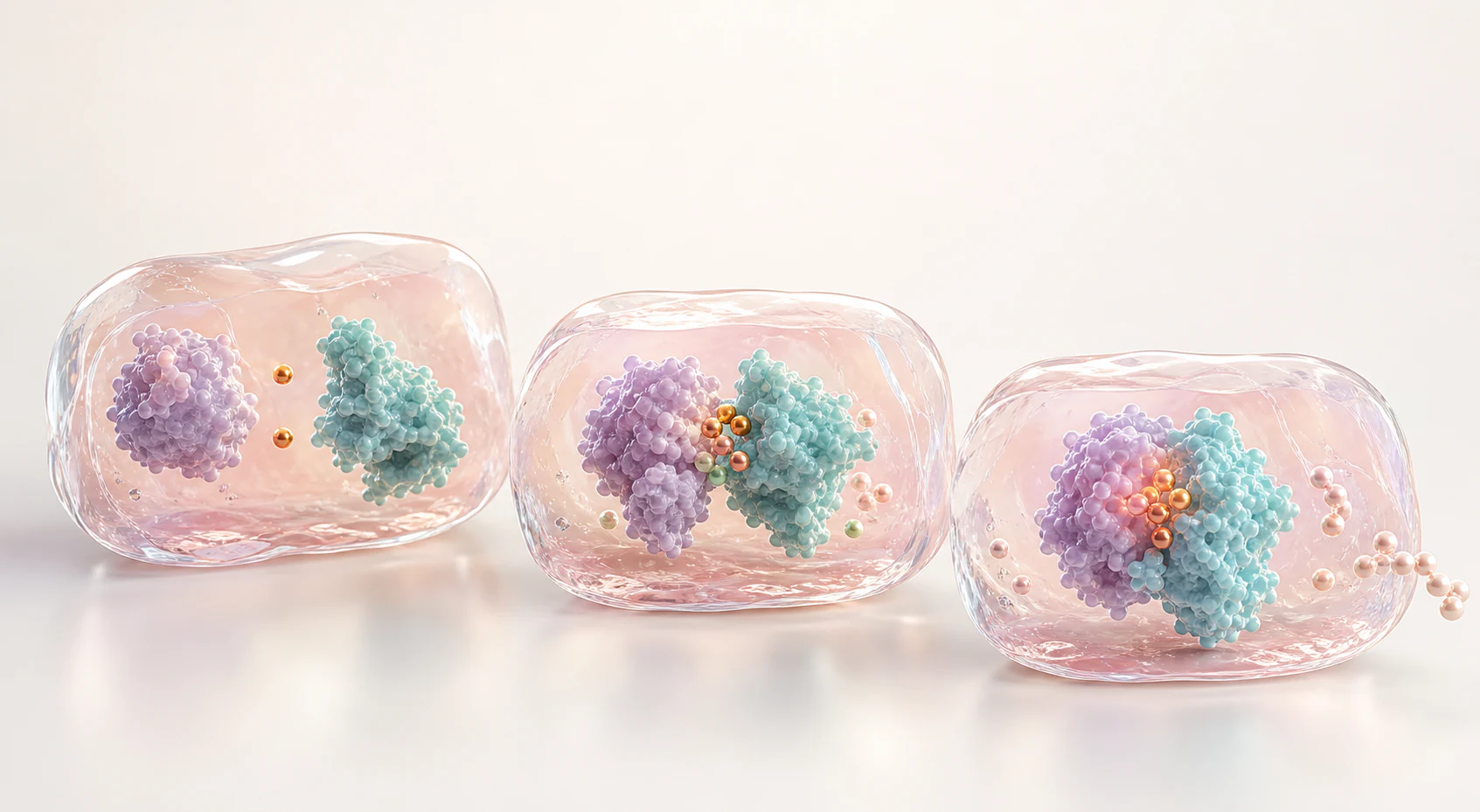
Ubiquitin signaling can easily turn into a cloud of beads if the animation does not control scale and timing. The viewer needs to understand that recruitment creates an opportunity for ubiquitination. They do not need every enzyme, intermediate and chain topology in a buyer-facing explainer. The goal is to show why the target is marked for degradation after the new complex forms.
A clear animation treats ubiquitin as a downstream signal. After the target and E3 ligase are stabilized, small repeated markers can appear on or near the target. The proteasome can be implied with a simple downstream destination in a longer video or omitted in a short website loop. The key is that the audience sees cause and effect: glue-stabilized proximity enables target marking, which supports degradation.
The same production thinking applies to mechanism of action animation services. The animation should make one claim at a time. If a scene tries to explain discovery screening, ternary complexes, ubiquitination, resistance and clinical differentiation all at once, even a beautiful render becomes hard to remember.
- Introduce ubiquitin only after the ternary complex is visually established.
- Use repeated small markers for tagging rather than a crowded pathway diagram.
- Reserve detailed chain architecture for technical versions that need it.
| Communication Goal | Visual Approach | Why It Works |
|---|---|---|
| Induced proximity | Two proteins move from separation to contact after a small molecule enters the interface. | The audience sees the core modality before downstream effects. |
| Ternary complex specificity | The new interface uses stable shapes, colors and a restrained contact highlight. | The scene explains selectivity without fake labels. |
| Ubiquitin marking | Small repeated beads appear only after the complex is formed. | The viewer understands cause and effect. |
| Platform extensibility | Target, ligase and glue modules are reused across program examples. | The company can present a coherent platform story. |
Connect Structure Biology Screening and Platform Value

Molecular glue companies often need to explain a platform, not only one program. The visuals may need to connect screening libraries, structural biology, proteomics, target engagement and degradation readouts. That is too much for one scene. The better approach is a modular asset system where each capability has a visual role and the final story shows how those capabilities combine.
For example, a discovery story can begin with a simple library-to-hit visual, move into a ternary-complex render, then close with degradation evidence and platform expansion. The same target and ligase assets can be used across those scenes. A platform team can then reuse the visuals in pitch decks, website pages, technical explainers and conference booth loops without changing the core identity of the science.
This is where commercial usefulness matters. A beautiful molecular surface is not enough if it does not help a buyer understand what the company can do. Molecular glue degrader animation services should translate platform strengths into visible assets: glueable surface discovery, ligase selection, target class expansion, selectivity rationale and assay-backed degradation.
- Separate discovery workflow visuals from mechanism visuals.
- Use one consistent material system for targets, ligases, glue molecules and ubiquitin markers.
- Design assets for decks, web, conferences and investor updates at the same time.
Storyboard the Animation Before Production
A precise storyboard prevents molecular glue animation from becoming a generic protein movie. The storyboard should define the audience, the decision they need to make and the scientific claim in each scene. A partner evaluating a collaboration may need platform breadth and assay logic. An investor may need to understand why the modality is differentiated. A scientific advisory board may need more detail on target engagement and complex formation.
A typical buyer-facing sequence might open with an undruggable or hard-to-inhibit target, introduce the E3 ligase, show the molecular glue stabilizing a new interface, add ubiquitin markers after the complex forms and close with degradation or platform reuse. Each scene should have one job. When one scene tries to do the work of the whole video, the viewer loses the mechanism.
Review needs to happen early. Subject matter experts should check whether the visual implies direct inhibition, irreversible binding, PROTAC-like bridging or degradation strength beyond the data. Regulatory and BD teams should also review captions and voiceover language. The image itself can imply claims even when the script is careful.
- Write one claim per scene before production starts.
- Review implied mechanism claims in the image, not only the script.
- Plan still renders, short loops and a full mechanism video from the same storyboard.
| Scene | Visual | Motion | Purpose |
|---|---|---|---|
| Unbound state | Target and ligase sit apart in a calm cellular context. | Slow camera reveal | Establish the starting biology. |
| Glue arrival | A compact molecule enters the interface region. | Gentle directional movement | Show that the small molecule drives the story. |
| Complex formation | Proteins settle into contact around the glue. | Controlled closing motion | Explain induced proximity clearly. |
| Ubiquitin marking | Small repeated markers appear near the target. | Soft sequential appearance | Connect recruitment to degradation signaling. |
| Platform reuse | Target, ligase and glue modules separate into a clean asset system. | Camera pulls back | Position the company as a platform. |
FAQ About Molecular Glue Degrader Animation Services
What should a molecular glue animation show first?
Start with the induced proximity claim. The viewer should see that the target and ligase are separate, then understand how a compact molecule stabilizes a new interaction before ubiquitin signaling appears.
How is a molecular glue animation different from a PROTAC animation?
A PROTAC often uses a visible linker or bridge between two proteins. A molecular glue animation should usually focus on surface remodeling, interface stabilization and compact molecule-driven recruitment rather than a long tether.
Can the animation include atomic detail?
It can, but only when the audience and data support that level of specificity. Many commercial assets work better with simplified 3D surfaces that make the mechanism clear while leaving detailed residues, distances and structures for technical figures.
What deliverables are useful beyond the final video?
Still renders, slide figures, looping web clips, conference visuals, investor deck scenes and modular 3D assets are all useful. Planning those deliverables together keeps the platform story coherent.
- Use one visual system for high-level and technical versions.
- Keep captions precise about what the visual claims.
- Build reusable assets when the platform may expand across targets or ligases.
Ready to Plan a Molecular Glue Degrader Animation
Molecular glue degrader animation services are most valuable when they turn a specialized targeted protein degradation strategy into a story that scientific, investor and partner audiences can follow quickly. The strongest assets explain induced proximity first, then ternary complex formation, ubiquitin signaling and platform value in a controlled sequence.
Animiotics can help teams turn structural biology, degrader chemistry, screening logic and platform positioning into clean 3D figures, still renders and animation-ready scenes. The result is a visual system that supports BD decks, investor updates, web explainers, conference campaigns and scientific review without rebuilding the story for every use case.
- Use this workflow when your team needs a mechanism video, figure set or platform visual system.
- Bring the target, ligase, glue chemistry, assay evidence and review constraints into the storyboard phase.
- Build the visuals around buyer understanding rather than visual spectacle.