Antibody Engineering Visualization Services for Biologics Teams
Antibody engineering visualization services turn a complex biologics story into a clear visual system that business development teams, discovery scientists and translational leaders can all use. The problem is rarely a lack of data. Most antibody programs already have binding curves, sequence changes, developability assays, format decisions and target biology scattered across slide decks. The harder problem is showing why those details matter as one coherent product story.
For therapeutic antibody companies, a strong visual narrative has to connect molecule design to biological consequence. Affinity maturation is not just a tighter binding number. Fc engineering is not just a sequence note. Developability screening is not just a manufacturing checklist. Each choice affects target engagement, tissue behavior, immune function, dosing logic, risk reduction and platform credibility.
Animiotics builds antibody visuals for teams that need more than a decorative molecule render. The goal is to make the engineering logic visible, so partners and clients can understand what changed, why it matters and how the platform can repeat the result across programs.
Why Antibody Engineering Stories Are Hard to Explain
Antibody programs often move through several layers of abstraction before anyone outside the technical team sees the story. A discovery group may focus on epitope mapping, affinity, specificity and cross-reactivity. A protein engineering group may focus on Fc mutations, half-life extension, effector function tuning, aggregation risk and expression. A clinical or partnering audience wants to know how those choices improve therapeutic index, patient relevance and competitive positioning.
That creates a communication gap. Standard structure views can show the Y-shaped antibody, but they often fail to show the decision logic behind the program. A flat pathway figure can show target biology, but it may not show how the engineered molecule behaves. A data slide can show assay results, but it may not explain why those assays answer investor or pharma diligence questions.
A useful antibody engineering visual bridges those levels. It shows molecule architecture, target context, functional consequence and development risk in a single visual language. Related Animiotics posts on bispecific antibody mechanism animation and antibody drug conjugate mechanism animation show how the same principle applies when antibody formats become even more specialized.
What to Visualize First in an Antibody Platform

The best starting point is not always the most beautiful molecular scene. It is the claim that needs to survive scrutiny. For some companies, the central claim is improved affinity without losing specificity. For others, it is Fc tuning that changes immune recruitment, half-life or receptor interaction. For many biologics platforms, the story is about selecting candidates that bind well and still behave like manufacturable drugs.
A visual strategy should begin with a short hierarchy of decisions. What is the target? Which regions of the antibody were engineered? Which functional property changed? Which evidence supports the change? Which audience needs to act on that evidence? Once those answers are clear, the visuals can be scoped as a repeatable system instead of one isolated hero graphic.
This approach is especially valuable for platform companies. A platform visual should show the reusable logic behind a pipeline, not only one asset. If the company can design binders, tune Fc behavior and screen developability across multiple targets, the visuals should make that repeatability obvious without turning the figure into a crowded process diagram.
- Show binding specificity as spatial context, not just an affinity number.
- Show Fc engineering as a functional module tied to immune or pharmacokinetic outcome.
- Show developability as risk reduction across stability, aggregation, expression and formulation.
- Show platform reuse as a modular asset system that can support future programs.
Affinity, Epitope and Specificity Visualization
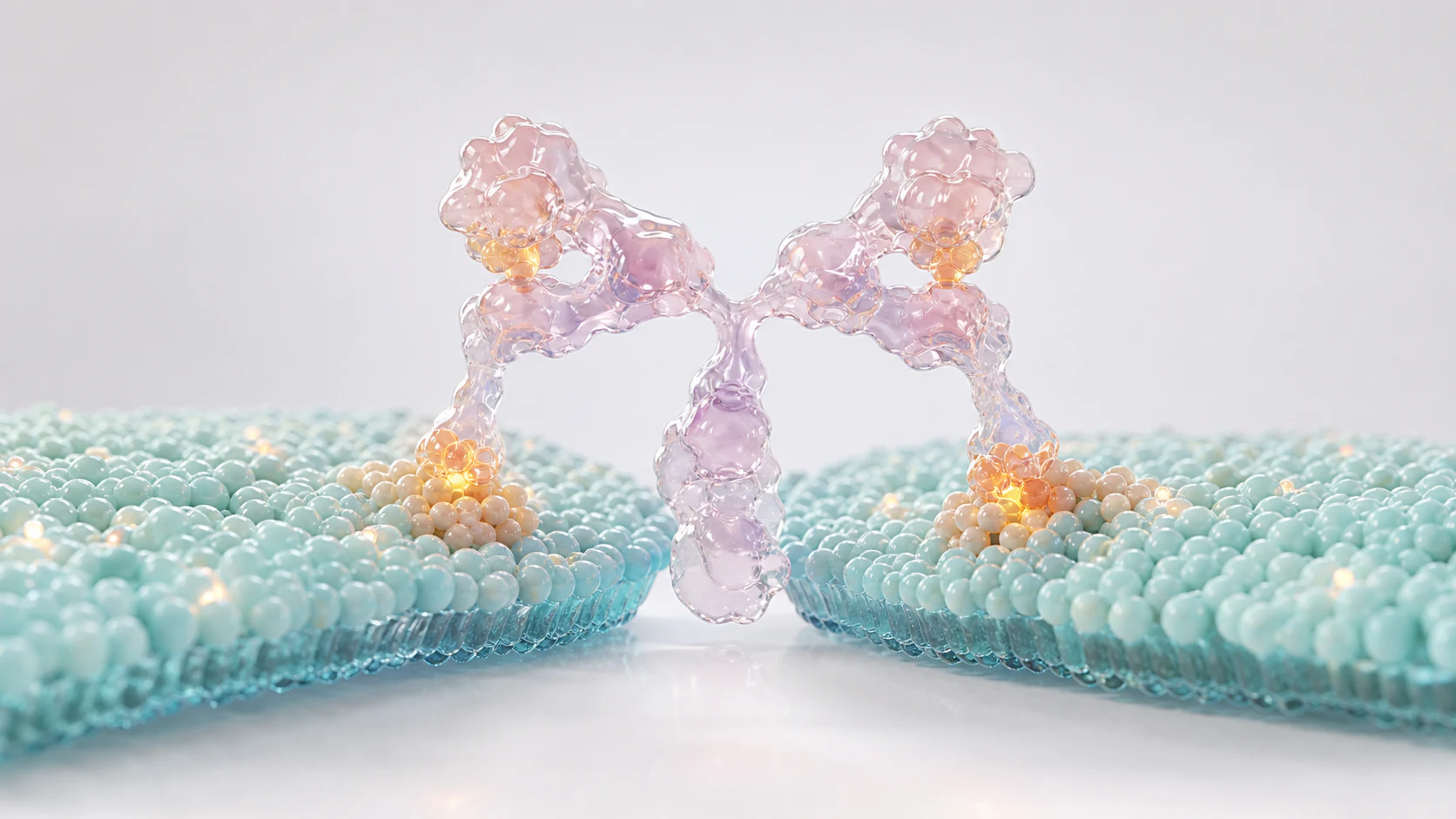
Affinity optimization is easy to overstate visually. A glowing contact point can look persuasive, but it only helps if the audience understands what changed and why the change matters. Strong affinity visuals show the antibody and target as a relationship: binding arm geometry, epitope access, receptor density, steric constraints and off-target avoidance all influence the story.
For early discovery teams, the most useful figure may compare a parental binder and an optimized candidate in the same visual frame. For partnering or investor use, the stronger asset may be a short animation that starts with a target in tissue context, introduces the engineered antibody and then shows improved engagement as a biological outcome rather than a floating number.
The visual should stay disciplined. Avoid pretending that a render proves a binding mode if the structure is unknown. If the team has structure data, use it carefully. If the team has assay evidence but not a solved complex, use an abstract binding scene that communicates the concept without implying false structural certainty.
Fc Engineering, Effector Function and Half-Life Scenes
Fc engineering deserves its own visual treatment because the Fc region often carries a different message than the antigen binding arms. One part of the molecule explains target recognition. Another part may explain immune recruitment, complement activity, receptor interaction, half-life extension or intentional silencing. If these ideas are forced into one small molecule diagram, the result usually becomes hard to read.
An effective Fc engineering animation can isolate the stem region, show its relationship to Fc receptors or neonatal Fc receptor biology and then return to the whole antibody so viewers understand the molecule as a complete therapeutic. That sequence helps audiences understand why a small engineering change can influence duration, potency or safety profile.
This is also where visual restraint matters. Fc receptor scenes should not look like generic immune system clip art. They should feel connected to the actual therapeutic question: enhance effector function, reduce unwanted activation, extend circulation or support a differentiated format.
| Engineering focus | Visual question | Commercial value |
|---|---|---|
| Affinity maturation | Where does the molecule engage the target and how does engagement improve? | Clarifies why the optimized candidate deserves attention. |
| Fc function | Which immune or pharmacokinetic behavior is being tuned? | Connects sequence choices to functional differentiation. |
| Developability | Which candidate risks have been reduced before scale-up? | Builds confidence in manufacturability and program readiness. |
| Platform reuse | How can the same design logic support the next target? | Shows pipeline leverage beyond one antibody asset. |
Developability Figures for Candidate Selection
Developability is one of the highest value topics to visualize because it connects science to business risk. A candidate that binds beautifully but aggregates, expresses poorly or creates formulation concerns may be weak as a product. For that reason, antibody developability figures should not feel like an afterthought at the end of a deck.
The visual challenge is that developability is multidimensional. Stability, solubility, aggregation propensity, viscosity, expression yield, post-translational heterogeneity and immunogenicity risk can all matter. A single render cannot prove those properties, but a clear visual framework can show how the team screens candidates before committing resources.
A useful developability visual often works as a candidate triage scene. Antibody variants enter as a set. Each candidate is evaluated across practical product constraints. The final molecule emerges as a cleaner decision, not as magic. This helps discovery, CMC and partnering teams stay aligned on why the selected molecule is more than a strong binder.
- Use visual tiers to separate binding performance from product behavior.
- Reserve detailed assay values for tables or adjacent slides.
- Keep the figure focused on decision confidence, not every laboratory step.
- Use consistent molecule colors so candidates remain identifiable across assets.
How Animiotics Builds Antibody Visual Assets

A production workflow for antibody visuals should start with technical alignment. Animiotics reviews the molecule format, target biology, engineering claims, available data and intended audience before designing the visual system. This prevents a common failure mode: building an attractive animation that does not answer the buyer, partner or reviewer question.
The next step is story architecture. We define the core scenes: molecule architecture, target engagement, Fc behavior, developability decision logic and platform reuse. Then we decide which scenes should become still figures, which should become motion sequences and which should stay as supporting slide graphics.
The final output can support websites, investor decks, partnering meetings, conference screens and scientific explainers. The same system can also extend into related topics such as protein-ligand interaction visualization or drug discovery animation services, which helps teams keep a consistent brand language across the full pipeline story.
FAQ About Antibody Engineering Visualization Services
What should an antibody engineering animation include?
It should include the molecule format, target context, engineered regions, functional outcome and the evidence hierarchy behind the claim. The exact scenes depend on whether the program is focused on affinity, Fc function, developability, tissue targeting or platform reuse.
Do antibody visuals need solved structures?
Solved structures help when they are available, but they are not always required. If a precise complex is not available, a responsible visual can use abstract molecular scenes that communicate engineering logic without implying unsupported structural detail.
Are these visuals useful before clinical data?
Yes. Preclinical and platform-stage companies often need visuals to explain why a candidate was selected, how the engineering strategy works and what future programs can inherit from the platform. The visual should be clear about what is measured, what is inferred and what remains a hypothesis.
How many assets does a typical antibody platform need?
Most teams benefit from one hero mechanism image, two or three supporting figures and a short animation sequence. Larger platform launches may need a broader visual library so the same antibody design language can support web pages, decks, posters and business development material.
Ready to Build Clear Antibody Engineering Visuals
Antibody engineering visualization services are most valuable when they make scientific decisions easier to understand. The right asset set can show how binding, Fc tuning, developability screening and platform reuse fit together as one product story.
If your team needs antibody figures or mechanism animations for a website, investor deck, partnering meeting or launch campaign, Animiotics can help turn the engineering logic into polished visuals built for biotech communication. Start with Animiotics or use /pricing?from=blog to scope a visual system around your next antibody program.