Why scientific figure accessibility alt text now belongs in every manuscript workflow
Scientific figure accessibility alt text is no longer a nice extra for the last production pass. It is part of clear scientific communication from the first draft onward. If a figure carries evidence then a reader using a screen reader needs access to that evidence in words. If a journal publishes EPUB or accessible HTML then text alternatives help that figure travel beyond the PDF. If your team wants figures that are easier to review reuse and explain then alt text also forces sharper thinking about what the visual is actually saying.
This matters even more for modern science visuals. Multi-panel microscopy layouts pathway diagrams protein interaction scenes omics plots and treatment schematics often compress a large amount of meaning into one frame. W3C guidance distinguishes between simple informative images and complex images such as graphs and diagrams. For complex visuals the key point is not to cram every detail into one short line. The short alt text identifies the figure and its purpose while the essential information should also be available in nearby text or a longer description.
That discipline improves figure design itself. Teams that can state a figure in one or two precise sentences usually make cleaner panels stronger labels and tighter captions. It is the same principle that improves graphical abstracts and mechanism visuals. If you want a related example of simplifying dense structure stories see https://animiotics.com/blog/pdb-to-animation-how-to-turn-a-structure-file-into-a-clear-3d-protein-story/ and https://animiotics.com/blog/graphical-abstract-maker-how-to-create-clear-publication-ready-visual-summaries-faster/.
- Accessible figures help readers who use screen readers
- Alt text clarifies the figure's job for authors reviewers and editors
- Complex visuals often need short alt text plus a longer textual explanation
- Accessibility work tends to improve visual clarity rather than compete with it
What good alt text for scientific figures actually does
Good alt text for scientific figures does not describe every pixel. It communicates the meaning a sighted reader gets from a quick look at the figure in context. NIH guidance emphasizes that alt text should give a person who is blind or has low vision the same information a sighted user would get from glancing at the image. Taylor & Francis makes a similar point for journal submissions by stressing concise objective and clear wording that is separate from the caption.
In practice that means your alt text should answer four questions. What type of figure is this. What is being shown. What is the main finding or intended takeaway. What details are essential for understanding the claim. For a simple schematic the answer may fit in one sentence. For a dense chart or biomedical workflow you may need one concise alt string and a fuller description in caption text body text supplement text or accessible metadata.
This is where many teams go wrong. They write labels like "Figure 2" or "Western blot results" which are too vague to help anyone. Or they produce a paragraph so long and tangled that the main point disappears. NLM training materials recommend working from general to specific focusing on meaning rather than surface appearance and reducing cognitive load. That is especially useful for accessible biomedical graphics where the same figure may contain symbols arrows colors labels and scale cues that are easy to over-describe.
A strong test is simple. If a collaborator heard your alt text without seeing the figure could they explain why the figure exists in the manuscript. If not then the text is probably either too generic or too cluttered.
- Lead with the figure type and subject
- State the core message early
- Keep objective language
- Avoid repeating caption text word for word
- Describe meaning before visual decoration
A practical workflow for alt text for scientific figures
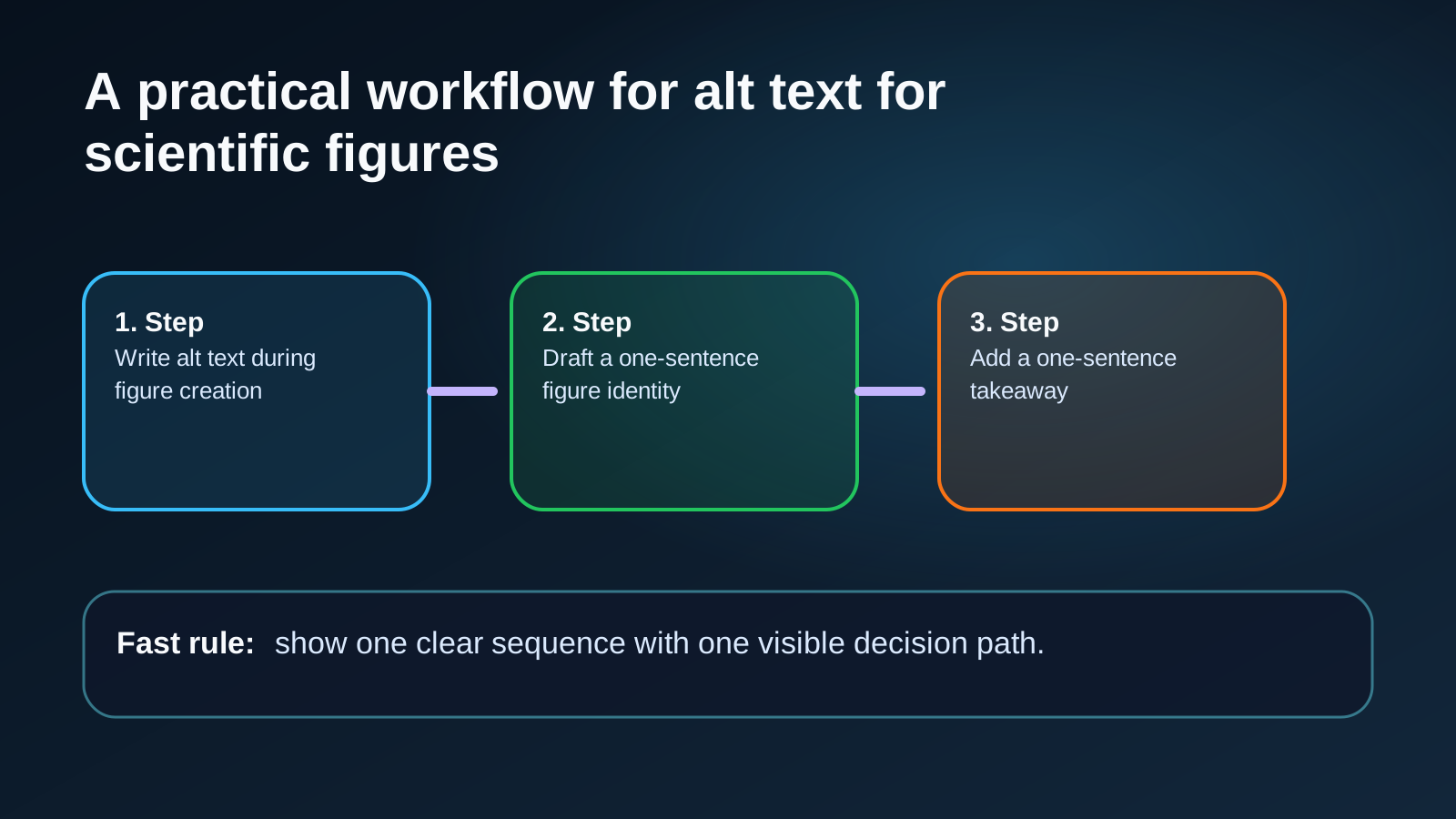
The easiest way to produce manuscript accessibility alt text is to write it when the figure is built not after the paper is typeset. Taylor & Francis explicitly recommends adding alt text as figures are created and attaching it clearly alongside captions. That advice is practical because you still remember the scientific intent of each panel when you are assembling it.
Start with panel purpose. Ask what job the figure performs in the manuscript. Is it showing experimental setup structural context mechanism comparison trend localization or validation. Next write one sentence that names the figure type and the scientific content. Then add one sentence with the main takeaway. If the figure is complex decide what belongs in nearby text rather than in alt text. W3C guidance for complex images is useful here because many journal figures really need a two-part approach: short identification plus a fuller text equivalent elsewhere.
Then check what depends on color shape position or label style. If a conclusion depends on red versus green channels dashed versus solid lines or left versus right placement say that in words. If those visual distinctions are not essential do not overload the description. After that review the caption. Remove duplication where possible. Alt text and captions should support each other rather than echo each other.
For teams building visuals across proteins pathways and therapeutic mechanisms this workflow scales well. The same clarity standard helps with figures videos and interactive stories. Related Animiotics examples include https://animiotics.com/blog/protein-ligand-interaction-visualization-how-to-build-clear-figures-for-papers-and-drug-discovery/ and https://animiotics.com/blog/alphafold-3-complex-visualization-how-to-turn-predictions-into-clear-protein-dna-rna-and-ligand-stories/ where visual complexity is managed by deciding the story before polishing the surface.
- Write alt text during figure creation
- Draft a one-sentence figure identity
- Add a one-sentence takeaway
- Move dense detail into caption or body text when needed
- Review for duplication and missing meaning
How to handle common figure types in accessible biomedical graphics

Different figure classes need different treatment. A microscopy panel may need specimen identity stain or marker names cellular location scale information and the key observation. A line graph may need variables direction of change comparison groups and the central trend. A mechanism diagram may need sequence of steps molecular actors and the outcome being illustrated. A structural figure may need molecule identity binding context viewpoint and the interaction or conformational change that matters.
For multi-panel figures do not pretend the whole figure is one undifferentiated image if the panels do different jobs. If panel A is a workflow panel panel B is a representative image and panel C is a quantification plot your text should reflect that structure. You can summarize the whole figure first then briefly identify the role of each panel. If the manuscript format permits a longer description this is often the best place to map panel order into words.
Color dependence deserves special attention in accessible journal figures. Elsevier recommends color blind safe palettes high contrast and non-color cues such as shape line type or position. Nature likewise asks authors to use accessible color palettes clear axis labels legible text and black text with colored keys instead of colored text labels. Alt text should not compensate for weak design choices that could have been fixed visually. If red and green channels are the only distinction in a merged image then the design itself needs work.
A useful standard is that both the visual and the text version should stand on their own. Accessible biomedical graphics are strongest when the panel design reduces ambiguity and the alt text confirms the intended interpretation.
- Microscopy figures: identify sample markers scale and observation
- Plots: name variables comparison and trend
- Mechanism diagrams: explain sequence actors and outcome
- Structure figures: describe entities viewpoint and interaction of interest
- Multi-panel figures often need a panel-aware description
| Figure type | What the alt text should prioritize | What belongs in longer text |
|---|---|---|
| Microscopy image | Sample marker localization and key observation | Acquisition context controls and full panel comparison |
| Graph or chart | Variables groups trend and main result | Exact values statistics and panel-by-panel detail |
| Mechanism diagram | Step sequence actors and biological outcome | Expanded pathway logic edge cases and references |
| Protein structure visual | Molecule identity interaction context and highlighted feature | Residue-level detail methods and alternate views |
Figure accessibility guidelines that go beyond alt text
Scientific figure accessibility alt text is essential but it is only one layer of figure accessibility guidelines. If the figure itself is hard to parse then even excellent text alternatives will feel like damage control. Nature's figure specifications emphasize axis labels with units legible text accessible color choices and avoiding decorative clutter such as shadows busy backgrounds overlapping labels and colored text. Those principles are not just visual polish. They reduce interpretation errors for everyone.
For accessible journal figures you should also check reading order and relationship between panels caption and body text. If the manuscript jumps from panel C to panel A in prose then the description becomes harder to follow. Keep panel labels obvious. Make abbreviations explicit on first use. If a figure contains embedded text that is essential to meaning make sure it is also present in actual text nearby because W3C guidance treats text-in-image cases differently from decorative visuals.
For manuscript accessibility alt text in PDF workflows also review document tagging and exported accessibility checks. NLM training materials recommend using accessibility reports to catch missing alt text reading order problems and contrast issues. That step matters because a well-written description can still fail in delivery if it never gets associated with the figure in the final file.
The bigger point is this: figure accessibility is a system not a sentence. Good design good labeling good captions and good text alternatives reinforce each other. If your team is already improving visual storytelling for papers and video abstracts the same mindset applies here. See https://animiotics.com/blog/ai-scientific-figure-generator-how-to-create-publication-ready-figures-faster/ and https://animiotics.com/blog/the-rise-of-the-video-abstract-why-your-next-paper-needs-a-trailer-2026-guide/ for adjacent communication workflows.
- Use accessible palettes and sufficient contrast
- Prefer black text with keys over colored text labels
- Keep axes labels units and scale information explicit
- Avoid decorative clutter that competes with data
- Check tagging reading order and export accessibility
Examples of weak versus strong manuscript accessibility alt text
Weak alt text usually fails in one of three ways. It is too short to carry meaning. It repeats the caption without adding access value. Or it lists visual fragments without explaining the science. For example "Figure of cells" tells the reader almost nothing. "Confocal image with green and red stains and nuclei in blue" may still miss the actual point if the paper is about nuclear translocation after treatment.
A stronger version would be: "Confocal microscopy images of treated and untreated cells showing nuclear accumulation of transcription factor X after treatment compared with diffuse cytoplasmic signal in controls." That version identifies the figure type the comparison and the main observation. If exact channels marker names or scale are important they can be added carefully or supported in the caption and body text.
The same applies to graphs. "Bar chart of cytokine levels" is weak. Better would be: "Bar chart comparing IL-6 and TNF-alpha levels in control and drug-treated macrophages showing reduced cytokine production after treatment." The goal is not literary elegance. The goal is reliable transfer of meaning.
This is also where scientific storytelling helps. If you can say what changed where and why it matters you are already close to usable alt text. If you cannot then the figure may need redesign before the wording pass. That redesign logic is similar to what helps in complex therapeutic visuals such as https://animiotics.com/blog/antibody-drug-conjugate-mechanism-of-action-animation-how-to-turn-complex-adc-biology-into-clear-visual-stories/ and https://animiotics.com/blog/how-to-create-a-mechanism-of-action-moa-animation-without-a-20000-budget-2026-guide/.
- Weak: names the object but not the message
- Weak: repeats the caption with no access benefit
- Strong: identifies the comparison and takeaway
- Strong: keeps detail proportional to the figure's role
FAQ
What is the ideal length for alt text for scientific figures?
AThere is no single universal limit. NIH advises keeping alt text short even though there is no hard technical character cap. Taylor & Francis suggests alt text is usually brief and often around 25 to 30 words with a broader working range depending on the figure. The practical rule is to keep the short alt text focused then move dense detail into caption or long description text when the figure is complex.
Do all journal figures need alt text?
AIn accessible digital formats any non-decorative figure should have an appropriate text alternative. Scientific figures are almost never decorative because they usually carry evidence interpretation or workflow information. If the surrounding text fully replaces the figure's information then the alt text can be minimal but that is uncommon in research articles.
Should alt text repeat the figure caption?
ANo. Captions and alt text serve related but different functions. The caption may include methods references or context that supplement the visual. The alt text should communicate the visual's content and purpose. Some overlap is normal but full duplication wastes listening time.
How do I write alt text for a multi-panel figure?
AStart with a whole-figure summary then identify the role of each panel in order if those panels contribute distinct evidence. If the figure is very dense provide a short alt text and a longer panel-by-panel explanation in adjacent text or supplementary accessible content.
Can alt text fix inaccessible figure design?
ANo. If a figure relies only on color uses unreadable labels or packs too much information into one panel then the visual needs redesign. Alt text supports accessible journal figures but does not excuse poor contrast cluttered layout or missing labels.
- Short alt text plus longer descriptive text is often the right model for complex figures
- Captions and alt text should complement each other
- Multi-panel figures usually need explicit structure
- Design accessibility still matters even with strong alt text
CTA
If your team is building figures that need to work for manuscripts presentations funding decks and accessible publishing workflows then treat accessibility as part of the visual strategy from day one. Animiotics helps teams turn dense scientific content into clear publication-ready visuals that are easier to explain review and adapt across formats. Explore Animiotics to plan stronger figures before your next submission cycle.
The fastest gains usually come from tightening the visual story reducing nonessential detail and writing figure-aware text alternatives while the science team and design team are still aligned. That approach produces clearer accessible biomedical graphics and less rework at the end of the project.