
Why this comparison matters
A strong boltz-1 vs alphafold 3 visualization workflow starts with a simple question: what are you actually trying to compare? Many teams open both files in the same molecular viewer, color by confidence and stop there. That is rarely enough. If one model outputs per atom confidence in a CIF plus summary JSON files while the other gives CIF files, confidence JSON, token level pLDDT arrays and pairwise error arrays, the visual comparison is only meaningful when the metrics are normalized into a clear story.
That is especially true for protein ligand work. AlphaFold 3 was introduced as a model for biomolecular interactions across proteins, nucleic acids and small molecules. Boltz-1 positioned itself as a fully open source model that reaches AlphaFold 3 level accuracy on biomolecular complex prediction. For visualization this means you are not just comparing shapes. You are comparing how each system represents certainty, interfaces and ligand context and how easy it is to turn those outputs into a usable figure, animation or review deck.
For biotech communication teams and structural biology groups the real goal is rarely a beauty render. The goal is to decide whether a predicted pocket looks believable, whether a protein complex comparison supports a claim and whether the resulting visual can survive scrutiny in a meeting. If you already work with explanatory structure stories, our guides to AlphaFold 3 complex visualization and PDB to animation fit naturally into the workflow described here.
- Compare outputs by decision relevance not just appearance
- Separate global fold confidence from interface confidence
- Treat ligand placement as a hypothesis that needs visual validation
What each model gives you to visualize
The first practical difference is output structure. AlphaFold 3 writes a top ranking mmCIF plus confidence JSON and summary confidence JSON files. Its documentation highlights pLDDT, PAE, pTM and ipTM as the main confidence metrics. pLDDT is per atom, PAE estimates relative positional error between tokens and for ligand atoms the modified local score focuses on errors between ligand atoms and polymers. That matters because AlphaFold 3 ligand visualization should emphasize the protein ligand relationship rather than pretending every internal ligand coordinate is equally certain.
Boltz-1 also writes mmCIF predictions plus separate confidence JSON and array files for PAE, PDE and pLDDT. Its prediction documentation shows aggregate fields such as confidence_score, ptm, iptm, ligand_iptm, protein_iptm, complex_plddt, complex_iplddt, complex_pde and complex_ipde. In plain terms Boltz gives you a very explicit confidence package for downstream visualization. That is useful when you want a Boltz structure prediction visualization that can switch cleanly between whole complex confidence, interface emphasis and pairwise error inspection.
The visualization implication is clear. AlphaFold 3 often lends itself to a top ranked model plus confidence overlays gathered from JSON. Boltz-1 often lends itself to a layered analytic view where the structure, aggregate confidence and token pair arrays are all part of the review. If your figure or animation will be used beyond a specialist audience you should simplify that complexity into a few interpretable panels instead of exposing every raw metric at once.
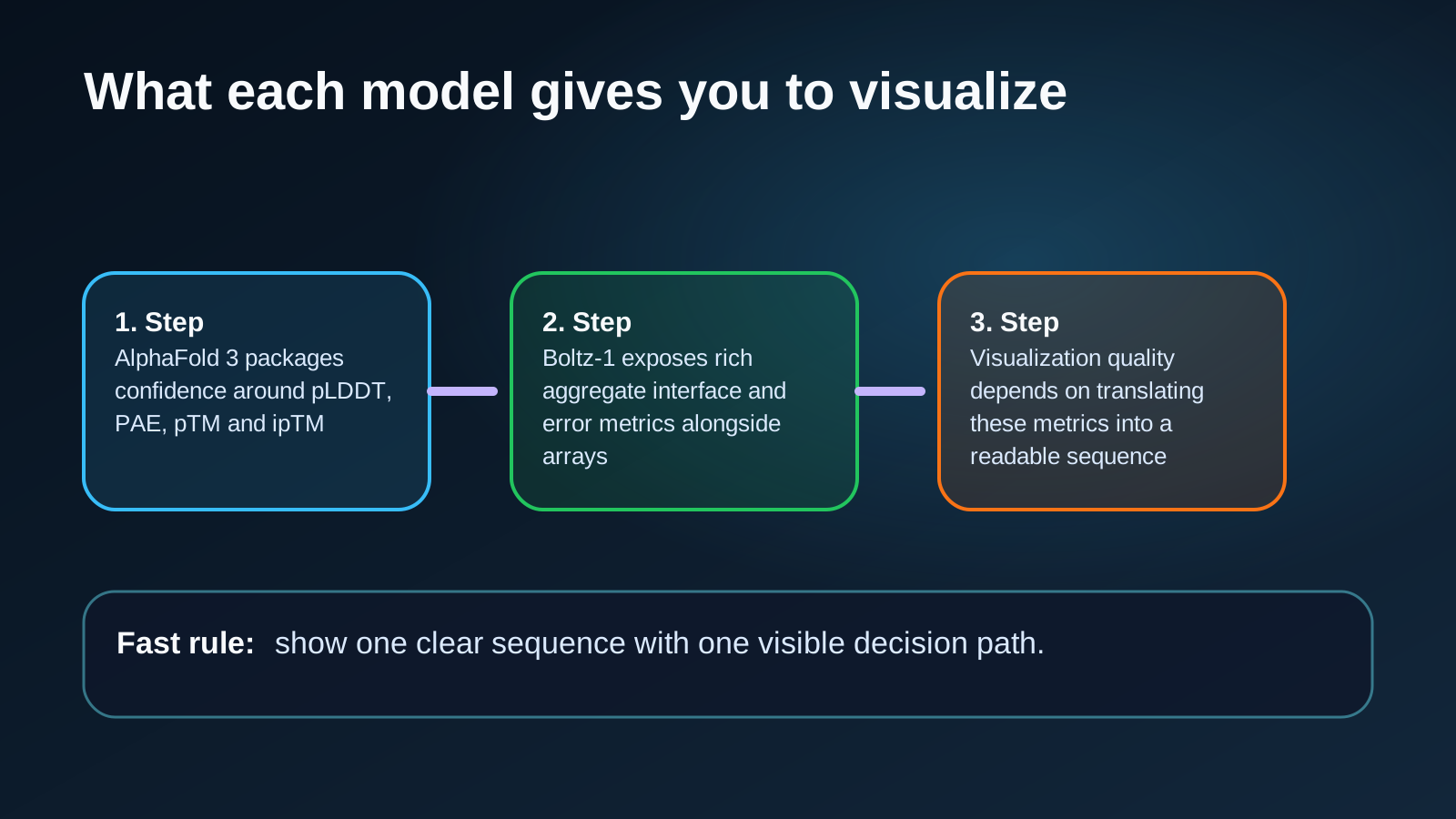
- AlphaFold 3 packages confidence around pLDDT, PAE, pTM and ipTM
- Boltz-1 exposes rich aggregate interface and error metrics alongside arrays
- Visualization quality depends on translating these metrics into a readable sequence
| Topic | AlphaFold 3 | Boltz-1 |
|---|---|---|
| Primary structure output | Top ranking mmCIF plus per sample outputs | mmCIF predictions ordered by confidence |
| Key confidence views | pLDDT, PAE, pTM, ipTM | confidence_score, pTM, ipTM, ligand_iptm, complex_plddt, PDE |
| Best visual use | Ligand context, interface confidence and multi entity stories | Interface inspection, ranked comparison and explicit analytic overlays |
How to build a fair side by side view

A good side by side comparison begins with normalization. Use the same orientation, chain colors and ligand style in both models. Keep the camera identical for the first pass. Then create a second pass where each model is colored by its own confidence logic. This prevents a common mistake where viewers think a color difference reflects biology when it really reflects incompatible scoring conventions. In a Boltz vs AlphaFold 3 figure you want one panel for geometric comparison and a second panel for confidence interpretation.
Next isolate the decision surface. If your question is about ligand plausibility, crop the view to the binding pocket and remove nonessential distal regions. If your question is about quaternary arrangement, zoom out and emphasize interfaces. Protein complex comparison works best when every panel answers one question only. Mixed scale panels create false certainty because the eye cannot decide whether to judge the fold, the interface or the ligand pose.
For internal review I recommend a four panel layout. Panel one shows the full complex in a neutral material. Panel two colors by local confidence. Panel three shows pairwise error or interface focused confidence. Panel four is a residue level or atom level closeup of the region that drives the project decision. If the asset needs to become an animation later the same editorial structure translates well into scenes. Our ChimeraX animation tutorial covers the camera discipline that makes this transition much easier.
- Lock camera and chain colors before comparing models
- Match each panel to one scientific question
- Use full complex, confidence, interface and closeup views as a repeatable template
Reading confidence without misleading yourself
Confidence visualization is where many comparisons fail. High pLDDT in a local region does not automatically mean the whole interaction is trustworthy. Low PAE between two regions can support a stable relative arrangement but it still does not prove biochemical reality. In other words confidence is a navigation tool not a validation stamp. Your figure should make that limitation obvious instead of hiding it.
For AlphaFold 3 ligand visualization the most useful habit is to inspect the ligand together with nearby residues, hydrogen bond candidates, clashes and the surrounding confidence pattern. Because AlphaFold 3 defines ligand atom confidence in relation to polymers, the pocket context is the meaningful visual unit. Show the ligand alone and the audience may overread precision that is only partially justified. Show the ligand with the surrounding protein shell and the confidence story becomes much more honest.
Boltz-1 offers a slightly different visual opportunity because its confidence JSON separates complex wide and interface weighted summaries. That means a Boltz structure prediction visualization can explicitly contrast overall fold confidence with interface confidence. When complex_plddt looks healthy but interface weighted terms soften, the visualization can signal that the fold may be fine while the interaction hypothesis still needs caution. This distinction is useful in project reviews where teams otherwise collapse all certainty into one number.
- Do not equate local confidence with full interaction validity
- Visualize ligands inside their pocket context
- Contrast whole complex confidence with interface confidence when possible
| Metric view | What it helps you see | Common misuse |
|---|---|---|
| Local confidence | Stable versus uncertain regions | Assuming a confident loop proves binding |
| Pairwise error | Relative placement of regions or entities | Treating low error as experimental confirmation |
| Interface weighted scores | How believable the contact geometry may be | Ignoring whether the rest of the fold is weak |
A practical workflow for ligand and complex review
If your main use case is a drug discovery or mechanism communication setting, start with ligand first triage. Load both top ranked structures, hide solvent style distractions and focus on pocket occupancy, orientation and gross clashes. Then inspect nearby residues and compare whether the ligand contacts are chemically sensible in both models. Only after that should you generate polished views. This order prevents the familiar trap of investing design time in an implausible pose.
After ligand triage move to interface review. For protein complex comparison use one scene that shows the entire assembly and one that isolates the key interface. If nucleic acids are present use a third scene focused on the protein nucleic acid boundary because mixed entity systems often need more explicit labeling. Keep labels minimal but specific. A generic label like binding site is weaker than ATP pocket candidate or heavy chain light chain interface.
Finally convert the review material into communication assets. Static figures are enough for many decisions. If the story needs temporal sequencing, create a short animation that moves from global architecture to local evidence. If you plan to publish the visual in a blog, deck or article, accessibility matters as much as polish. Our post on scientific figure accessibility and alt text is useful here because confidence driven imagery can become unreadable very quickly when color is doing too much work.
- Review plausibility before polishing visuals
- Split full assembly and interface views into separate scenes
- Add accessibility rules early so confidence maps stay interpretable
What a clear deliverable should look like

The best final deliverable is not the most detailed one. It is the one that lets a scientist, project lead or partner answer the core question quickly. For a boltz-1 vs alphafold 3 visualization deliverable that usually means one overview image, one confidence comparison and one local evidence panel. If motion is needed, the same structure can become a 30 to 60 second sequence that starts broad and ends with the decision relevant closeup.
Keep the writing as disciplined as the visual. Titles should state the claim in plain language such as Both models support the same pocket orientation or Global fold agreement masks interface uncertainty. That style is far stronger than generic captions like Predicted complex view. If your team also needs publication support material, a simplified companion visual such as a graphical abstract or summary figure can help bridge specialist and non specialist audiences. Our guide to the graphical abstract maker explains that compression step well.
When in doubt choose interpretability over spectacle. A restrained protein complex comparison that shows confidence honestly will do more work for your program than a dramatic render that hides uncertainty. That is the central lesson across Boltz vs AlphaFold 3 workflows. The models may be sophisticated but the communication standard should remain simple: show the structure, show the confidence and show the biological implication.
- Deliver one overview, one confidence view and one local evidence panel
- Write captions as claims not topics
- Prefer honest clarity over cinematic excess
FAQ
What is the biggest difference in visualization practice between the two models?
AThe biggest difference is how you extract and communicate confidence. AlphaFold 3 centers discussion around pLDDT, PAE, pTM and ipTM while Boltz-1 gives you additional aggregate interface and error summaries that are very useful for review panels and ranked comparisons.
Is AlphaFold 3 better for ligand visualization by default?
ANot automatically. AlphaFold 3 is strong for multi entity interaction prediction and its output documentation explicitly describes ligand confidence in relation to surrounding polymers. That makes AlphaFold 3 ligand visualization particularly useful when the pocket context is the main story. But the quality of the final visual still depends on careful scene design and honest interpretation.
Is Boltz-1 easier to turn into an analytic comparison figure?
AOften yes. Because Boltz-1 exposes separate confidence JSON and array outputs including interface oriented summaries, it can be very effective for structured review workflows where you want to compare overall fold quality against interaction quality.
Should I compare only the top ranked model from each system?
AStart there but do not stop there for important decisions. If a project depends on a narrow interface or a specific ligand orientation, inspect more than one sample and note whether the same story persists.
What software should I use for the actual images?
AChimeraX, PyMOL and similar molecular viewers work well as long as you impose editorial discipline. The tool matters less than whether the scenes answer one question at a time.
- Focus on confidence interpretation not just geometry
- Use pocket context for ligand stories
- Check more than one sample when decisions are high stakes
CTA
If your team needs a boltz-1 vs alphafold 3 visualization that does more than show two nice structures, Animiotics can help turn raw prediction outputs into figures and animations that clarify confidence, ligand placement and complex logic for real audiences.
We build structure driven visuals for biotech, pharma and research teams that need clear communication across internal reviews, partner discussions, fundraising and web content. The goal is a deliverable that helps people understand what the models suggest, where uncertainty remains and why the result matters.
- Use the homepage CTA link for the next step
- Turn prediction files into review ready and audience ready visuals
- Keep scientific uncertainty visible while improving clarity