Why Teams Need a Better Bispecific Antibody Story
A bispecific antibody mechanism of action animation usually fails for one reason. It tries to explain everything at once. Dual targeting, cell proximity, receptor occupancy, tumor selectivity, cytokine risk, step-up dosing and administration sequence all get pushed into the same visual moment. The result looks sophisticated but the audience cannot tell what matters first. A useful animation does the opposite. It decides which causal links must be understood in sequence then builds each shot around one decision point.
This matters even more for bispecific programs because the audience is rarely one group. Discovery teams want target rationale. Clinical teams want to explain why the therapy is given in a specific schedule. Business development wants a dual target antibody visual that makes differentiation obvious in a thirty second conversation. Investors want to know why the construct changes outcomes instead of just adding complexity. One animation often has to support all of those conversations.
The best starting point is to define the core sentence before you design the first frame. In many programs that sentence is simple: one arm binds the tumor target while the other arm recruits or modulates an immune effector to produce a controlled therapeutic response. Once that sentence is clear the rest of the animation becomes an editorial exercise rather than a software exercise. That same message-first approach is why our article on antibody drug conjugate mechanism of action animation performs well with teams that need to simplify highly technical biology.
- Lead with one mechanism claim not every assay detail
- Separate target recognition from downstream effect
- Design for mixed audiences from scientists to commercial teams
What a Bispecific Antibody Animation Must Show First
The first job of a bispecific antibody animation is orientation. Viewers need to know which cells are present, what each binding arm recognizes and why simultaneous engagement changes behavior. If those basics are unclear the rest of the sequence feels like unexplained motion. A good bsab moa animation therefore begins with spatial context. Show the disease relevant cell population. Identify the effector cell if one is involved. Label the two targets with language that is clinically meaningful instead of relying on color alone.
After orientation the second job is discrimination. Why is this construct different from a monospecific antibody, a cocktail or an ADC? The answer should appear visually. One arm binds target A. The other arm binds target B or CD3 depending on the modality. Once both interactions are visible the animation can demonstrate the key advantage, whether that is cell bridging, pathway co-blockade, signal clustering or improved selectivity. The viewer should be able to describe the mechanism without reading the speaker notes.
This is where a t cell engager mechanism animation often becomes cluttered. Designers jump directly to synapse formation with too many particles, too much membrane motion and no pause for recognition. Resist that. Show the initial state. Show first engagement. Show second engagement. Only then show immune activation or cytotoxic consequence. That pacing is similar to how we recommend staging complex 3D evidence in our PDB to animation workflow.
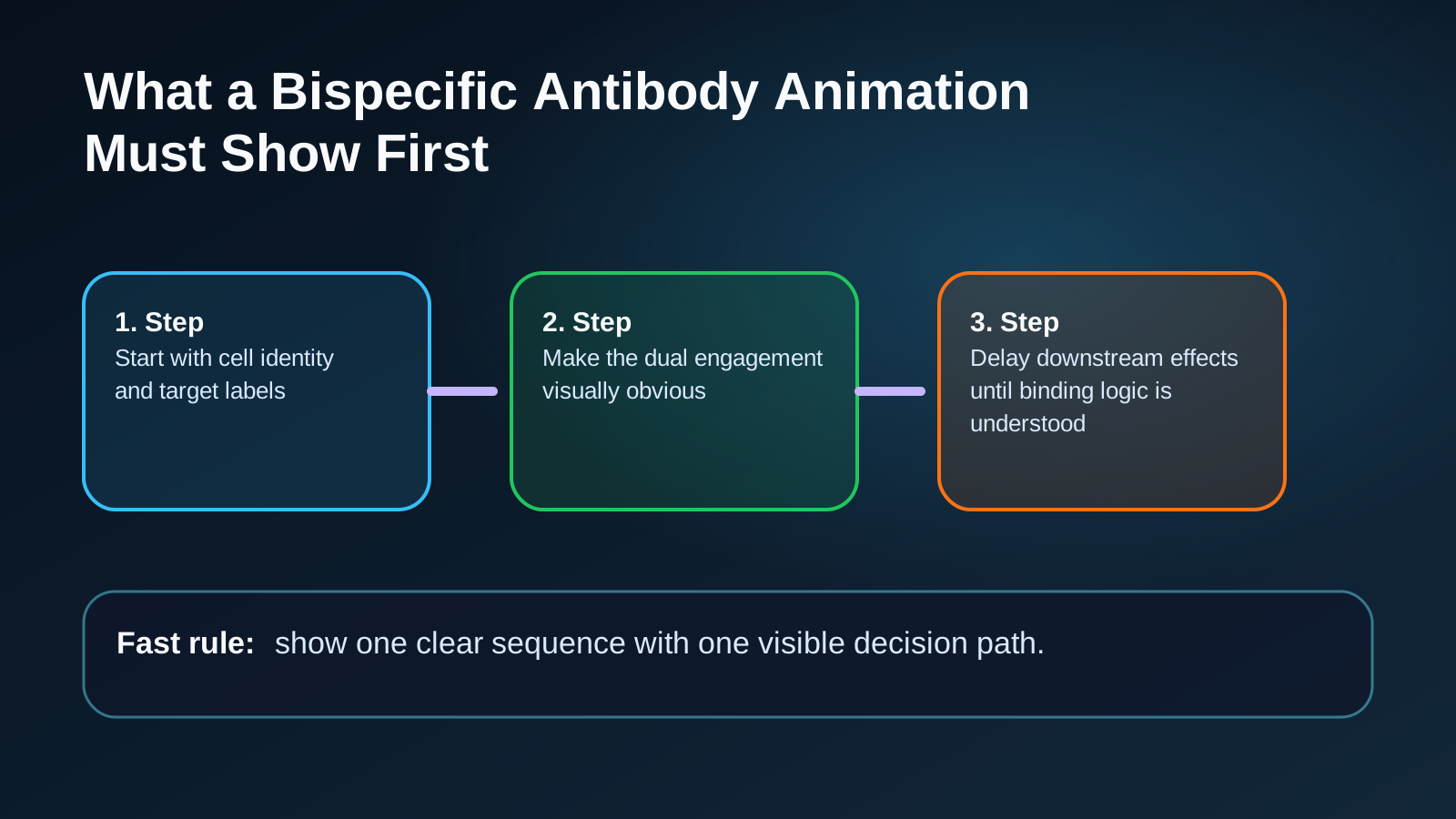
- Start with cell identity and target labels
- Make the dual engagement visually obvious
- Delay downstream effects until binding logic is understood
| Story beat | Viewer question | Visual answer |
|---|---|---|
| Orientation | What am I looking at | Label disease cell, effector cell and both targets |
| Dual binding | Why is this construct different | Show each arm engaging its own partner |
| Functional effect | Why does that matter | Animate synapse formation, blockade or redirected killing |
How to Visualize T-Cell Engager Logic Without Creating Noise

For many oncology teams the most urgent use case is a multiple myeloma bispecific antibody or another CD3 engaging construct. These programs generate heavy demand for communication because the clinical promise is intuitive only after the geometry is understood. The animation should show more than a T cell touching a tumor cell. It should clarify why bringing those cells into close proximity changes the probability of activation and killing. That means attention to distance, contact timing and membrane scale.
A clean sequence usually uses four shots. Shot one establishes the malignant cell and the T cell in the same field. Shot two introduces the bispecific molecule and labels each arm. Shot three shows dual engagement and narrows the field so the immune synapse becomes the focus. Shot four depicts the functional outcome with minimal ornament, such as granule release, target cell apoptosis or a simplified efficacy cue. You do not need to animate every downstream cytokine or every intracellular signaling branch to make the point.
Clinical nuance still matters. If step-up dosing is central to the product story the animation should acknowledge it as a separate communication layer instead of forcing it into the receptor binding scene. A short transition into a schedule graphic often works better than trying to encode dosing into molecular choreography. The same principle applies to adverse event mitigation or site-of-care workflow. Separate biological mechanism from care pathway. That editorial separation is one of the main differences between an informative scientific animation and a merely flashy one.
- Use four shots to control complexity
- Keep immune synapse detail purposeful and limited
- Move dosing and care pathway details into their own scene
Build the Narrative Around Claims the Audience Must Remember
A dual target antibody visual is only useful if it helps the audience retain the strategic claim. Ask what the program team needs viewers to repeat after the meeting. Perhaps the molecule bridges a tumor antigen and CD3. Perhaps it binds two tumor epitopes to reduce escape. Perhaps it blocks two signaling nodes that cooperate in resistance. Whatever the claim is, each section of the animation should support that one memory outcome. If a scene does not strengthen recall, cut it.
This is also the stage where internal consistency matters. Use one color for each target family and keep it stable from the opening frame through the CTA. Keep camera direction predictable. Use labels that match slide deck terminology and clinical documents. If your broader launch package includes static figures or journal graphics, align the same visual language across formats. Teams doing this well often pair motion work with stronger static communication assets such as graphical abstracts or accessible supporting figures guided by our post on scientific figure accessibility and alt text.
A useful rule is to treat every scene heading like a slide title. Instead of generic labels such as Mechanism or Mode of Action write the editorial claim in plain language. Examples include Dual binding creates selective proximity or Step-up dosing supports safer initiation. This prevents beautiful sequences that still leave the audience guessing what conclusion they were meant to draw. Clarity is not a style choice. It is the product.
- Choose one memory outcome for the whole piece
- Keep colors, labels and camera logic stable
- Write scene titles as claims not topics
Production Choices That Make a Biotech MOA Animation Easier to Reuse
A strong bispecific antibody mechanism of action animation should not be locked to one use case. The same master scene set should support a homepage cutdown, a congress booth loop, a narrated sales enablement clip and short investor excerpts. That requires modular production. Build scenes that can stand alone. End each scene on a clean frame. Avoid transitions that only work when every segment is played in order. Reusability saves budget and keeps the message consistent across channels.
Think in layers. Layer one is the core molecular story. Layer two is the disease or patient context. Layer three is the clinical or commercial framing such as line of therapy, route of administration or differentiation claim. When you separate those layers you can generate tailored versions without rebuilding the science each time. This matters for fast-moving programs where new data drops can shift the emphasis from mechanism novelty to clinical practicality in a matter of weeks.
The production pipeline should also account for what your team already has. If a structural model exists use it where it adds credibility. If not, use a stylized but internally consistent representation rather than a fake atomistic view. Over-rendered detail rarely improves understanding. Purposeful abstraction often does. In scientific storytelling the right level of simplification can look more authoritative because it signals editorial control.
- Design scenes that can be reused in short and long edits
- Separate molecular story from clinical framing
- Prefer purposeful abstraction over decorative complexity
| Asset layer | Best use | Why it matters |
|---|---|---|
| Core molecule scene | Website, investor deck, sales clip | Keeps the main claim identical everywhere |
| Clinical context overlay | Field teams, congress, training | Adds schedule and patient relevance without changing the science |
| Modular CTA ending | Homepage and campaign landing pages | Lets marketing tailor the close without recutting the mechanism |
FAQ: Common Questions About Bispecific Antibody Animation
What is the main goal of a bispecific antibody animation?
AThe goal is to show why dual engagement changes biology in a way the audience can understand quickly. That usually means making cell context, arm specificity and the resulting functional effect visible in sequence.
How much molecular detail should be shown?
AShow enough detail to support trust and no more. If fine structural detail does not change the decision the viewer must make, simplify it. For most commercial and cross-functional audiences mechanism clarity beats molecular completeness.
Should step-up dosing appear in the same scene as receptor binding?
AUsually no. Binding logic and dosing logic answer different questions. Show the mechanism first then transition to a separate schedule or care pathway scene if dosing is part of the story.
Can one master animation support multiple audiences?
AYes, if it is built modularly. A reusable master can be trimmed for marketing, expanded for medical affairs and adapted for training while preserving the same mechanistic core.
How long should a bispecific antibody animation be?
AFor broad awareness thirty to sixty seconds often works well. For scientific presentations or internal training ninety seconds to two minutes can be appropriate if each scene adds a clear message.
- Clarity outranks decorative detail
- Mechanism scenes and dosing scenes serve different goals
- Modular production supports multiple teams
CTA: Turn Your Bispecific Mechanism Into a Story People Understand
If your team is preparing a launch, fundraising process, congress presentation or partner discussion, the right bispecific antibody animation can shorten explanation time and improve recall. The goal is not to make the biology look complicated. The goal is to make the mechanism feel inevitable once viewers see the sequence.
Animiotics helps scientific and biotech teams turn dense mechanisms into clear visual stories that work across web pages, decks, training content and publication support. We can shape the narrative, choose the right level of abstraction and build reusable assets that fit the rest of your communication system.
- Use one master asset across teams
- Make the dual-target claim memorable
- Point all CTA traffic to /